
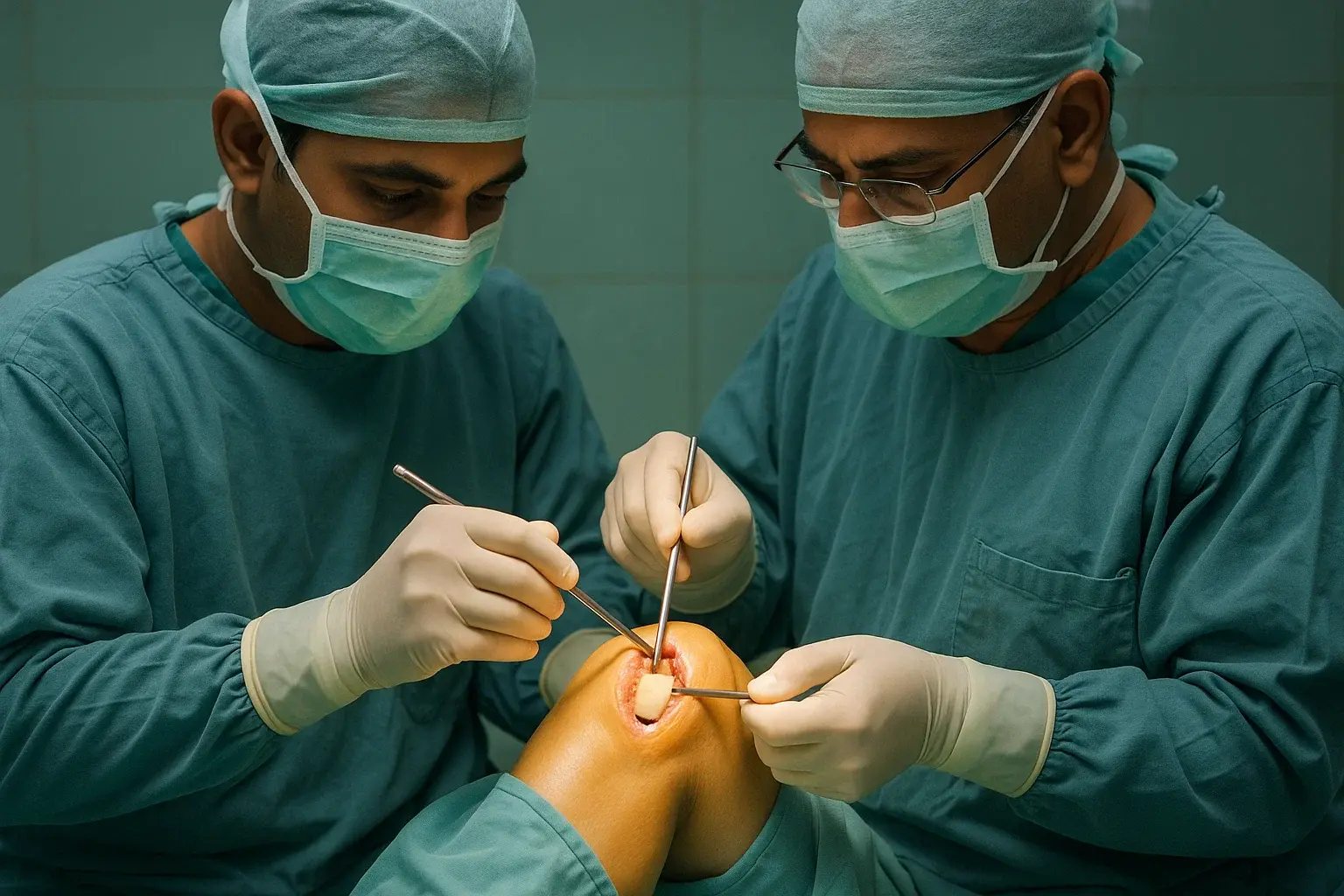
Unstable Knee-Cap Surgery in India
The solution to the common problem of Unstable knee is Unstable knee-cap Surgery in India. There are mainly two types of problems in the instability, one is cap dislocation (Patellar Subluxation) and the other is bone replacement. It gives different symptoms of pain and makes the situation chronic for the patients.
Book Appointment
GET A FREE QUOTE
Patellar instability encompasses various conditions such as dislocation, subluxation, and maltracking of the kneecap (patella). These various conditions in common are also referred to as the Unstable knee cap. Sometimes surgery is the only solution, but we will discuss all possible treatments for the knee cap instability.
What is Patellar Instability?
Patellar instability refers to the kneecap failing to track smoothly within the trochlear groove during knee flexion and extension. It is a critical movement of the knee, and in the above situation, it causes extreme pain.
There are mainly two conditions that tend to recurring instability: The kneecap fully moves out of its groove, or subluxation, and partial dislocation. The first case usually happens during twisting movements or trauma, in the second case, where the patella shifts laterally but returns partially or fully on its own.
Unstable Kneecap Symptoms
Unstable Knee-Cap Surgery in India, make the condition stable with implants and reconstruction surgery. The need for surgery is felt by the symptoms, which predominantly include knee pain and stimulation of the medial and lateral patellar nerve. These are nerve branches of the femur bone, and surgery is the only option for pain management. Diclofenac injection is the only option. Before starting, all those issues and symptoms are shown:
- Swelling and Stiffness in the knee, with a hard knee cap.
- There are various painful sensations, such as locking, catching and grinding, felt by the patient.
- Many individuals feel the knee shift suddenly or buckle under weight—this is a hallmark of patellar instability.
- Anterior (front) knee pain near the patella is common, especially during activities climbing stairs, squatting, running, or after sitting for prolonged periods.
- In Chronic subluxations, there is sharp pain or persistent ache.
- During or right after a dislocation, the kneecap may visibly sit off-centre (usually laterally), sometimes causing bruising.
- Restricted range of motion and the patient will be unable to bear weight.
- In severe dislocations, there may be numbness or tingling if nerve/vessel compression occurs.
Book Appointment
GET A FREE QUOTE
Floating Kneecap Symptoms- Sometimes called floating kneecap, this feeling of kneecap shifting is due to subluxation, often misaligned patella against the femur. Enjoying a full recovery depends on correcting structural imbalances and undergoing rehab
Unstable Kneecap Causes
The instability of the knee cap is crucial to understand; there are different causes. For unstable knee-cap surgery in India, you have to understand the causes behind the pain and the stiffness. We will also try to understand the anatomical position of the knee, because of which pain is caused.
- There is instability in the soft tissue of the knee; Weak vastus medialis obliquus (VMO), tight lateral structures, or torn medial patellofemoral ligament (MPFL).
- Loose ligaments because of a genetic syndrome are also a reason behind the knee cap instability.
- Shallow trochlear groove, trochlear dysplasia, patella alta, or misaligned lower limb bones.
- Various sport activity causes sudden twisting and traumatic conditions are form. The mentioned situation is common in Football players and gymnasts.
- Chondropathy is a condition in which repetitive use of the knee joint is the reason of pain and an unstable kneecap.
How successful is knee cap surgery?
The first line for any medical condition starts from the home treatment like ice compression, rest & elevation. If the pain continued patient moved to the diagnostic steps and later to the unstable knee-cap surgery in India. There are various surgical options like trocheoplasty or MPFL reconstruction, performed according to the area of the injury and pain.
The success rate of different surgeries like MPFL, Troceoplasty and TTO ( Tibial Tubercle Osteotomy) is above 90% in India. Combined realignment surgeries offer long-term relief for complex cases. Patient returns to daily activities within 1–3 months; sports resume in 4–6 months post‑MPFL.
Book Appointment
GET A FREE QUOTE
Different Surgeries for Unstable Knee Cap- How do you tighten a loose knee cap?
Unstable knee-cap surgery in India is performed based on diagnosis. There are multiple cases like bilateral instability, twisting and twitching of muscles. These cause the same type of pain, but the conditions are different. Here are some different types of knee-cap surgeries:

Different Surgeries for Unstable Knee Cap
Cost of Knee-Cap Surgery in India
The cost of the treatment is defined by the procedure included. An estimate of the cost packages is ₹1,50,000 to ₹6,00,000, which includes all types of facilities by the hospital and stay during the treatment. For specific treatment, there are costs and treatment guidance provided by the hospitals and their management. The mentioned cost table will give you an idea about the treatment and its cost for the Patella Knee Cap Dislocation.
|
Surgery Procedure |
Cost Range (₹) |
|
MPFL Reconstruction |
~ 4,60,000 (₹4–5 L) |
|
Patellar Realignment (Lateral Release) |
₹1,20,000–₹1,90,000 |
|
High Tibial Osteotomy (Tibial Tubercle) |
₹1,20,000–₹1,80,000 |
|
Trochleoplasty |
₹3.5 to 6 lakhs |
|
Combined Procedures |
₹6–8 L (combined individual surgery costs) |
We Care Health Services For Unstable Knee-Cap Surgery in India
We Care Health Services is the best place for the knee cap stability surgery. The hospital is famous for supporting medical tourism in India and providing coordinated facilities. It is also meant for the different surgeries other than orthopaedic. They highlight access to robotic-assisted techniques and arthroscopic ACL reconstructions, usually for arthritis or ligament repair.
Book Appointment
GET A FREE QUOTE
Their focus tends to be on joint replacement and ACL/PCL surgeries, rather than addressing patellar instability directly. The MPFT and TTO success rate is also more than 90% for the particular solutions. Here are the surgery-specific solutions and key treatments of the We Care Health Services:
- Patients can join the floating chatbot on the website to learn about surgery specifications.
- Accessible from different cities in the country.
- The success rate of the different surgeries is more than 95%.
- Customised departments for various treatments like fertility solutions, orthopaedic surgeries, Pediatric surgeries and cardio-vascular treatment.
- We Care Health Services excels in coordinating knee replacement and sports ligament procedures for international patients.
- Integrated lab and diagnostic facilities for the different conditions.
- Expert doctors for treatment and well-coordinated staff for providing all kinds of services.
Top Hospitals For Unstable Knee-Cap Surgery
There are various hospitals for knee cap surgery treatment in India. They are not only providing treatment and surgery also give all possible solutions to the surgery or treatment. Hospital infrastructure and technical development are also at the top for the mentioned hospitals. These facilities are also introduced during digital development in the hospital sector os India. Because of this success rate hike of the last decade is noticeable.
Book Appointment
GET A FREE QUOTE
|
Hospital / Clinic |
City |
|
Dr Aditya Pawaskar (MPFL specialist) |
Mumbai |
|
Dr Biren Nadkarni (MPFL Reconstruction) |
Delhi NCR |
|
Kneecares Clinic |
Jaipur |
|
Max Healthcare |
Delhi NCR |
|
OrthoOne Orthopaedic |
Coimbatore |
|
HOSMAT Hospital |
Bangalore |
|
Sanjay Gandhi ITO |
Bangalore |
|
Safdarjung Sports Injury Centre |
Delhi |
|
Sir Ganga Ram Hospital |
Delhi |
|
Aster CMI Hospital |
Bangalore |
|
MIOT International Hospital |
Chennai |
|
Apollo (Yash Gulati) |
New Delhi |
|
A.V. Gurava Reddy (Sunshine Hospitals) |
Hyderabad |
|
Manipal Hospital |
Multiple cities |
|
Gleneagles Hospitals |
Chennai/Bangalore |
Frequently Asked Questions:
Another innovative approach uses nasal-septum-derived cartilage cells to regenerate damaged joint cartilage. In a Swiss trial, 90% of patients saw improved mobility and pain relief, particularly those receiving more mature lab-grown tissue; benefits persisted for two years.