
IVF Success Rate in Delhi: Cycles, Age & Embryo Quality

Success rate in Delhi can vary depending on multiple factors such as the age, location, the qualifications of the doctors, the clinics and so on. There is no factor that affects the rate of IVF success but there are many. If planning for IVF treatment it is suggested that the success rate should be taken into consideration.
The clinics situated in Delhi provide a highly-inclusive and advanced medical infrastructure. The doctors here are highly-qualified which can be trusted and chosen for treatment. The couples who are diagnosed which leaves them with IVF treatment which can help them get pregnant.
The chances of IVF success rate in Delhi or any other place for that sake highly depends on the age of the patient which should be under 35 years of age.
Pregnancy Rate vs Clinical Pregnancy Rate: What is the difference?
The basic difference between pregnancy rate and clinical pregnancy rate is that the former counts any positive pregnancy test and the later counts if there is a physical confirmation of the developing pregnancy which is done with the help of ultrasound scans which shows a gestational sac.
Live Birth Rate
The live birth rate is the percentage for IVF cycles that helps determine the data of live births during an IVF cycle. The IVF success rate in Delhi when counting live birth rates is quite higher as compared to other cities. This is the test which is considered to be the most trusted and clinically meaningful tests as compared to other tests.
Tests for Pregnancy Confirmation:
- Biochemical Pregnancy – If there is a positive hCG blood test that confirms the pregnancy.
- Clinical Pregnancy – It helps in confirming pregnancy with ultrasounds where gestational sac and heartbeat helps confirm pregnancy.
- Live Birth – When pregnancy reaches its term and an actual baby is born.
Success Rate Per Embryo Transfer or Per IVF Cycle
Both success rate per embryo transfer and per IVF cycle differs on the following basis:
- Per embryo Transfer – It helps measuring the success when the embryos are placed in a single
- Per IVF Cycle – It is the success rate which is calculated on a single IVF cycle which begins from an ovarian stimulation and ends with embryo transfer or pregnancy test.
| Measurement | Success Rate |
| Success rate per embryo transfer | Around 70–85% |
| Success rate per IVF cycle | Around 65–70% |
| Under 35 per cycle | Around 80–90% |
| 35–37 per cycle | Around 40–60% |
| 38–40 per cycle | Around 20–30% |
| Over 40 per cycle | Around 10–20% |
Dr. Hrishikesh Pai
- Gold Medallist MD
- Past President, FOGSI
- Regional Trustee, FIGO (Asia-Oceania)
- Director, IFFS
Dr. M. Gouri Devi
- Member of FOGSI
- ESHRE and AOGD
- Author of books on IVF
Dr. Kaberi Banerjee
- MBBS (1994)
- MD (1998) both from AIIMS New Delhi
Dr. Prerna Gupta
- MBBS and MD (O&G) from AIIMS New Delhi
- MRCOG, Royal College of Obstetricians & Gynaecologists, London
- Former Head of Department, Moolchand Fertility & IVF
Dr. Neha Khandelwal
- Member of Indian Fertility Society
- Indian Menopause Society
- FOGSI and AOGD
IVF Centres in Delhi
There are multiple IVF centres in Delhi which incorporates advanced technology and have well-equipped labs. These IVF clinic success rate in Delhi remains quite high.
Different Clinics presents different percentages of success rate
There are a number of clinics which provide fertility treatments with a high IVF success rate in Delhi. And there are multiple factors on which the success rate can differ. Different clinics may present different success rates since on the basis of technology used, doctor’s expertise the success may differ. The vary due to the following:
On the Basis of Which Stage is Being Measured
- There can be multiple stages in an IVF cycle on the basis of which the success rate can be calculated, it can be from per cycle, per egg retrieval and per embryo transfer. With each stage the success rate calculated can differ.
- It can also be based on either per transfer or a cumulative rate over multiple number of cycles and it can differ too since the chances of success of a cumulative cycle is considered to be calculated as always higher than a single cycle.
How is success of IVF counted?
The success can be based on clinic pregnancy and as per live birth. It can be counted based on different factors.
- Clinical pregnancy rate is mostly higher since it is based on the heartbeat measured by ultrasounds.
- Then it can be on the basis of live birth rate which is calculated on the basis of the live birth when the pregnancy reaches term.
- The success rate is also counted on the basis of per embryo transferred in the IVF cycle and as per patient.
Type of Patients
If donor eggs or sperms are combined with the standard IVF, then the chances of success rises as compared to the use of own gametes for treatment. The data then presented regarding the success rate is higher and can vary.
Age is a major factor that can affect the rate of success since the rate of success highly depends on the age of the patient. If under the age 35 the success rate is higher if older then the success rate is lower.
The condition of the patient in the case of the patient also contributes in determining the success rate of the treatment. There are clinics which do not take the cases of poor-prognosis patients.
If donor eggs or sperms are combined with the standard IVF, then the chances of success rises as compared to the use of own gametes for treatment. The data then presented regarding the success rate is higher and can vary.
Procedures and Lab Chosen
The success rate also depends on the procedures or protocols the IVF treatment is undertaken. There are treatments that are combined such as:
🔬 Fresh and Frozen Embryo Transfer
🔬 If there is single or multiple embryos used for transfer
🔬 Blastocyst transfer
🔬 Genetic Testing combined with IVF
These are a few treatments that are combined with IVF and there are clinics which do not disclose the data regarding these procedures and then the success rate can vary if these data are not disclosed.
Time Period
There are clinics which have presented old data sets and due to that there can be a difference in the data of the success rate of different clinics. The distinction between the current data and old data sets can significantly vary.
Average IVF Success Rate in Delhi
The IVF success rate in Delhi is presented below and highly depends on the age group. The IVF success rate Delhi by age can differ with since if the intended mother is younger then the rate of success is higher if the age of intended mother is older than the rate of success is lower.
| Age Group | Approximate Success Range | Important Limitations |
|---|---|---|
| Under 35 years | 60–85% | Rates vary according to embryo quality, ovarian reserve and clinic reporting method |
| 35–37 years | 50–75% | Egg quality and embryo chromosomal abnormalities can increasingly affect outcomes |
| 38–40 years | 30–55% | Success generally declines with age; individual ovarian reserve and embryo quality remain important |
| 41–42 years | 15–30% | Own-egg outcomes can be considerably lower; donor eggs may have different outcomes |
| 43+ years | 5–20% | Outcomes vary substantially; age, egg source, embryo quality and treatment history have major effects |
What is the IVF success rate by the number of attempts?
The IVF success rate in Delhi on the basis of number of attempts can vary, the success is mostly observed to be achieved when undergone more than one attempt. IVF success rate first cycle vs multiple cycles varies in the following ways.
- The first IVF cycle usually works for the patients who are younger since they have a better ovarian reserve as compared to older patients.
- There are multiple clinics that take the first cycle for the diagnosis as it helps with the diagnosis of the embryo quality, rate of fertilization and the endometrial receptivity even if the first attempt does not result in pregnancy.
- Age is a major factor why the first attempt does not result in a successful pregnancy as with an advancing age the both the quality and the quantity of embryos significantly declines.
- If the first attempt does not give success it does not mean the treatment will not work, further attempts can help in getting success.
- Success rate rises when taken cumulatively, it rises in the second attempt.
- The age here too is a major contributor in the success of the attempt.
- The protocols and the dosage that is provided to the patient is also important which is provided and decided on the basis of first attempt.
- Additional tests such as ERA, genetic testing also raises the chances of success.
- There can be one treatable case that has affected and if treated can help in getting successful results.
- The cumulative success of three cycles is generally highest and after the first and second attempt.
- There can be additional treatments such as donor programmes and surrogacy programs if the patient fails to get success even after three rounds of IVF.
- It is mostly suggested by the doctors to undergo around 3 rounds for a successful result.
| IVF Attempts | Estimated Live-Birth Success Rate | What It Means |
|---|---|---|
| 1st attempt | 35%–45% | Chance of a live birth from the first IVF cycle/retrieval |
| After 2 attempts | 50%–65% | Combined chance after two IVF attempts |
| After 3 attempts | 65%–75% | Cumulative chance after three attempts |
| After 4 attempts | 70%–80% | Cumulative chance after four attempts |
IVF Success Rate by Treatment Type
The success rate by treatment type can vary, the treatments can be:
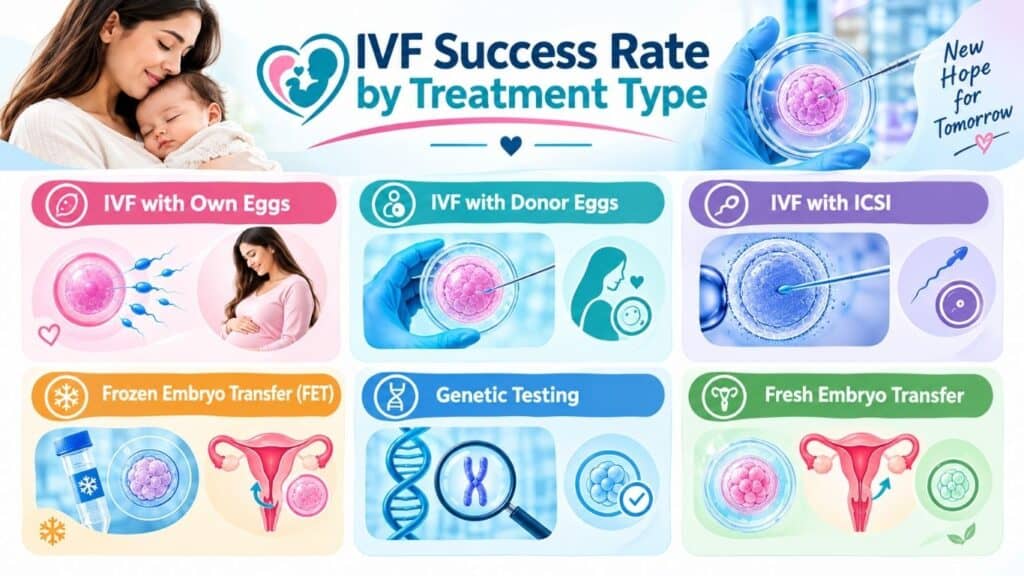
- IVF with own eggs – The success with using own eggs is higher when the age of the intended mother is younger. If not, the rate of success lowers.
- IVF with donor eggs – If IVF is performed with donor eggs then the chances of success rises with donor eggs.
- IVF with ICSI – The IVF with ICSI is combined when male factor infertility is diagnosed and then the success rate rises.
- Frozen Embryo Transfer (FET) – It is a procedure where a previously frozen embryo transfers to the uterus which helps in saving time for the doctors and raises the chances of success of IVF.
- Genetic Testing – It is prescribed to assure that no genetic disorder is transferred to the future child. The success rate rises since it helps in selecting the healthy embryo for the transfer.
- Fresh Embryo Transfer – The fresh embryo is used for the transfer which is developed during the IVF cycle. The success rate is higher when the intended mother is under 35.
What affects the IVF success rate in Delhi?
The IVF success rate IN Delhi is affected by multiple factors and they are as follows:
Woman’s Age
The age is a major determinant for the success rate of IVF treatment. This remains the major factor since the younger the age the better the quality and quantity of eggs.
Ovarian Reserve
The better the ovarian reserve the better the result. And for that either the intended mother should be of younger age or go with a donor egg program.
Egg Quality
The egg quality affects the stage of fertilisation, and it affects other procedures such as embryo development too. And here age remains a major factor too but it can vary too person to person.
Sperm Quality
The sperm quality depends on multiple factors such as sperm count, concentration, motility and the structure of the embryo development. In the cases of severe infertility, treatment such as ICSI is required.
Embryo Quality
The embryo quality highly depends on the development of the embryo, the structure or morphology of the embryo and the number of chromosomes, which affects the chances of implantation and pregnancy.
Uterine Health
The uterine health is an important factor and is considered essential since it is important for the implantation. There are different uterine conditions which affect the implantation, conditions such as Polyps, adhesions and fibroids too can affect the chances of pregnancy and affect the success rate of IVF.
Endometriosis
When the lining of the uterus grows outside instead of inside of the uterine cavity that condition is called endometriosis, and can affect the success of the treatment since it affects the ovaries, pelvic anatomy and the overall reproductive environment.
PCOS
This is the condition where the irregular or complete absence of ovulation affects the fertility treatments. And affects the success rate of IVF treatment.
Fibroids
The size, number or the location of the fibroid affects the uterine cavity and can affect the chances of pregnancy.
Previous IVF Results
The results from the previous cycle is also important since it helps planning for the cycles further. In this way it helps raise the rate of success since the doctors according to the information from the previous failed cycle.
Laboratory Quality
The lab quality is a major determinant too, it contributes in raising the success of the treatment. The condition of the lab and the use of the equipment, the protocols of quality-control also helps in realising success.
Embryo-transfer Technique
The timings of the transfer of embryos also affects the rate of success of the treatment. The correct positioning of the catheter.
How Does Embryo Quality Affect the IVF Success Rate?
The success rate of the IVF treatment depends on the quality of embryos too. There are different stages of embryo development that affect the success of the treatment.
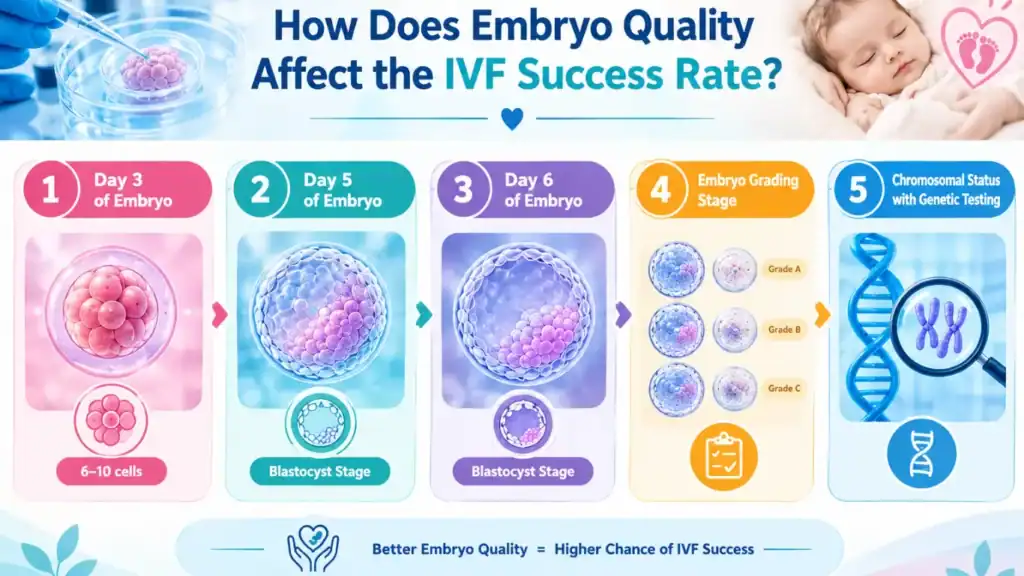
Day 3 of Embryo
The embryo consists of six to ten cells till it reaches three days after fertilisation.
So, some of the embryos are ready for transfer at this stage. But there can be embryos that are required to reach the blastocyst stage.
Day 5 of Embryo
The stage of embryo development is called the blastocyst stage, which is 5 days after embryo development.
It helps in selecting the embryos based on their development and structure. There are many labs which undertake the culture of embryos to the blastocyst stage when required.
Day 6 of Embryo
This stage is called the blastocyst stage, where the embryo develops for six days.
This stage is appropriate for both freezing and transfer. The morphology and the chromosome is count are both taken into consideration.
Embryo Grading Stage
The evaluation of the embryo is checked for its appearance and observing how it is developing such as how is the cell organization.
It helps the embryologists to evaluate and then choose the embryos for either transfer or can be used for freezing but it does not completely predict the implantation or the live birth.
Chromosomal status with Genetic Testing
PGT can analyse and evaluate cells from the embryo itself and then help identify and provide information regarding the chromosomal or genetic conditions.
It helps in choosing a healthy embryo in certain specific cases but does not guarantee a positive result.
Success Rate of IVF with Own Eggs vs Donor Eggs in Delhi
The success rate of IVF with own eggs highly depends on the age of the patient, and in cases of advanced age, donor egg programmes are prescribed during IVF.
| Treatment Type | Approx. Success Rate | Key Consideration |
|---|---|---|
| Donor Egg IVF + FET | 70%–90% | Uses donor eggs with a frozen embryo transfer; outcomes are influenced by donor age and embryo quality |
| Donor Egg IVF + ICSI | 70%–85% | ICSI is generally used when there is a specific indication, such as male-factor infertility |
| Donor Egg IVF | 60%–80% | Success is generally less dependent on the recipient’s egg quality |
| Donor Embryo Transfer | 40%–60% | Uses an embryo created from donor egg and sperm |
| Donor Sperm IVF/ICSI | 40%–60% | Uses donor sperm while the patient’s own eggs are used |
| Own-Egg IVF | 30%–60% | Success varies mainly with maternal age, ovarian reserve, egg quality and embryo development |
Success Rate Based on Pregnancy Rate vs Live Birth Rate in Delhi
| Measure | Delhi Data | What It Represents |
|---|---|---|
| IVF success rate | 35–55% per cycle | General term; Delhi clinics may use it to refer to different outcomes, so the exact definition should be checked. |
| Clinical pregnancy rate | 40–50% per cycle for women under 35 | Pregnancy confirmed clinically, generally through ultrasound. |
| Live birth rate | Approximately 44–50% per started cycle for ages 30–34 | The proportion of IVF cycles resulting in a live birth; rates decline with increasing age. |
A Failed IVF Cycle: What happens Next?
If an IVF cycle fails, it does not mean that the cycles ahead will have the same results. IVF doctors carefully review information from the previous cycle, then decide on the next cycle and evaluate which treatment or medications are appropriate for the patient’s condition.
- Ovarian Stimulation – The ovarian stimulation response from previous cycles is analysed, including follicle development, egg retrieval, and how the stimulation medications worked, and the response is assessed.
- Fertilisation Results – Mature egg count is checked, and the number of fertilised eggs. If fertilisation is poor, then it is checked if ICSI is required.
- Embryo Development – The development of embryos is checked, which is required to know the cause of the failure of the previous cycle. If there is poor embryo development, other factors such as egg and sperm development and lab conditions are considered.
- Uterine Conditions – The uterine environment is also a deciding factor. There are conditions such as polyps and fibroids that also affect the rate of success of the treatment.
- Sperm Factors – The condition of sperm is assessed via semen analysis. If there are male-factor infertility, treatments and medications for that condition are provided for the next cycle.
- Lab Conditions – If there are all the equipment and the right technology incorporated in the lab, that too is taken into consideration for the next cycles.
- Diagnosis and Treatment Plan – If the diagnosis and the treatment plan do not work, a different approach and treatment plan is incorporated for the success of the next cycle.
Conclusion
IVF success rate in Delhi can differ based on multiple factors, such as age, which can be a major factor in causing for the failure of pregnancy, and in cases like these, IVF is suggested to patients for successful results. Delhi has a number of best clinics that provide the not only IVF but other fertility treatments and provide services for both local and international patients.
Frequently Asked Questions
Somewhere between 40-60% per cycle if you’re under 35 that’s the honest range most clinics will quote. Past that age bracket, numbers start dropping, sometimes sharply. A clinic that gives you one flat percentage without asking your age first isn’t being fully straight with you.
Because egg quality starts declining well before you’d notice any other signs of it. A 32-year-old and a 41-year-old can walk into the same clinic and walk out with very different odds, even with identical protocols. It’s frustrating, but it’s biology, not something any lab can fully engineer around.
Two or three, on average. Patients getting there on the first try and others needing five or six there’s no single “normal.” What usually happens is the doctor studies exactly what went wrong (or right) in the previous cycle and adjusts from there.
No, and this trips people up constantly. One clinic might quote success “per embryo transfer,” another “per cycle started,” and another “per live birth” three completely different numbers that all sound similar on a brochure. Always ask which metric you’re looking at.
Quite a bit, yes. Blocked tubes or male-factor infertility tend to respond well to IVF. Low ovarian reserve or certain uterine issues are tougher. This is basically why a proper diagnostic workup upfront saves so much guesswork later.
A little, though don’t expect miracles. Getting to a healthy weight, cutting down on smoking and drinking, sleeping properly, managing stress these help at the margins. They won’t cancel out age or a serious medical factor, but they’re not nothing either.
Not anymore, really. With vitrification techniques where they are now, FET success rates in Delhi have caught up to sometimes edged past fresh transfers. A lot of doctors actually prefer FET these days since it lets hormone levels settle first. The IVF success rate with fresh vs frozen embryo transfer differs on the basis of multiple factors.
More than most patients realize. The lab and the person handling your embryos day to day can make a real difference in outcomes, which is part of why two clinics with similar equipment can post different numbers. It’s worth asking about the team’s experience, not just the machines.
It’s not a bad idea. Different clinics weigh your case differently, and a second doctor might catch something or suggest a different protocol that changes the picture. It costs you a consultation fee and maybe a week of time, not much else.
Usually this comes up after a few failed cycles with a patient’s own eggs, or upfront for women over 40-42 depending on ovarian reserve testing. It’s a hard conversation, but clinics in Delhi have gotten a lot more direct about raising it earlier rather than after multiple disappointment.