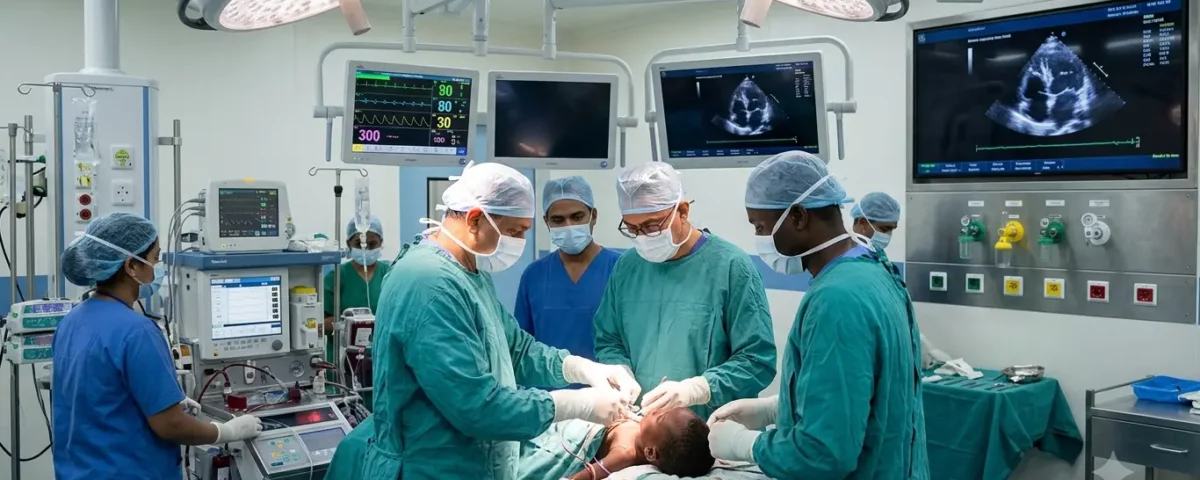
Certain congenital conditions affect the normal functioning of the heart; to treat these conditions, pediatric surgeries or Child Heart Surgeries are performed. The common surgeries treat conditions for infants, adolescents, and children, and mainly acquired heart diseases can be treated.
Depending on the structure and function, surgery may be performed to repair heart valves, closing abnormal openings between heart chambers. Reconstructing blood vessels and treating complex heart abnormalities are some other treatments. The primary goal of these surgeries is to relieve the symptoms of patients and restore normal heart function.
India offers affordable treatment for children and adolescents of all ages. There is a wide range of treatments for Congenital Heart Diseases, many of which are high-quality. There are some common conditions in which the wall of the heart is not closed properly, which happens just after the birth of a baby. There are certain surgical methods, like catheter closure and surgical ligation, which are used to treat such conditions.
At first they were not easy, but later they can be performed with the help of minimally invasive methods. Other conditions reduce the level of dissolved oxygen in the blood, for which open-heart surgery needs to be performed. We are going to make some points about each heart condition that can be treated in India:
Arterial Septal Defects- This condition happens when oxygen doesn’t pass properly. Because of this, a hole present in the upper chambers of the heart remains open, causing some abnormal blood flow. Also, this condition can be treated with the help of the catheter closure method, and the surgery performed is open-heart surgery.
Ventricular Septal Defects- This is a condition in which the hole between the lower ventricular septum remains open. Results in mixing of the impure and pure blood of both ventricles. It is also closed with the help of catheter closure and surgical ligation.
Patent Ductus Arteriosus (PDA)- The ductus arteriosus is a common blood vessel that closes after birth, but sometimes it remains open and needs surgery. So this condition is also treated with the help of catheter closure and surgical ligation.
Tetralogy of Fallot (TOF) - This is a severe condition in which the heart supply is not enough to meet the oxygen demands. Along with the above condition, pulmonary stenosis and overriding of the aorta happen, which increases the size of the heart. Thus, a reduction in the level of the dissolved oxygen and open heart surgery is the only solution.
Transposition of the Great Arteries (TGA)- The other severe condition is reversing the effect of blood circulation. In this case, the main arteries in the heart reverse the circulation, and surgery is needed in an emergency. The surgery known as the arterial switch surgery is commonly performed in infancy.
Coarctation of the Aorta- Narrowing of the aorta (great blood vessels), this condition restricts the blood flow. This condition needs balloon angioplasty or stenting to widen the artery.
Pulmonary Valve Stenosis- It is a narrowing of the pulmonary valve that causes restriction of the blood flow to the lungs. This condition also results in less oxygen. It is treated by balloon valvuloplasty or valve surgery.
Atrioventricular Septal Defect (AVSD)- This condition is noticed when a hole between the upper and lower chambers of the heart doesn’t close properly. This results in too much effort on the heart when supplying blood to the lungs. It most of the time happens with Down syndrome patients and can also be corrected by open heart surgery.
Truncus Arteriosus- This is a rare condition in which a single blood vessel leaves the heart in comparison to the two separate arteries. Early surgical repair is needed in this case to treat the patient.
Total Anomalous Pulmonary Venous Connection (TAPVC)- In this case, the pulmonary veins connect to the wrong side of the heart. Surgical correction in the early stage of life is a better way to treat patients.
India is one of the leading countries for conducting pediatric cardiac surgical procedures because it combines advanced medical expertise. The utilization of modern technologies and cost-effectiveness. Pediatric cardiac surgery units, advanced operating rooms, and specialized pediatric intensive care units are available in many of the hospitals throughout India. As a result, children's surgeries in India will have a smooth continuum of care from the time they arrive to the time they are discharged.
In many cases, the cost of treatment in India for children is significantly less than in most developed Western countries.
The standard of care, quality of care, and outcomes of the procedure do not suffer due to the lower costs.
Some of the other advantages enjoyed by international patients are shorter wait times for surgery, individual treatment plans, multilingual support services, assistance in obtaining medical visa(s), making travel arrangements/hotel accommodations, and assistance with follow-up care after surgery.
The success rate and quality of care given to children undergoing pediatric cardiac surgeries in India are consistently high, as most of the facilities have been accredited by a recognized international accreditation organization.
In addition, children and their family members receive an extraordinary level of compassion.
Therefore, India is an excellent option for pediatric cardiac surgical procedures and will cost significantly less than other developed countries.
We Care Health Services could be the best choice for anyone seeking emergency pediatric heart surgery. There are many advanced technologies like fetal echocardiography, cardiac MRI, CT angiography, cardiac catheterization, and 3D imaging, helping in surgeries. They are not possible everywhere; they need to be sustained, and also a team of doctors who know their operation very well.
A good hospital must offer international patient care options and a family-centred approach; all of these are collectively available at We Care Health Services. We have been providing services in the health sectors from past 19 years, and particularly for pediatric surgeries for the past 6 years. Here is the best advice and our approach to taking care of children's heart surgeries.
In preparing for the heart surgery of their child, international families need to ensure that the necessary documents are arranged before traveling to India to avoid possible delays in visa processing and hospital admission. The following are the documents that should be arranged before traveling:
By having both hard and soft copies of the documents, families will experience a smooth admission and treatment in India.
Pediatric surgery always looks too risky in the imagination of the parents, but they are more precise. First of all, an infant or child should undergo a proper diagnosis for the condition, and the remarks of the doctors for the surgical treatment should be there. There are various international patient services to which you can connect.
After looking at the medical records of the child, they gave the case to the known cardiologist in India. Parents contact hospitals or doctors through International Patient Services or the agencies with government certification. They consult about the condition of the patients and then decide the next step. Here is the step-wise guidance to Indian cardiology hospitals:
Parents get in touch with the hospital’s international patient services and supply data about their child’s health status and prior therapies. Pediatric heart doctors analyze the child’s information and give recommendations regarding the best treatment solution.
The medical professionals check all the data regarding echocardiography, ECG, CT scan, MRI, and cardiac catheterization. After the diagnosis is confirmed, the hospital presents a temporary treatment plan as well as provides an approximate price, possible length of stay in the medical institution, and recovery period.
After deliberating over options, parents of the sick kid are provided with a final treatment strategy, price details, and a letter necessary for obtaining an Indian Medical Visa.
An Indian medical visa is applied for by the child, while the parents or guardians apply for a medical attendant visa. The essential documents that are required include a passport, a photo, medical records, a visa application form, and an invitation letter from the hospital.
After the approval for the visa, families book flights and accommodations. Several Indian hospitals help with airport pickups, hotel bookings, and interpreter services.
The international patient coordinator assists the patient with registration and admission to the hospital after he/she has arrived in India. If you have a good International services contact in India, then they will pick you up from the airport.
When it comes to the diagnosis and determining fitness for surgery, the child will go through an extensive medical evaluation, which may include the following:
The child will undergo general anesthesia before the surgery, depending on the condition, either open-heart surgery, minimally invasive cardiac surgery, or a catheter-based procedure is performed. In case of complicated procedures, a heart-lung machine is used during the surgery to sustain the blood flow.
The child is monitored post-surgically in a Pediatric Cardiac Intensive Care Unit (PCICU) with the medical team observing the heart functioning, breathing, blood pressure, and level of pain.
When the condition of the patient is completely stable, the discharge procedure begins. Before this period, doctors took regular follow-up of the pediatric ward's physical activity. Most children remain in hospitals for approximately 2 to 4 weeks after surgery, depending on the complexity of the procedure, their recovery, and their healing. Doctors offer information about how to continue the recovery period, depending on the particular procedure. Most children remain in India from 2 to 4 weeks after the operation, depending on the complexity of the procedure and restoration.
During this procedure, you need proper documentation and citizenship of the country from which you are applying for a medical Visa. Also, your medical report will be scanned with the permission copy from the hospital, which is allowing you to come to India for treatment. Recommendations of doctors are another important thing in this procedure.
The very first step in this procedure is to obtain medical documents or reports of your diagnosis.
Get permission from a recognised hospital in India for treatment.
Apply for a medical Visa, which has the following requirements:
Patients are generally advised to avoid long-distance travel immediately after surgery.
After Visa approval, do FRRO registration.
It depends on the duration of treatment. Usually, pediatric cardiac surgery takes 2-4 weeks of hospital stay. It is another important step to be involved during your journey of treatment in India. You have to complete the registration of the Foreigners Regional Registration Office (FRRO) within 14 days if your doctor is asking for more than 180 days. It is a general procedure during neurosurgery or complex surgery. For smaller treatments, it is not required. During an extended time period, it shows legal compliance. Registration can be completed online by submitting passport details, visa information, photographs, and proof of residence
The departure home after pediatric heart surgery is determined by the child’s surgeon. Children should have stable vital signs when being discharged before travelling home. Furthermore, children should be advised to stay in India for 2-4 weeks in order to get follow-up care in the local hospitals. Parents must take along all pertinent medical documents when travelling. During their trip, it is equally important to keep the child well-hydrated, ensure that they take their medication properly, and avoid any unnecessary physical activities.
Ans. Indeed, India is regarded as a safe place for pediatric heart surgery whenever the procedure is performed in high-quality medical facilities run by skilled pediatric cardiothoracic surgeons. Several hospitals comply with the best international safety protocols regarding the surgical method, as well as having high-tech surgical equipment; they also have a pediatric ICU available, follow strict infection control measures, etc.
Ans. Heart surgery in India is commonly practiced on patients aged from birth to 18 years of age. The range of patients includes newborn babies, infants, children, and even teenagers with congenital or acquired conditions of the heart. There is no minimum age for performing a life-saving heart surgery, as children suffering from certain congenital heart anomalies are treated even when being a couple of days or months old.
Correct, patients from other countries can obtain a Medical Visa in India for treatment, and accompanying relatives can apply for a Medical Attendant Visa. The length of stay will depend on the visa issued and the medical treatment protocol. Extensions can also be obtained if required.
According to the current immigration principles of India, those foreigners who enter India with a Medical Visa are required to register with the Foreigners Regional Registration Office (FRRO). Registration through the e-FRRO online portal is usually possible, which saves patients' time.