

Total Colectomy and ileostomy surgery in India are two different procedures. They are performed in extreme conditions, like: Advanced or widespread colon cancer, severe ulcerative colitis not responding to treatment. The other two conditions are: familial adenomatous polyposis, toxic megacolon, or repeated bowel obstruction.
For Free Online Consultation
GET A FREE QUOTE
A total colectomy means complete removal of the colon, and at the same time ileostomy means extending the small intestine. This condition shows a complex surgery, and the patient may not return to regular mode till the complete healing procedure. There are different types of cases in this aspect; colon cancer is the most malignant, and ulcerative colitis is also life-threatening.
What is Total Colectomy?
Now, questions move to an individualised manner. What is a colectomy? Removing the colon, which is also known as the large intestine, is known as a colectomy. The surgical procedure in which all or part of the colon is removed (colectomy). It is done primarily for treating colon cancer, ulcerative colitis, diverticulitis, bowel obstruction, or trauma to the colon. Depending on the severity and extent of the disease, colectomy can be either total, subtotal, or partial. Once the colon is cut away, the surgeon will reattach the healthy portion of the colon or create a stoma (an opening in the abdomen) for the removal of wastes. In addition to relieving symptoms and preventing complications, colectomy can significantly improve the long-term health of the digestive system.

What is Total Colectomy
What is an Ileostomy?
A surgical operation that brings the Ileum (the last portion of the small intestine) out through an opening formed in the abdominal wall for the removal of faecal matter from the body. The stoma diverts stools into a pouch outside of the body, attached to the skin. Ileostomy is performed when part of the colon or rectum is diseased, has been removed, or needs to heal. The procedure may be temporary or permanent based on the patient's medical condition. After surgery, with proper care of their stoma, modifications to their nutritional regimen, and sufficient fluid replacement, the vast majority of individuals adjust to living with an ileostomy and live healthy individuals who lead very active lifestyles. The upper part of the bowel is called the small bowel. It joins the lower part of the bowel (the colon) just to the right of the waistline.
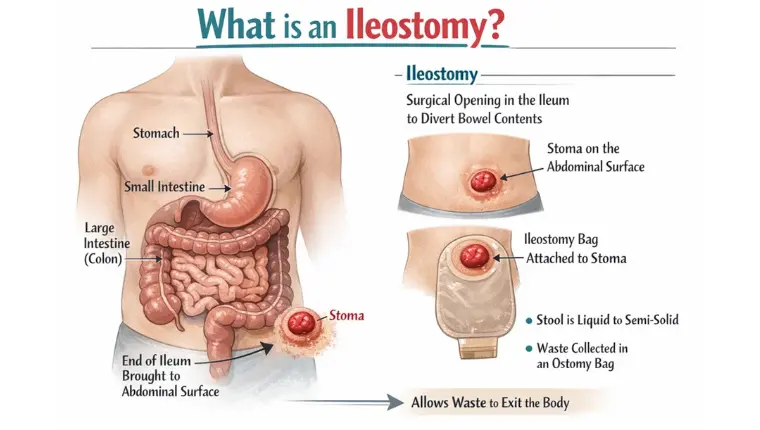
What is an Ileostomy
Need for Total Colectomy With Ileostomy
If any of the above-mentioned conditions persist in the patient, there is a chance of simultaneous operation with these procedures. Rerouting of the digestive system is also necessary, besides removing the previous route. There are several seasons for these surgeries mentioned here:
- Colorectal cancer
- Inflammatory intestinal diseases (eg, colitis, Crohn’s disease)
- Intestinal blockage
- Trauma to the intestine
- Diverticular disease—small pouches form in the wall of the colon
- Precancerous polyps, especially those seen in familial polyposis
- A hole in the bowel wall, or a dead piece of bowel
- Bleeding from the colon
Colonic disease may become so advanced that the colon becomes unsafe for you to use for normal digestion, causing you to need a Colectomy and Iliostomy simultaneously. You will need to have the colon removed at that time to help control the disease, and the ileostomy will give you another way to eliminate morbid waste products. Most of the time, these two procedures are performed at the same time to give maximum protection to patients from having to face serious medical complications later on in their recovery process and to provide the highest quality of life possible.
A total colectomy removes the source of infection, malignancy, or inflammation and allows for complete drainage of the digestive system through an ileostomy without causing a strain on a healing bowel. For most patients, the ileostomy is used as an interim measure to give the intestine time to heal before it can be reconstructed; however, in some patients, the ineffectiveness of the anus or rectum may require continued use of the ileostomy indefinitely.
Total Colectomy and Ileostomy Surgery in India: Cost and Hospital
In India, you will find the best hospitals and affordable costs for surgeries, also for emergency cases, beds are available. These surgeries are performed on the basis of diagnosis and emergency action needed. In India, total colectomy with ileostomy has been performed extensively to treat greater severity stages of the colon, as in the case of malignant neoplasia (i.e., cancers) or medical conditions of severe chronicity (i.e., infrequent bowel movements), or other serious episodic complications (i.e., toxic megacolon), etc.
For Free Online Consultation
GET A FREE QUOTE
During a total colectomy with ileostomy, an abdominal surgeon operates to first remove all parts of the colon, thereby completely ridding the body of all affected portions of it; thereafter, the last segment of ileum is brought to the abdominal surface via the provided stoma site or a newly created opening, whereby the patient receives "stoma" or colostomy bags to hold expelled waste flooring. The stoma or colostomy bag is placed on the abdominal wall, allowing the expelled bowel contents to pass into it, thus bypassing the removed portion of the colon. Here is the cost table showing the price:
|
Procedure |
Typical Cost Range (INR) |
|
Total Colectomy (partial or full) |
₹70,000 – ₹3,50,000 |
|
Ileostomy Surgery |
₹35,000 – ₹1,10,000 |
|
Combined Colectomy + Ileostomy |
₹1,00,000 – ₹4,00,000+ |
In India, the best government and private hospitals have experienced surgeons in the field of colorectal and gastrointestinal surgery. Preoperatively, there is an initial assessment performed on the patient's bloodwork, physical exam, imaging, and anesthetic evaluation. Post-operatively, patient care will include pain management, prevention of post-operative infections, and establishment of a learning environment for stoma care. Several hospitals also offer educational programs that prepare the patient to manage their stoma before being discharged from the hospital.
Follow-up & Recovery Procedure: Best Hospitals for Recovery Procedure
The recovery of every individual is different; however, on average, recovery from dialysis requires a hospital stay for 1-2 weeks, a gradual increase in diet, and the need for follow-up appointments. Long-term success of dialysis will ultimately rely on proper hydration, proper nutrition, and regular health check-ups. You will have a fine thin plastic drip tube in an arm vein connected to a plastic bag on a stand containing a salt solution or blood. You may have a fine plastic tube coming out of your nose and connected to another plastic bag to drain your stomach. This is to decompress your stomach, which, along with the bowel, may feel sluggish after an operation. Swallowing may be a little uncomfortable.
You will have a dressing on your wound and a drainage tube nearby, connected to yet another plastic bag. This drains any residual blood from the operation. You may have a fine rubber tube (catheter) passing into the bladder through the front passage. This lets the bladder stay empty and small during the operation and helps control your body fluids afterwards. Here is the list of the best hospitals in the line, especially in Delhi NCR:
|
Hospital / Centre |
City |
|
Medanta - The Medicity, Gurugram |
Gurugram |
|
We Care Health Services |
Delhi NCR |
|
Kokilaben Dhirubhai Ambani Hospital and Medical Research Institute |
Mumbai |
|
Apollo Proton Cancer Centre |
Chennai |
|
VPS Lakeshore Hospital |
Kochi |
|
Rajagiri Hospital |
Kochi |
|
Rajiv Gandhi Cancer Institute & Research Centre, Rohini, New Delhi |
New Delhi |
|
India Cancer Surgery Site |
Gurugram |
For Free Online Consultation
GET A FREE QUOTE
Moving to the Home After Surgery: Total Colectomy & Ileostomy
You are likely to feel very tired and need to rest two or three times a day for a month or more. You will gradually improve so that by the time three months have passed, you will be able to return completely to your usual level of activity. You can drive as soon as you can make an emergency stop without discomfort in the wound, i.e., after about three weeks. You can restart sexual relations within two or three weeks when the wound is comfortable enough. Sometimes the operation affects the sex nerves. This will be discussed with you. You should be able to return to a light job after about six weeks and any heavy job within 12 weeks.
How We Care Health Services Help People with Surgery?
We Care Healthcare Services are committed to being by your side through each step of your surgical journey—making it much easier for patients who are having a total Colectomy or ileostomy to deal with surgery and recovery.
Our goal is to provide a clear, well-coordinated, compassionate approach to every surgical patient, regardless of location (Europe, the Middle East, etc.), and especially for patients travelling from other countries or across India.
- Connects patients with experienced surgeons and reputed hospitals
- Assists in choosing the right treatment plan after medical review
- Arranges hospital appointments, admissions, and surgery scheduling
- Provides cost estimates and helps with financial planning
- Supports medical travel, accommodation, and local transportation
- Coordinates pre-surgery tests and documentation
- Ensures post-surgery follow-up and recovery guidance
By reducing confusion and delays, We Care Health Services allows patients and families to focus on healing rather than logistics. Their patient-first approach improves confidence, treatment adherence, and overall experience, especially during major surgeries that require careful planning and long-term support.
Conclusion
In summary, total colectomy and ileostomy surgery, when performed by skilled surgeons in well-respected hospitals and with appropriate postoperative support in place, are effective treatments (and frequently lifesaving) for patients with serious diseases of the colon. When performed at the appropriate time and in conjunction with adequate medical care, it reduces complications and improves patients' quality of life substantially. With progress in surgical techniques, the experiences of established hospitals in India and improving quality of supportive aftercare systems, patients can recover, regain confidence and face their future with long-term health stability.
For Free Online Consultation
GET A FREE QUOTE
Frequently Asked Questions:
This is where the appendix pouches out from the colon. The colon runs up to the right ribs and loops across the upper part of the belly. Then it passes down the left side to run backwards into the pelvis (the lower part of your abdomen) towards the back passage, where it is called the rectum. If most of the colon is diseased, it can cause diarrhoea, bleeding, or general illness, which can potentially be life-threatening. It is better removed.
- The nature of the underlying condition at the time of surgery;
- The overall health and wellness of the individual before (and after) surgery;
- The extent to which individuals adhere to recommended follow-up medical visits. By providing patients regular access to medical professionals, nutritional counseling (and support), sufficient fluid intake, and appropriate stoma care, patients can achieve a long (and productive) life following surgery.