
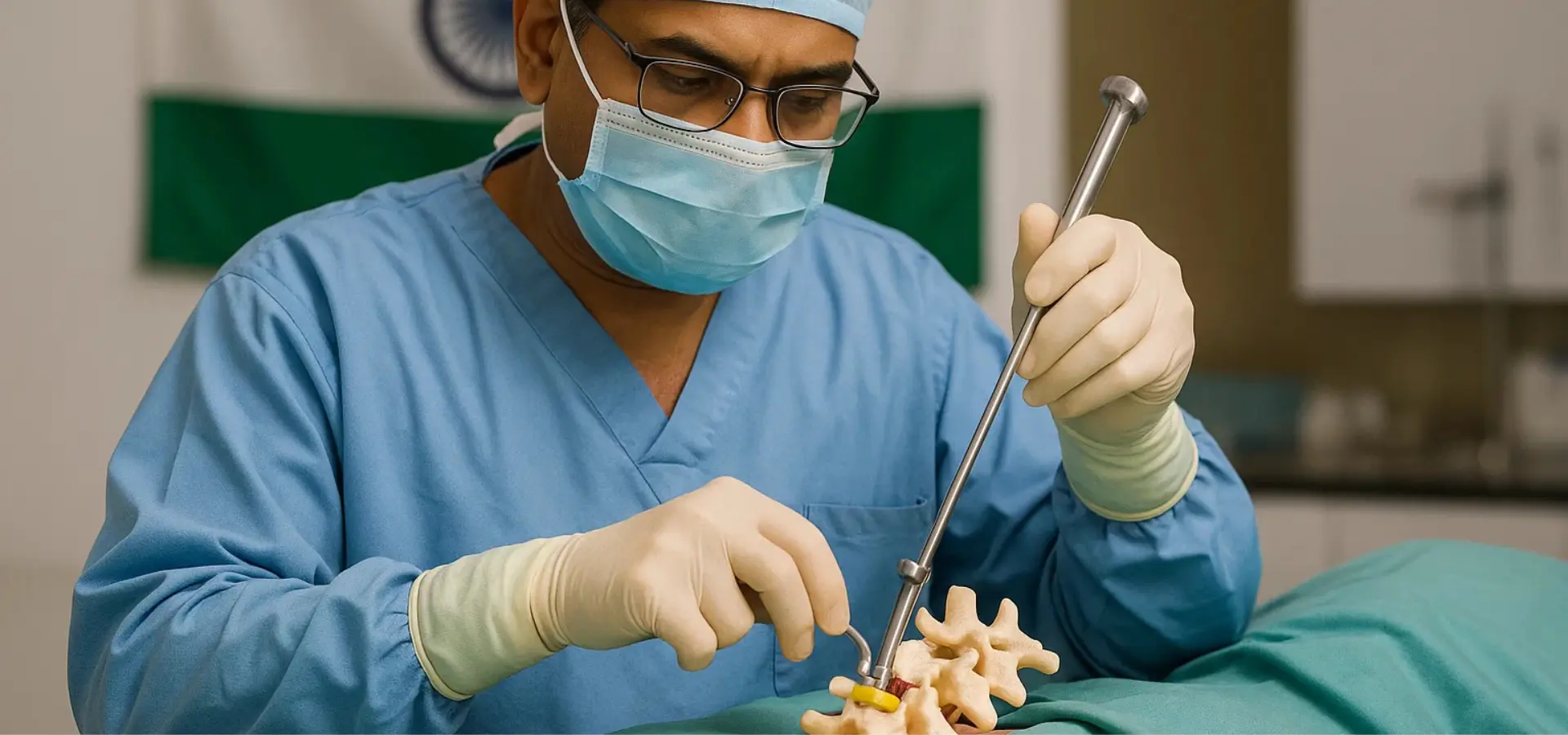
Spondylosis surgery in India is good for patients looking for a permanent solution to neck pain. There are different types of pain, and usually they are in the shoulder and in the lower neck region. When patients suffer from chronic pain in their neck or back that doesn't benefit from medication or therapy, or lifestyle changes, they often opt for surgery as a final choice. Surgeons try to relieve pressure on the nerves, support the spine, and improve how they function daily when treating these patients. As a result of hospitals providing high-tech imaging, skilled spine surgeons, and costs that are less than those in other parts of the world, India has become a good choice for patients looking for surgery.
For Free Online Consultation
GET A FREE QUOTE
Types of Spondylosis Pan in Patients
It is a degenerative condition of the spinal bones and joints, mostly caused by aging. Spinal arthritis is a normal part of life and does not cause ANY symptoms in many people who have it. If you have minor symptoms, you will probably require little or no treatment. If you are among the minority who suffer moderate to severe symptoms, then some form of symptomatic treatment might be necessary.
Cause of Spondylosis
Cervical spondylosis can be caused by previous injury, repeated fractures, or dislocations of the joints of the neck. These cause abnormal tears of joints, ligaments, and the structures surrounding the joints. Over time, spondylosis develops as there is a progressive degeneration, with no sudden onset. As the spine begins showing its age and the wear and tear begins to increase, the impact on the discs, joints, and ligaments will be seen as greater due to reductions in the body's ability to heal. Many factors increase this process and therefore increase the severity of the pain associated with spondylosis.
- Due to the decrease in water content of the discs, with aging, they will shrink in height and lose their shock-absorbing capabilities, leading to stiffness of the spine and increased chances for friction.
- As a result of prolonged periods spent seated, heavy work on a daily basis, as well as the continual movements of bending, carrying, and lifting weights, these individuals are subjected to repetitive stress/pressure on their spinal joints/discs.
- In addition, the positions that people take while working/computing (i.e., slumped forward, head forward), along with the poor support provided by sleeping on a mattress, cause an ongoing progressive change in the alignment of the spine.
- The spinal column can become less stable and more susceptible to aging due to previous traumatic events, either by injury or by falling.
- Genetic predisposition - Certain people are genetically susceptible to having weaker areas in their intervertebral discs and connected joints, which makes them at risk of developing spondylosis at an earlier age.
- Being Overweight - Overweight individuals carry extra force on their lower back and neck due to their extra body weight, which adds to the wear and tear of the spine and increases the speed of degenerative changes.
- Inactivity - A lack of physical activity means that muscles surrounding the spine are not well-developed, which increases the progression of degeneration due to inadequate muscle support.
Diagnosis of Spondylosis
- Neck or lower back pain that is worsening is a symptom of cervical spondylosis. An
- X-ray will show any abnormalities associated with cervical spondylosis.
- Lower lumbar spine X-rays usually reveal degenerative changes occurring within this area.
- A CT or MRI will confirm the diagnosis.
- A Myelogram uses X-rays or CT scans after a dye is injected into the spinal column to help determine how severe the injury is.
For Free Online Consultation
GET A FREE QUOTE
Treatment Options for Spondylosis
- Chiropractic can help patients maintain flexibility and range of motion in the hard times of stiffness.
- Acupuncture is an all-natural pain reliever and a separate healing modality for all kinds of pain.
- Epidural Injections can block severe pain for extended periods of time.
- Pain management drugs or medicines can be helpful, but not in a severe condition.
- Heat Therapy is wonderful for arthritis pain and other conditions related to bones.
- Massage is relaxing and beneficial, also known as manipulative therapies.
- Physical Therapy is highly recommended to maintain normal mobility.
- Knowledge Therapy is perfect for those who are worried about arthritis; it works on the thinking pattern of the patients.
- Glucosamine and Chondroitin may help to prevent arthritis pain, although a type of rare treatment for many.
- Surgical Option is for people not opt for any of these treatments. If one of these treatments is effective for you, then stick to that for some time.
Types of Spondylosis Surgery: Spondylosis Surgery in India
There are some common names like laminotomy, laminectomy, and others, such as decompression surgery, which are all surgeries of spondylosis. Back surgery should always be a final option. Surgery to correct spinal arthritis is usually a very invasive procedure and is grueling to endure. Surgery is usually performed if there is significant evidence of a pinched nerve, caused by bone spur formation.
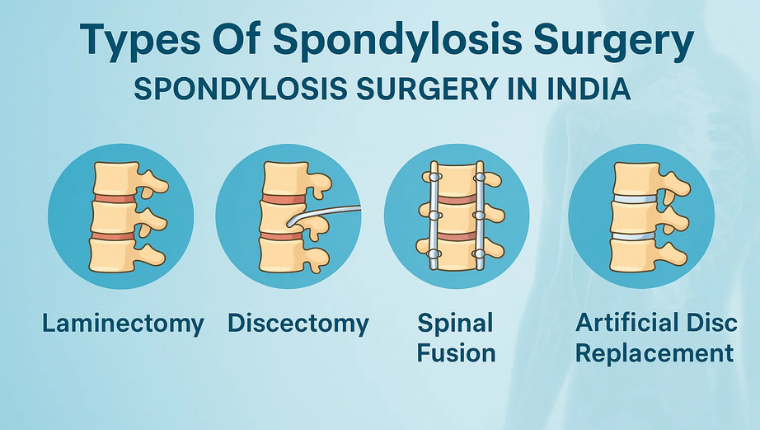
Types of Spondylosis Surgery
Cost of Spondylosis Surgery in India
There is also variation in prices based on city, hospital class, and whether the surgeon employs minimally invasive surgical techniques; however, no matter what cost is associated with surgery, the majority of patients will select a hospital providing excellent post-operative care, including physiotherapy support and consultation from a spine specialist, due to the significant impact these factors will have on long-term success and comfort after recovery.
|
Procedure |
Approx Cost (₹) |
|
Discectomy |
1,50,000 – 2,75,000 |
|
Decompression (Laminectomy/Foraminotomy) |
1,50,000 – 2,50,000 |
|
Spinal Fusion |
2,50,000 – 5,00,000 |
|
Artificial Disc Replacement |
3,60,000 – 6,00,000 |
For Free Online Consultation
GET A FREE QUOTE
Best Clinic For Spondylosis Surgery in India
Spondylosis surgical costs vary in India based on surgical type, hospital facility, and patient health. Decompression and discectomy are typically less expensive than fusions and artificial discs due to the higher costs associated with implants and longer surgical procedures. Discectomy surgery is usually done for disc herniation and has a higher success rate for patients than other forms of surgery. If you're in the process of researching where to get your surgery done, then I highly recommend you consider the top-rated hospitals across the world for this type of surgery. These hospitals have highly talented and skilled staff who perform surgeries using the latest technology available. In addition, they provide their patients with a great deal of attention after the surgery.
|
Hospital / Clinic |
Location (City) |
|
Medanta – The Medicity |
Gurgaon (near Delhi) |
|
Apollo Hospitals |
Chennai |
|
Fortis Memorial Research Institute |
Gurgaon |
|
Max Super Speciality Hospital |
Delhi |
|
Ganga Hospital |
Coimbatore |
We Care Health Services For Spondylosis Surgery in India
Degeneration of the intervertebral disc, often called "degenerative disc disease" (DDD) of the spine, is a condition that can be painful and can greatly affect the quality of one's life. While disc degeneration is a normal part of aging and, for most people, is not a problem, for certain individuals, a degenerated disc can cause severe, constant, chronic pain. There are different types of surgery, and the cost is also different depending on their management method.
The most likely cause of the surgery nerve pain because to the disc replacement. There are artificial methods also, but not yet that supportive.
Fusion disc operation is good for people looking for flexibility even after the operation.
There are several possible causes for Degenerative disc disease. Sometimes discs become dry and shrunken due to the leaking of protein from the disc. Degenerative disc disease can result from trauma (acute or chronic/repetitive), infection, or the natural processes of aging. It can euphemistically be referred to as the “grey hairs of the spine”.
For treating these conditions, experts from the We Care Health Services suggest surgery with a minimally invasive method. There are good chances to recover in less time. Here are the best facilities by We Care Health Services:
- Affordable Treatment With Cost Transparency
- Variety of minimally invasive methods.
- Good for recovery in less time.
- Handled by different types of experts trained in International centres.
- There are few or no side effects
- Best for the young patients because technology is used in the surgery
For Free Online Consultation
GET A FREE QUOTE
Spondylosis surgical costs vary in India based on surgical type, hospital facility, and patient health. Decompression and discectomy are typically less expensive than fusions and artificial discs due to the higher costs associated with implants and longer surgical procedures.
Conclusion
Today, the spinal disorder known as spondylosis is generally accepted as one of the most significant areas of concern for many people around the world. It is not until they experience limitations on their daily activities due to back pain that the majority of people fully appreciate the severity of this problem. Nevertheless, a comprehensive understanding of the causes of spondylosis and the different forms of back pain caused by spondylosis will allow the patient to understand what effects spondylosis is causing and how best to treat it. India has become a centre for excellence for spine care. It offers patients many benefits, including highly trained surgeons, advanced surgical techniques, comfort during recovery, and treatment at very reasonable prices. Patients may require either decompression surgery or other more complicated surgeries, such as spinal fusion or disc replacement, and health outcomes after all types of treatments for spondylosis are better than expected. With the appropriate treatment, the right hospital, and rehabilitation programs that are implemented in conjunction with treatment, most patients can achieve a good level of comfort and range of motion after treatment for spondylosis.