

Anterior cervical discectomy in India is a spine procedure that is performed to treat nerve compression in the lower spinal region. Anterior Cervical Discectomy, or just ACD, basically, it’s neck surgery, but not the medieval kind—you get a nice little scar up front, not some giant Frankenstein vibe. They go in through the front of your neck, yank out that annoying, busted disc that’s been squashing your nerves and making your arm feel like it belongs to someone else. Sometimes they insert a small piece of bone or an implant to stabilize your spine after the procedure.
Book Appointment
GET A FREE QUOTE
People usually end up on the operating table for this if all the meds, stretches, and other nice stuff just haven’t cut it—think herniated disc, worn-out neck cushioning, or when the spinal canal in your neck gets way too cramped. The traditional treatment is not effective for this pain, and surgery with a lot less pain, a bit more feeling in their hands, and ideally, no more wobbly, numb arms.
What is Cervical Discectomy?
Anterior Cervical Discectomy (ACD) is a surgical procedure performed to relieve pressure on the spinal cord or nerve roots in the neck. It involves making a small incision at the front of the neck, removing the damaged or herniated disc, and creating space to reduce nerve compression. Sometimes a bone graft or implant is placed to stabilize the spine.
This surgery is commonly used to treat conditions like cervical disc herniation, degenerative disc disease, or spinal stenosis when conservative treatments fail. It helps reduce neck pain, arm pain, numbness, and weakness, while also enhancing mobility and improving overall quality of life.
What are the Symptoms of the Anterior Cervical Discectomy?
Anterior Cervical Discectomy (ACD) isn’t some weird illness you wake up with one day. It’s a fix, not the problem. Nobody just strolls into a clinic with “symptoms of ACD,” ya know? What actually happens is your neck decides to be a jerk—herniated discs, nerve squishing, maybe the ol’ spinal cord getting crowded. That mess is what pushes folks toward surgery. So, if someone’s headed for an ACD, it’s usually because their nerves in the neck are ticked off. Stuff like:

Anterior Cervical Discectomy
Anterior Cervical Discectomy
- Herniated or slipped disc – when the inner disc material bulges out and presses on a nerve.
- Degenerative disc disease – natural wear and tear of the cervical discs with aging.
- Cervical spinal stenosis – narrowing of the spinal canal that squeezes the nerves or spinal cord.
- Bone spurs (osteophytes) – bony overgrowths that develop from arthritis and pinch the nerves.
- Trauma or injury – accidents or falls that damage the cervical discs.
- Cervical spondylosis – age-related changes in the neck causing stiffness and nerve compression.
Types of Anterior Cervical Discectomy Surgeries
There are four types of anterior cervical discectomy in India, which are performed with the best technical equipment with minimally invasive methods. From traditional types of surgeries to the most advanced level of surgeries, they are well accepted by patients.
Book Appointment
GET A FREE QUOTE
All the mentioned surgeries are not performed by traditional surgeons because for equipment training is required. So you must check in the hospital and the availability of the equipments in that hospital.
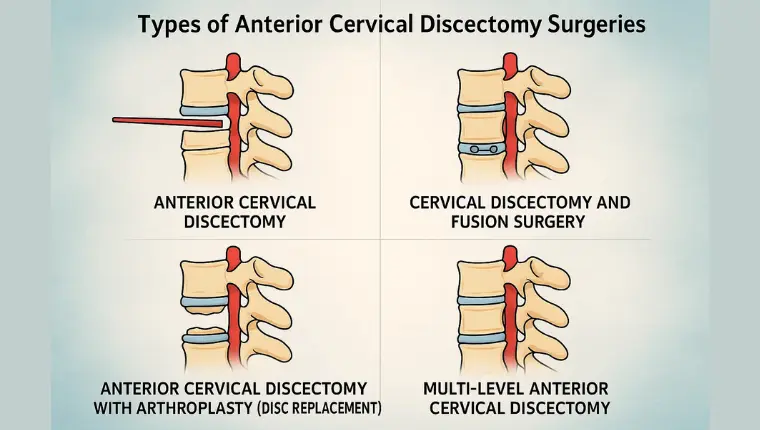
Types of Anterior Cervical Discectomy Surgeries
Cost of Anterior Cervical Discectomy
The cost of an anterior cervical discectomy varies depending on factors like the type of surgery (with or without fusion or disc replacement), the hospital’s reputation, the surgeon’s expertise, and whether it is single-level or multi-level. In India, the cost generally ranges from ₹2,00,000 to ₹9,50,000.
Private hospitals with advanced facilities and international standards may charge on the higher side. The package usually includes surgery, hospital stay, medicines, and follow-up care, but additional expenses like physiotherapy or special implants may be extra.
|
Type of Surgery |
Approximate Cost in India (INR) |
|
Anterior Cervical Discectomy (ACD only) |
₹2,00,000 – ₹2,80,000 |
|
Anterior Cervical Discectomy with Fusion |
₹2,50,000 – ₹4,00,000 |
|
Cervical Disc Replacement (Arthroplasty) |
₹3,50,000 – ₹5,50,000 |
|
Multi-Level Discectomy (2 or more discs) |
₹4,00,000 – ₹6,00,000+ |
Best Hospitals for ACD or Spinal Surgeries
The hospital for spine surgeries is giving VIP treatment, because it is about the complex nervous system. The robotics are also engaged in the surgeries, possibly i the advanced hospitals. These hospitals are known for their experienced spine surgery teams, advanced technology, success rates, and good post-op rehabilitation facilities.
Book Appointment
GET A FREE QUOTE
The Best Part is that these hospitals have NABH-accredited facilities with staff with better communication skills. These hospitals are also open for foreign patients. Choosing among them depends on location, cost, and whether you prefer a private or government setup.
|
Hospital |
City |
|
Indraprastha Apollo Hospitals |
New Delhi |
|
Medanta – The Medicity |
Gurgaon |
|
Max Super Specialty Hospital (Saket) |
New Delhi |
|
Fortis Memorial Research Institute |
Gurgaon |
|
Ganga Hospital |
Coimbatore |
|
Manipal Hospitals |
Multiple Cities |
|
Kokilaben Dhirubhai Ambani Hospital |
Mumbai |
|
BLK Super Speciality Hospital |
New Delhi |
|
Global Hospitals |
Mumbai |
|
Nanavati Super Specialty Hospital |
Mumbai |
|
New Age Wockhardt Hospital |
Mumbai |
|
Artemis Hospital |
Gurgaon |
|
Saifee Hospital |
Mumbai |
|
Indian Spinal Injuries Centre |
New Delhi |
|
AIIMS (All India Institute of Medical Sciences) |
New Delhi |
We Care Health Services for Spine Surgeries or Anterior Cervical Discectomy
Among many hospitals, there is a balance of the surgeries, waiting list, and staff, and that is We Care. It is one of the best Indian hospitals for complex surgeries and treatment. It is providing treatment to foreign patients. If you are not getting a way for spine surgeries or heart surgeries that you can contact us. There are many kinds of medical services available under the same roof.
The cost transparency and the success rate are other attributes of the hospital. We are already coordinated with the best hospitals, if there is an emergency case, otherwise it is a left-hand game for us to be your trusted partner medical field. Here are our best facilities provided by us:
- Cost transparency with affordable packages.
- High success rate of the surgeries upto 95%.
- Best guidance for the weak and old patients.
- Multilingual staff coordination
- The best experts in spine surgery to perform surgery.
- Continuously working on our services to give you all medical assistance at one place.
- Personalized approach for the patients.
- Diet and health guide for patients.
- Good stay hospital facilities.