

Kyphoplasty surgery in India is a procedure with less invasion, and the recovery duration is also less. The success rate of this surgery is around 95%, and it has helped many patients in successful recovery. It can cure osteoporosis and bone-related disorders in patients. It is also called balloon kyphoplasty procedure because of the procedure involved.
Kyphoplasty is a minimally invasive spinal surgery used to treat vertebral compression fractures, often caused by osteoporosis, trauma, or cancer. The procedure involves inserting a small balloon into the fractured vertebra to create space, which is then filled with bone cement to stabilize the bone, relieve pain, and restore spinal height.
Kyphoplasty Surgery in India: What is Verteboplasty Surgery?
Kyphoplasty is synonymous to Vertebroplasty and Cementoplasty. Kyphoplasty is a minimally invasive surgical procedure used to treat vertebral compression fractures in the spine, which are often caused by osteoporosis, trauma, or cancer. The main goal of kyphoplasty is to stabilise the fractured vertebra, relieve pain, and restore the height and shape of the collapsed bone.
Get An Expert Medical Opinion
GET A FREE QUOTE
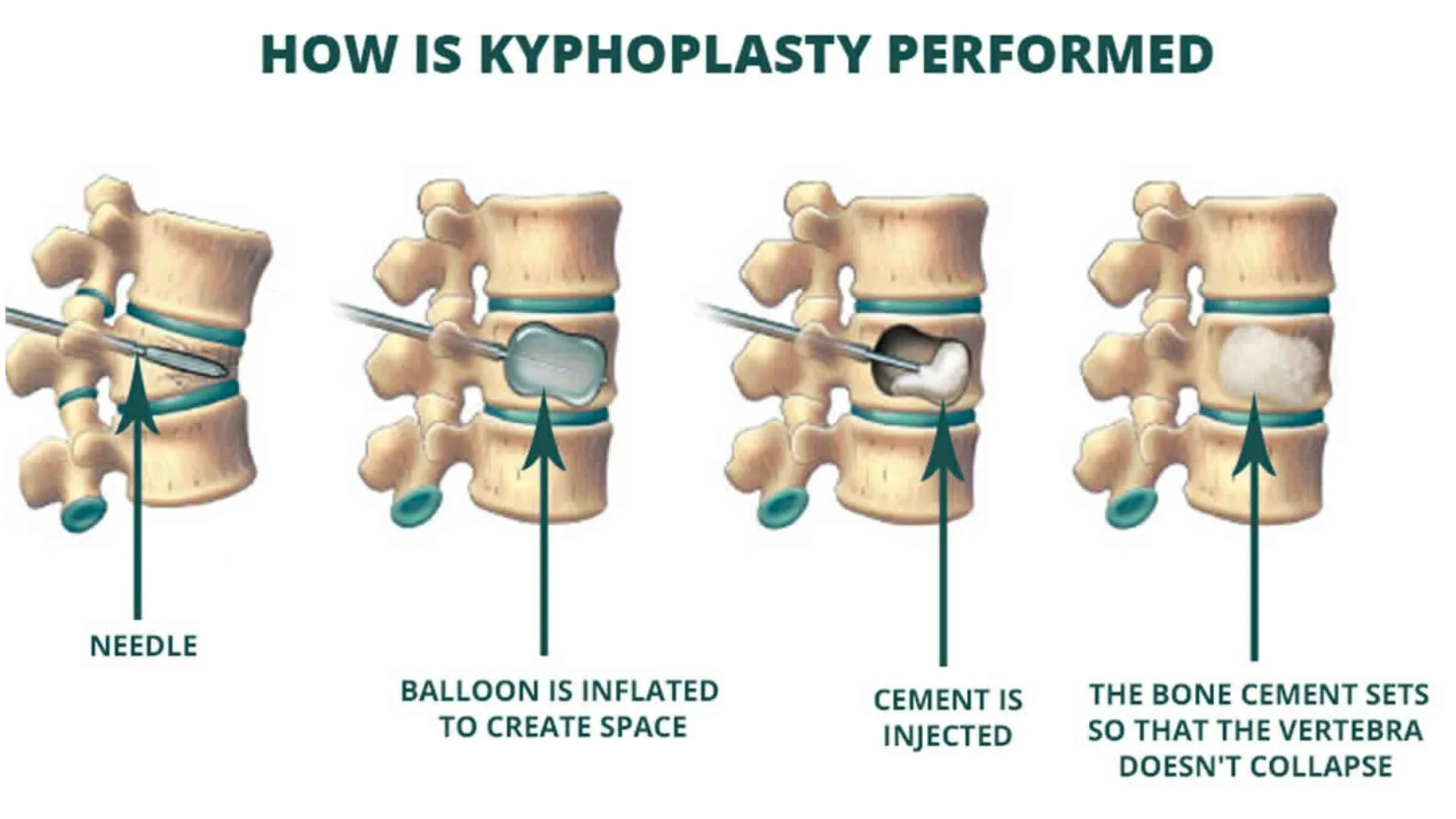
Kyphoplasty Surgery in India: Kyphoplasty Procedure Steps
The procedure involves only a tiny incision, resulting in minimal blood loss, reduced muscle damage, and a quicker recovery time. Most patients require only a short hospital stay, and some can even go home the same day. Additionally, kyphoplasty has a lower risk of cement leakage due to the controlled space created by the balloon, making it a safer option in many cases. Overall, kyphoplasty not only relieves pain but also enhances the patient’s quality of life by enabling a faster return to daily activities with fewer complications.
Preoperative Preparation For the Patient
The preoperative procedure for kyphoplasty surgery involves a series of careful evaluations and preparations to ensure patient safety and optimal outcomes. Before undergoing kyphoplasty surgery in India, the patient is thoroughly assessed through physical examinations and diagnostic imaging, such as X-rays, MRI, or CT scans, to identify the exact location and severity of the vertebral compression fracture.
Blood tests are conducted to evaluate the patient’s general health, and an anesthetic assessment is carried out to determine whether local or general anesthesia is appropriate. Patients are usually advised to fast for several hours before the surgery and to temporarily discontinue certain medications, such as blood thinners, under medical supervision. In India, leading hospitals offering kyphoplasty prioritize patient education during the preoperative phase, ensuring that individuals understand the procedure, its benefits, and any associated risks.
Actual Procedure of Surgery
In India, leading hospitals offering kyphoplasty prioritize patient education during the preoperative phase, ensuring that individuals understand the procedure, its benefits, and any associated risks. This comprehensive preparation helps pave the way for a safe, efficient, and successful kyphoplasty surgery experience.
Get An Expert Medical Opinion
GET A FREE QUOTE
- The surgical procedure of kyphoplasty is a precise and minimally invasive technique designed to treat vertebral compression fractures and relieve back pain.
- During kyphoplasty surgery in India, the patient is first given either local or general anesthesia, depending on their health condition and the surgeon’s preference.
- The patient is then positioned face down on the operating table.
- A small incision is made over the affected vertebra, through which a hollow needle (cannula) is inserted into the collapsed bone under fluoroscopic (X-ray) guidance.
- A special balloon is then passed through the cannula into the vertebra and gently inflated to restore its height and create a cavity.
- Once the desired correction is achieved, the balloon is removed, and the space is filled with bone cement, which quickly hardens to stabilize the vertebra.
- The incision is then closed with a bandage, and the patient is monitored in the recovery area.
- Hospitals performing kyphoplasty surgery in India follow international safety standards, ensuring precise cement placement and minimal complications, which allows for faster recovery and improved patient outcomes.
Kyphoplasty Cost in India: Is Kyphoplasty Covered by Insurance?
The more complex or specialized the procedure, the higher the cost. Surgeries that involve delicate areas (like the spine or brain), require precision, or take more time generally cost more due to the expertise and equipment involved. The cost of any medical procedure is defined based on a combination of several key factors that reflect the complexity, resources, and care involved in delivering that treatment. Here's how it is typically determined:
|
Type of Kyphoplasty Procedure |
Details |
Average Cost (INR) |
|
Single-Level Kyphoplasty |
Treatment of 1 fractured vertebra |
₹1,20,000 – ₹2,50,000 |
|
Two-Level Kyphoplasty |
Treatment of 2 adjacent vertebrae |
₹2,20,000 – ₹3,50,000 |
|
Balloon-Assisted Kyphoplasty |
Standard method using inflatable bone tamp |
₹1,50,000 – ₹3,00,000 |
|
Unilateral Kyphoplasty |
Entry through one side only (less invasive) |
₹1,00,000 – ₹2,20,000 |
|
Bilateral Kyphoplasty |
Entry from both sides of the vertebra |
₹1,50,000 – ₹2,80,000 |
|
Kyphoplasty with Imported Implants |
Use of premium, foreign-made balloons/cement kits |
₹2,50,000 – ₹4,00,000 |
|
Kyphoplasty at Government Hospitals |
Subsidized cost with Indian-made materials |
₹70,000 – ₹1,50,000 |
|
Kyphoplasty at Private Super-Speciality Hospitals |
High-end setup with advanced imaging and recovery |
₹1,80,000 – ₹3,50,000 |
|
Day-care/Outpatient Kyphoplasty |
Same-day discharge, usually for single-level cases |
₹90,000 – ₹1,60,000 |
Insurance Coverage For Kyphoplasty
Kyphoplasty surgery in India is generally covered by insurance, but coverage depends on several important factors, including the type of insurance policy, the insurance provider, and the medical necessity of the procedure.
If kyphoplasty is deemed medically necessary—for example, in cases of painful vertebral compression fractures due to osteoporosis, trauma, or certain cancers—most health insurance plans (private or group policies) will cover the procedure either partially or fully. However, coverage may vary for pre- and post-operative expenses, diagnostics, implants, and hospital room charges, depending on the terms and limits of your insurance policy. Points to be noted are:
- Get pre-authorization from the insurance company before the procedure.
- Submit all required medical reports, imaging, and the surgeon's recommendation.
- Confirm if both surgical implants (balloon, cement kit) and hospital stay are covered.
Factors Affecting the Cost of Kyphoplasty Surgery in India
In cases where the patient has multiple spinal fractures or comorbid conditions, the duration and complexity of the surgery may also increase, leading to longer operating room time, more use of imaging guidance, and possibly ICU care post-surgery. Such factors raise both the surgical and hospital-related expenses. Here are some factors that affect the cost exclusively:
Top 10 Kyphoplasty Hospitals in India
The comprehensive surgery care and the personalized treatment for the patients are given by some selective hospitals. Some of these hospitals are handled by government bodies, others are independent. Here is an enhanced and detailed table of the best hospitals for kyphoplasty surgery in India, including expanded descriptions and integration of the keyword for better relevance:
|
Hospital Name |
City |
Key Features |
|
All India Institute of Medical Sciences (AIIMS) |
New Delhi |
Government hospital, affordable rates, advanced spine care unit |
|
Medanta – The Medicity |
Gurugram |
Robotic spine surgery, top orthopedic and neurosurgeons |
|
Apollo Hospitals |
Chennai, Delhi, Hyderabad |
Internationally accredited, minimally invasive spine procedures |
|
Fortis Memorial Research Institute |
Gurugram |
NABH-accredited, 24x7 neuro and orthopedic teams |
|
Manipal Hospitals |
Bangalore |
High-end diagnostics, spine and neurology excellence center |
|
Narayana Health (NH) |
Bangalore |
Cost-effective spine care, multidisciplinary team |
|
Max Super Speciality Hospital |
New Delhi |
Advanced image-guided spine surgeries, personalised recovery programs |
|
Christian Medical College (CMC) |
Vellore |
Renowned teaching hospital, economical, highly trained specialists |
|
Kokilaben Dhirubhai Ambani Hospital |
Mumbai |
Fully equipped spine surgery department with advanced navigation systems |
|
Sancheti Hospital |
Pune |
Specialises in orthopedic and spinal disorders, advanced kyphoplasty facilities |
Top 10 Kyphoplasty surgeons in India: Top Spine Doctor in India
There are many reasons to choose kyphoplasty surgery in India, and a prominent one is surgeons with high skills and multiple coordination abilities. Spine surgery is a complex surgery, and it takes more than 8 years to take complete handover of the surgery to a new doctor. It is also a sensitive region in the body where various nerves of the body make a connection with the Autonomous nervous system.
Apart from the surgery, a doctor makes coordination with the patient and various diseases, and it is possible with years of experience. India harbours such doctors, and here is the list of the doctors:
Dr. H.S. Chhabra

Dr. Bipin S. Walia

Dr. Kalidutta Das

Dr. Hamza Shaikh

Dr. V. A. Senthil Kumar

Dr. Vishal Nigam

Dr. Amit Chugh

|
Doctor's Name |
Experience |
Specialties |
Affiliated Hospital |
|
Dr. H.S. Chhabra |
32+ years |
Spine Surgery, Spinal Cord Injury |
Indian Spinal Injuries Centre, New Delhi |
|
Dr. Bipin S. Walia |
20+ years |
Neurosurgery, Spine Surgery |
Max Hospital, Saket, New Delhi |
|
Dr. Kalidutta Das |
28+ years |
Orthopedics, Spine Injury |
Indian Spinal Injuries Centre, New Delhi |
|
Dr. Hamza Shaikh |
17 years |
Spine Surgery |
Manipal Hospital, Dwarka, Delhi NCR |
|
Dr. V. A. Senthil Kumar |
27 years |
Orthopaedics |
Dharamshila Narayana Superspeciality Hospital, Delhi NCR |
|
Dr. Vishal Nigam |
21 years |
Orthopaedics and Spine Surgery |
Sitaram Bhartia Institute of Science and Research, New Delhi |
|
Dr. Amit Chugh |
Not specified |
Spine Surgery |
IBS Hospital, Delhi |
We Care Health Services: Kyphoplasty Surgery in India
We Care Health Services is recognised for delivering comprehensive medical care, including advanced procedures like spine surgery. Their integrated approach allows patients to undergo multiple treatments simultaneously, enhancing convenience and reducing overall recovery time. With a team of experienced cardiologists and facilities, We Care Health Services ensures high-quality care tailored to individual patient needs.
Kyphoplasty surgery in India is the best possible with time-diagnosis. Here are the possible advantages of the We Care India health Organisation.
- Gives you pocket-friendly treatment solutions in the various cities of India.
- Hospitals are at the perfect site that is connected to the city and outstations for ease of travelling.
- Provide cost packages with different treatment services.
- Gives counselling about the treatment, mediations and psychological challenges during the treatment.
- Personalized approach to the various treatments. It has facilities for various surgeries and coordinates with the best Indian Surgeons.
- They made spine surgery in India an easy option for the patient.
- The hospital is equipped with advanced technology for spine surgery, ensuring precision, safety, and high success rates in treating blocked arteries.
- A team of highly experienced knee replacement surgeons and interventional specialists perform procedures with expertise, reducing complications and improving long-term outcomes.
- The hospital provides dedicated post-surgery monitoring, lifestyle guidance, and cardiac rehabilitation programs to ensure optimal recovery and heart health management.
- With advanced minimally invasive techniques, patients experience quicker recovery and shorter hospital stays, enabling them to return to daily life sooner.
- The hospital is well-equipped for international patients, providing visa assistance, travel coordination, and language support for a hassle-free experience.
Who is a Candidate for Kyphoplasty Surgery?
A person is considered a candidate for kyphoplasty surgery in India if they are suffering from painful vertebral compression fractures (VCFs) caused by conditions such as osteoporosis, spinal trauma, or certain types of cancer (metastatic lesions or multiple myeloma). These fractures lead to the collapse of vertebrae, resulting in severe back pain, reduced mobility, and spinal deformity. Patients who do not respond to conventional treatments such as rest, pain medications, or bracing within a few weeks may be referred for kyphoplasty.
Get An Expert Medical Opinion
GET A FREE QUOTE
- Ideal candidates are those experiencing acute or subacute fractures (generally less than 3 months old), with MRI or bone scan confirmation of an active, unhealed compression fracture.
- Patients must be in reasonably good general health and capable of undergoing a minimally invasive procedure under local or general anesthesia.
- It is also important that there is no presence of infection, spinal instability, or severe neurological deficits, which could complicate the outcome
- Kyphoplasty surgery in India is recommended for individuals with persistent back pain due to vertebral compression fractures.
- Patients who have been evaluated through imaging and clinical tests and for whom conservative treatment has failed.
- Early intervention often leads to better outcomes, improved spinal stability, and a quicker return to normal life activities.