
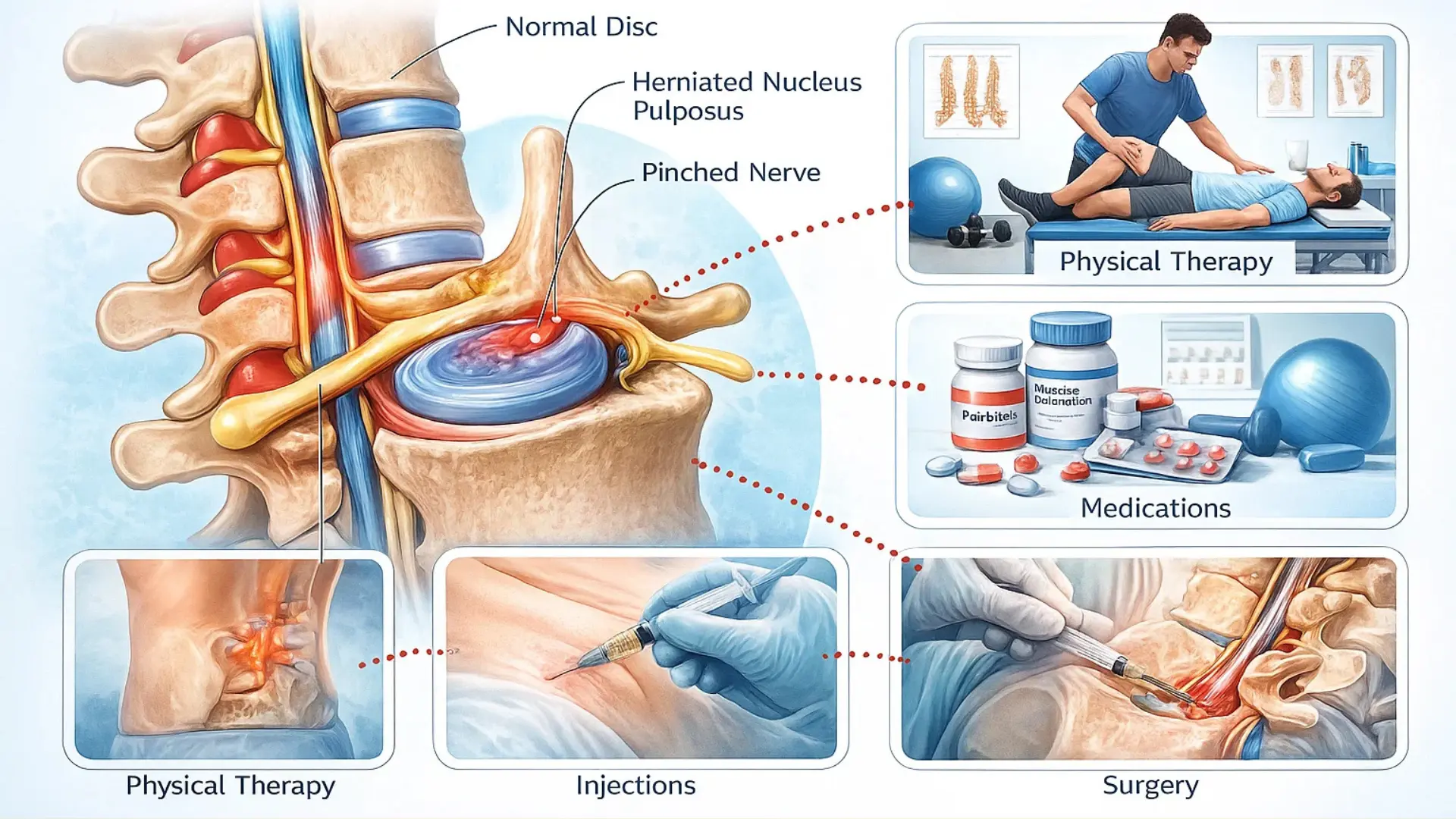
Slipped Disc Treatment in India: there is a combination of affordable treatments, knowledge, and high-quality care for the treatment of slipped discs. Patients often start with conservative treatments such as Physiotherapy, Pain Management, Correcting Posture, Yoga, and Changing Lifestyle. When patients continue to have problems associated with symptoms from the slipped disc, nerve compression, or dysfunction reaching a critical point, patients may be recommended to have a procedure called Microdiscectomy or an Endoscopically performed surgery for the spine.
For Free Online Consultation
GET A FREE QUOTE
India has some of the most skilled spine surgeons, along with many advanced technologically equipped hospitals and rehabilitation centres in all of the major urban cities in India. Each patient's treatment plan will generally include some type of Personalised Treatment plan (for pain relief, Mobility Restoration, and long-term spinal Health), making India a very attractive option for our domestic and International Patients.
How Does Disc Get Slipped? Is a Slipped Disc Dangerous?
This can produce problems with the bowels and bladder and disrupt the way you walk. Fine motor skills of the hand may also be impaired. In a corpectomy, the front part of the spinal column is removed. (Corpus means body, and ectomy means to remove.) Bone grafts are used to fill in the space.
This procedure is used when bone spurs have developed in more than one vertebra. In mild cases, injury recovery may be facilitated through rest and treatment; however, if a slipped disc is pressing against a nerve root, then severe symptoms may develop, such as great pain, loss of sensation, decreased muscle strength, or loss of bladder control. Prompt intervention by a qualified physician is necessary in these instances to prevent further complications.
Slipped Disc Treatment
A herniated disc, also referred to as a slipped disc, occurs when the softer inner portion of a spinal disc shifts from its original location and irritates the nerve roots above or below it. Herniated discs are a common cause of pain, stiffness, tingling, numbness, or weakness in parts of either the arms or the legs.
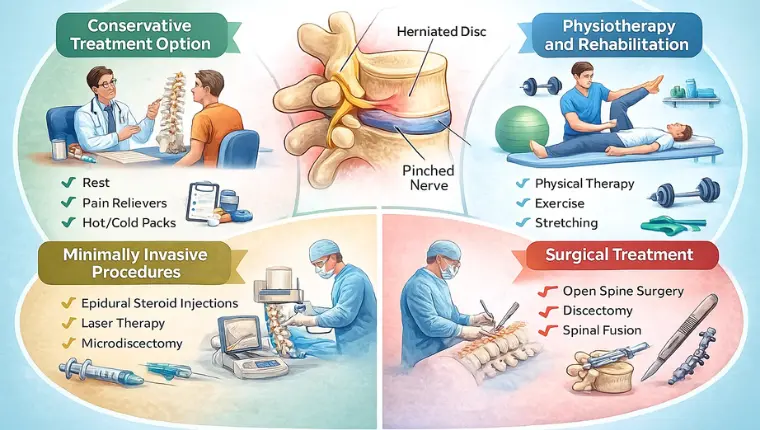
Slipped Disc Treatment
Before inserting the bone graft, the surgeon increases the traction on the neck to further separate the space. The bone graft is sized to fill the full length of the removed section of bone and discs from one end to the other.
Other methods can provide pain relief and/or reduction in patient muscle spasms. Heat therapy, ultrasound, and electric stimulation have been shown through research and clinical data to successfully provide these types of relief.
The surgeon starts by making an incision up the left side of the neck to the ear and then under the jaw to the bottom of the chin. The skin flap is opened to expose the structures of the neck. Retractors are used to separate and hold the muscles and soft tissues apart so the surgeon can work on the front of the spine.
Special instruments are attached either to the skull or the spinal bones to stretch the neck with mild traction. The traction pull spreads the neck joints apart to give the surgeon more room to work. It also takes additional pressure off the spinal cord. Then the surgeon inserts a needle into the disc and does an X-ray to locate the exact sections where the bones are to be removed.
Cost of Surgical Treatment in India
Surgery for a Slipped Disc, in India, is less expensive when compared with most countries worldwide. Surgical costs (Microdiscectomy & Endoscopic Spine Surgery) range from approximately ₹1,50,000 - ₹6,00,000, depending on the hospital, location, the surgeon's expertise & the complexity of the particular issue or case. Government hospitals and smaller centres may charge less, whereas higher-end private hospitals charge the highest amount due to their superior facility and amenities. The overall cost of surgery includes all costs relating to surgery (including all hospital stays), anesthesia, and initial follow-up care, therefore making India an attractive/affordable option for those seeking spinal surgery.
|
Procedure |
Estimated Cost in India (INR) |
|
Microdiscectomy |
₹1,50,000 – ₹3,00,000 |
|
Endoscopic Spine Surgery |
₹2,00,000 – ₹4,00,000 |
|
Laminectomy |
₹2,50,000 – ₹4,50,000 |
|
Discectomy |
₹1,80,000 – ₹3,50,000 |
|
Spinal Fusion (if required) |
₹3,50,000 – ₹6,00,000 |
For Free Online Consultation
GET A FREE QUOTE
Different Types of Slipped Discs
The term slipped or "herniated" is used to describe a slipped disc that can present in several different ways, depending on the severity, direction, and position of the displacement of the disc. Identifying each type will assist the doctor in determining the best treatment and estimating the chances of recovery.
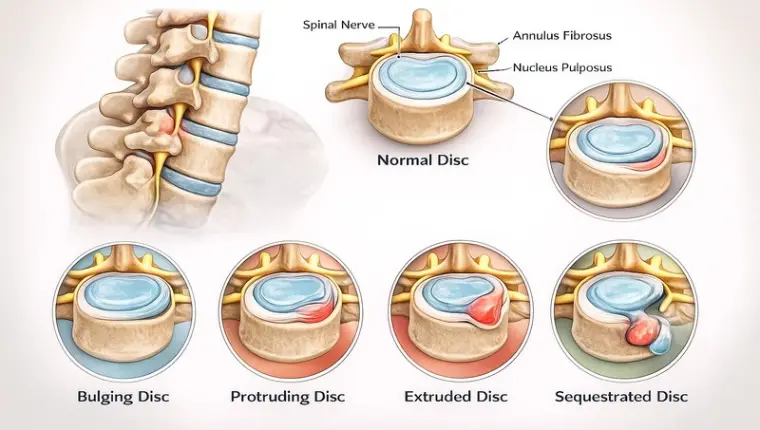
Different Types of Slipped Discs
Best Hospitals for slipped disc treatment
In India, surgery for sciatica is an increasingly popular specialty. Therefore, when someone experiences constant nerve pain that won't go away, in the lower back and gluteal region the most important factor in ensuring a smooth experience. To choose an appropriate hospital to treat the problem, we have to go through many details, but We Care Health Services is making it easy. With many hospitals to choose from in India, it can be daunting to find the right facility. There are several that continue to provide consistent results because of their successful record.
The best qualities of these hospitals are: qualified spinal surgeons, effective diagnostic services, and unique physiotherapy and rehabilitation programs.
There is usually one name that many consider to be the best, i.e., Medanta Hospital (Gurgaon); another is We Care Health Services due to its spine team's extensive experience and treatment volume. Both have treated thousands of patients for both nerve compression and disc-related issues every year. In addition, their staff continuously updates their knowledge base with the latest minimally invasive methods. They maintain an organised facility that eases the burden on patients suffering from acute pain.
For Free Online Consultation
GET A FREE QUOTE
|
Hospital Name |
City |
|
Medanta – The Medicity |
Gurgaon |
|
Apollo Hospitals |
Multiple cities |
|
Fortis Memorial Research Institute |
Gurgaon |
|
Max Super Speciality Hospital |
Delhi |
|
Kokilaben Dhirubhai Ambani Hospital |
Mumbai |
|
Christian Medical College (CMC) |
Vellore |
|
AIIMS |
Delhi |
|
Artemis Hospital |
Gurgaon |
|
Manipal Hospitals |
Bangalore |
|
Yashoda Hospitals |
Hyderabad |
We Care Health Services for the Best Services for slipped disc treatment in India
We Care Health Services' office is located in Delhi, but they are operating at different levels of treatment with the help of their staff and online presence. We are the best in all kinds of treatment systems, cancer, diabetes, pediatric surgeries, and infertility. Treatment is something that we have done several times during the journey. We offer the best treatment with the best doctors and with the legalities of medical tourism in India.
We care is not about the selection of the diseases: we diagnose, and then we care rest of the journey. Both our management skills and care staff are good selections, which have been proven during the previous cases. Knowing our best future is directly accessing us with the knowledge of the system. Most of the time, we give the cause of the diseases and symptoms that are seen during peak levels. Our laboratory's function is also best like staff and hospital safety. Here are some good points about our services:
- Cost transparency in treatment
- Hygienic stay in the hospital
- Treatment as per the Indian treatment legalities
- We have different sections like cancer care, infertility treatment, heart treatment, pediatric services, and replacement of the bone and joints.
- Laboratories for diagnosis.
- Emergency care units for patients.
- Support medical tourism in India, which has the legal support of the government.
Other Treatment at We Care Health Services for Nerve Compression
There are some terms like Lumbar Spinal Stenosis, Lumbar Bulging or Herniated Disc, Piriformis Syndrome, and Spondylolisthesis. They all are because of the nerve compression, and the pain is almost the same as a sharp tingling sensation. The common symptoms that cause pain are pressure on the spinal cord and spinal nerves.
Preventive measures for such conditions are exercise and regular weight lifting, so that it may not be heavy for you to push or pull. On the other hand lumber bulge or herniated disc is also known as ‘non-contained’ disc disorder. Spondylolisthesis may happen due to age, stress on the spine or a previous injury. Piriformis syndrome is burning or pulling pain that spreads from the buttocks down the leg. You will notice all these have the same symptoms and are caused by nerve compression at any age. Whether a disc herniates or bulges, disc material can press against an adjacent nerve root and compress delicate nerve tissue and cause sciatica. Irritation and nerve compression cause pain and inflammation, often leading to extremity tingling, muscle weakness, and numbness.
For Free Online Consultation
GET A FREE QUOTE
Conclusion
Slipped disc treatment in India is open to foreign patients. If you are one having no effect of exercise and therapy, then quickly come for surgery, as it is always better to have a cure. Sciatica is a nerve compression caused by a herniated disc and muscle spasm in the muscles. There are some other factors responsible for the disc displacement, like heavy weight pulling. Choosing a hospital is now easy with our help. The best hospitals for slipped disc treatment in India share a few common qualities that make them reliable. They have skilled surgeons who specialize specifically in spine and nerve conditions rather than general orthopaedics. We are known for the best guidance with treatment.