

For Specific pituitary tumour treatment in India, a specific diagnosis and a customised solution are designed. Pituitary tumours are abnormal growth of the pituitary cells, which causes an increase or decrease in hormones in the blood. The symptoms can also be seen externally in any patient. There are mainly two categories of these tumours: carcinomas and microadenomas.
With the advanced technology, they can be surged or treated easily by the oncologists. Hormonal imbalances are the main symptoms of having any pituitary tumours. It can also be cured with the help of surgery and medications.
What are Pituitary Tumours?
Pituitary tumours are abnormal growths that develop in your pituitary gland. Sometimes pituitary tumours can cause excessive production of hormones that regulate important functions of your body. Other times, pituitary tumours can restrict your pituitary gland, causing it to produce lower levels of hormones.
Book Appointment
GET A FREE QUOTE
Most pituitary tumours are noncancerous, nonspreading growths (adenomas). Adenomas remain confined to your pituitary gland or surrounding tissues and don't spread to other parts of your body. Treatment for pituitary tumours involves various options to either remove the tumor or control its growth. You may also need medications to correct hormone production that is too high or too low.
What Causes Pituitary Tumours?
Researchers do not know at this time what causes pituitary tumours. However, research studies show that having a hereditary condition, multiple endocrine neoplasia, type I (MEN 1), increases the risk of developing pituitary tumours, thyroid tumours, and pancreatic tumours. Multiple endocrine neoplasia, type I (MEN 1) is responsible for about all inherited (those that run in families) pituitary tumours, but only 3 per cent of all pituitary tumours.
- Genetic mutations: Inherited or spontaneous mutations in certain genes, like MEN1, can trigger abnormal cell growth in the pituitary gland.
- Hormonal imbalances: Long-term hormonal fluctuations can influence cell activity and increase tumour risk.
- Radiation exposure: Prior exposure to head or brain radiation can raise the chances of developing pituitary tumours.
- Family history: Individuals with a family history of endocrine or pituitary disorders are more susceptible.
- Family history: In many cases, the exact cause remains unclear, but research continues to explore possible links.
- For those affected, pituitary tumours treatment in India offers advanced surgical, medical, and radiation therapies at affordable costs with high success rates.
Symptoms of Pituitary Tumour
If a pituitary tumour exists, the pituitary gland may make an excessive amount of hormones. Tumours that make hormones are called functioning tumours, and those that don't make hormones are called non-functioning tumours.
Book Appointment
GET A FREE QUOTE
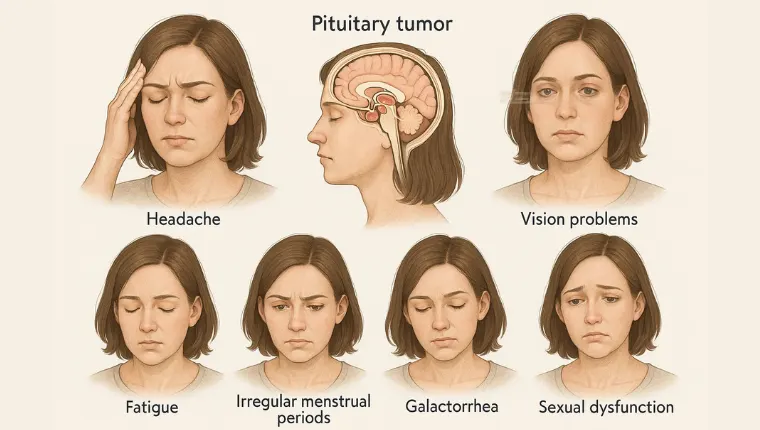
Symptoms of Pituitary Tumour
Tumours that secrete hormones tend to be smaller than the pituitary gland when they're diagnosed. Most pituitary tumours are microadenomas that measure 3 to 9 millimetres in diameter. Less common tumours are macroadenomas that are 10 millimetres or larger in diameter. Tumours that don't secrete hormones, called endocrine-inactive adenomas, tend to be larger and may compress other tissue, such as the optic nerves, causing vision loss.
- Headache
- Loss of peripheral vision or decreased acuity in one or both eyes
- Double vision
- Nausea with or without vomiting
- Weight loss or gain
- Loss of appetite
- Fatigue or decreased energy
- Joint pain
- Increase in shoe or ring size
- Development of high blood pressure or diabetes mellitus
- Decreased mental function
- Dizziness
Book Appointment
GET A FREE QUOTE
Diagnosis of the Pituitary Tumour
Diagnosis of pituitary tumours involves a combination of clinical evaluation and imaging tests. Doctors usually begin with hormone level blood tests to detect abnormalities. MRI scans are the most effective imaging tool to locate and assess the size of the tumour. In some cases, vision tests are also done to check for optic nerve pressure. Early and accurate diagnosis is crucial to plan effective pituitary tumours treatment in India, ensuring better outcomes and minimal complications.
- Blood or Urine Tests - These simple tests are used to measure the hormone levels in your blood and urine.
- Electrocardiogram (ECG or EKG) - A simple, painless test that records the electrical activity of the heart through electrodes placed on the skin of the chest.
- X-rays - High-energy radiation is used to take pictures of the pituitary gland.
- Magnetic resonance imaging (MRI) - This is a non-invasive procedure that produces two-dimensional views of an internal organ or structure, particularly your brain and spinal cord.
- Computed tomography (CT) - This is a non-invasive procedure that takes cross-sectional images of the brain or other internal organs to detect any abnormalities that may not show up on an ordinary X-ray.
Book Appointment
GET A FREE QUOTE
What are the Treatment Options for Pituitary Tumour?
Treatment options for pituitary tumours depend on the type, size, and symptoms. Common approaches include medications to shrink hormone-producing tumours, surgery (usually transsphenoidal surgery) to remove the tumour, and radiation therapy for tumours that can't be fully removed or recur. Hormone replacement therapy may also be needed if the pituitary gland is affected. Advanced hospitals offering pituitary tumours treatment in India provide comprehensive care using minimally invasive techniques, ensuring faster recovery and high success rates.
- Surgical removal of the tumour
- External radiation (external beam therapy) - a treatment that precisely sends high levels of radiation directly to the cancer cells. The machine is controlled by the radiation therapist.
- Since radiation is used to kill cancer cells and to shrink tumours, special shields may be used to protect the tissue surrounding the treatment area. Radiation treatments are painless and usually last a few minutes.
- Radiosurgery (stereotactic radiosurgery) - a type of radiation therapy that uses a single high dose of radiation sent directly into the cancerous tissue with very narrow beams of radiation. This is a precise technique that targets the cancer tumour, causing less damage to the surrounding tissues.
- Radiosurgery is called "surgery" because it is a one-session radiation therapy treatment that creates a similar result as an actual surgical procedure. An example of radiosurgery is called the "gamma knife."
- Medications - to control the growth-hormone production by the tumour (i.e., bromocriptine and cabergoline - medications which act on hormone-producing tumours to suppress their hormone-producing function).
Pituitary tumour surgery cost in India: Prolactinoma surgery cost in India
The cost of pituitary tumour surgery in India is significantly more affordable than in many Western countries, without compromising on quality. The price typically depends on the hospital, the surgeon’s expertise, and the post-surgical care required. Most multispecialty hospitals offer advanced transsphenoidal surgical techniques with shorter recovery times and high success rates.
|
Treatment Type |
Estimated Cost in India (INR) |
|
Transsphenoidal Surgery (endoscopic) |
₹2,00,000 – ₹5,50,000 |
|
Craniotomy (open brain surgery) |
₹4,50,000 – ₹7,00,000 |
|
Radiation Therapy (SRS/SRT) |
₹1,50,000 – ₹3,50,000 |
|
Medication (e.g., Cabergoline, Bromocriptine) |
₹2,000 – ₹10,000 per month |
|
Hormone Replacement Therapy |
₹1,000 – ₹5,000 per month |
|
MRI & Diagnostic Tests |
₹15,000 – ₹40,000 (initial diagnosis) |
|
Post-surgical Hospital Stay (5–7 days) |
₹50,000 – ₹1,00,000 |
Best Hospital For Pituitary Tumour Surgery
India offers world-class care for pituitary gland surgery at affordable rates across top hospitals. From advanced diagnostics to minimally invasive transsphenoidal surgeries, patients receive comprehensive and expert care. Hospitals like AIIMS, Medanta, Apollo, and Fortis provide specialised neurosurgery and endocrinology departments.
Costs range from ₹1.5 lakh to ₹6.5 lakh, depending on the hospital, treatment type, and patient condition. These centres are equipped with experienced neurosurgeons, high-end MRI, and post-operative care, making pituitary tumour treatment in India reliable, safe, and globally sought-after for both Indian and international patients.
|
Hospital Name |
Location |
|
All India Institute of Medical Sciences (AIIMS) |
New Delhi |
|
Fortis Memorial Research Institute |
Gurugram |
|
Medanta – The Medicity |
Gurugram |
|
Apollo Hospitals |
Chennai |
|
Artemis Hospital |
Gurugram |
|
Max Super Speciality Hospital |
New Delhi |
|
Christian Medical College (CMC) |
Vellore |
|
Kokilaben Dhirubhai Ambani Hospital |
Mumbai |
|
Tata Memorial Hospital |
Mumbai |
|
BLK-Max Super Speciality Hospital |
New Delhi |
|
Narayana Health City |
Bangalore |
|
Manipal Hospitals |
Bangalore/Delhi |
|
Amrita Institute of Medical Sciences |
Kochi |
|
Aster Medcity |
Kochi |
|
Jaslok Hospital |
Mumbai |
Side Effects After Pituitary Tumour Surgery

Side Effects After Pituitary Tumour Surgery
- Hormone Imbalances: The pituitary gland may produce fewer hormones, requiring lifelong hormone replacement therapy.
- Fatigue and weakness: Common during the recovery phase due to hormonal changes.
- Vision Issue: Temporary blurred or double vision may occur if the optic nerves are affected.
- Nasal Congestion or Discharge: As surgery is often done through the nose, mild nasal issues are expected.
- Diabetes insipidus: A condition causing excessive thirst and urination due to hormone disruption.
- Headache or sinus discomfort: Mild to moderate pain post-surgery is common but manageable.
- Infection or bleeding Risk Though rare, these are possible surgical complications.
Book Appointment
GET A FREE QUOTE
We Care Health Services for Pituitary Tumour Treatment in India
We Care Health Services is a leading medical tourism facilitator, specialising in arranging pituitary tumour treatments in collaboration with JCI/ISO-accredited hospitals. Key offerings include:
- Expert Hospital Network: Partners with top Indian hospitals featuring neurosurgery, endocrinology, and radiotherapy departments
- Access to Internationally-Trained Specialists: Through affiliations, it provides access to doctors trained in the USA/UK with extensive neurosurgical experience.
- Personalised Treatment Planning:
- Cost Efficiency: Patients can save 60–85% compared to Western care. We Care negotiates prices directly for procedures, hospital stays, and diagnostics
- End-to-End Coordination:
- International Patient Support:
- 24/7 assistance, multilingual coordination.
- Personalized hospitality and recovery care.
- Transparency & Trust:
Why Choose We Care?
- Proven track record in complex neurosurgical cases, including pituitary tumours.
- Focus on value through negotiated pricing and exceptional quality.
- Tailored support from consultation through to recovery, making India a top choice for international patients seeking pituitary tumour treatment.
Pituitary Gland Surgery Success Rate
The success rate of pituitary gland surgery is generally high, especially when performed by experienced neurosurgeons using advanced techniques like endoscopic transsphenoidal surgery. Success rates range from 80% to 95% for small, non-invasive tumours, and around 60% to 80% for larger or more complex tumours.
The outcome depends on tumour size, type, location, and whether it affects hormone production. In India, many top hospitals report excellent success rates due to skilled specialists and modern equipment. Pituitary tumours treatment in India is both effective and affordable, attracting patients from around the world for high-quality care.
What to avoid with a pituitary tumour?
With a pituitary tumour, it’s important to avoid anything that can worsen symptoms or interfere with treatment. Avoid heavy lifting, strenuous exercise, or sudden head movements, especially before or after surgery. Limit stress, as it can affect hormone levels. Do not skip medications or hormone therapy without consulting your doctor.
Avoid smoking and alcohol, as they may interfere with healing and hormonal balance. Regular follow-ups and a healthy lifestyle are essential. For patients undergoing pituitary tumours treatment in India, specialists provide clear guidance on post-treatment precautions to support safe and complete recovery.
Book Appointment
GET A FREE QUOTE