

Neoadjuvant therapy in India is an adjunctive therapy given before the main therapy, and has become an integral part of modern multidisciplinary cancer management. Organised by the primary organ involved by cancer, this review summarises the outcomes of neoadjuvant therapy for common malignant solid tumours, based on large, randomised, controlled trials.
Book Appointment
GET A FREE QUOTE
In locally advanced bladder and cervical cancer, patients who undergo neoadjuvant therapy before radical surgery appear to have better survival than those receiving definitive therapy alone; however, it is unclear if the neoadjuvant approach will be superior to definitive therapy followed by adjuvant therapy.
What is Neoadjuvant Therapy?
Neoadjuvant therapy is treatment given before the main treatment, usually surgery, to shrink a tumour and improve the chances of a successful outcome. It can include chemotherapy, radiation, hormone therapy, or targeted treatments. This approach helps make tumours easier to remove, may allow less invasive surgery, and can also begin treating cancer that may have spread. Commonly used in breast, rectal, lung, and oesophageal cancers, neoadjuvant therapy also helps doctors assess how well the cancer responds to the treatment.
The main purpose of the Neoadjuvant therapy in India is:
- Reduce the tumour size before surgery or radiation.
- Improve surgical outcomes, possibly allowing less invasive procedures.
- Treat micrometastases (tiny cancer spreads not yet visible on scans).
- Assess tumour response to therapy early on.
All Details About Application of Neoadjuvant Therapy in India
It enables patients with locally advanced laryngeal cancer to have their vocal function preserved. Many patients with rectal cancer can avoid permanent colostomy after undergoing this approach. In addition, in certain cancers, neoadjuvant therapy may improve long-term survival. Recent years have seen an increase in the popularity of this treatment technique. The number of clinical trials on this topic published from 2000 to 2003 exceeded the number published during the entire previous decade.
This review summarises the outcomes of neoadjuvant therapy for common malignant solid tumours. Since many patients rely on non-oncologists for guidance and support during cancer treatment, understanding the rationale and benefit of neoadjuvant therapy may aid primary care physicians in providing support and encouragement to their patients, ultimately improving care and treatment outcomes. The effect of neoadjuvant therapy can be delineated by comparing it with main therapy alone, or in some cancers, with main therapy plus adjuvant therapy, an adjunctive therapy given after the main treatment modality. This review, organised by organ of primary cancer, puts emphasis on long-term survival and organ preservation based on large phase III randomised, controlled trials.
Neoadjuvant Therapy Examples
Neoadjuvant therapy is widely used in cancer treatment to shrink tumours before surgery. A well-known example is breast cancer. In a case at Tata Memorial Hospital, a 42-year-old woman with HER2-positive locally advanced breast cancer received neoadjuvant chemotherapy with trastuzumab. Her tumour size reduced significantly, enabling breast-conserving surgery instead of mastectomy. Post-surgery analysis showed a complete pathological response, improving her prognosis.
In rectal cancer, a 55-year-old male patient at AIIMS, Delhi, was diagnosed with stage III rectal cancer. He received neoadjuvant chemoradiotherapy for six weeks, which led to a 60% reduction in tumour size. The surgery that followed was less extensive, and the patient retained bowel function, avoiding a permanent colostomy.
Book Appointment
GET A FREE QUOTE
In bladder cancer, a 60-year-old man with muscle-invasive disease was treated at PGI Chandigarh. He underwent neoadjuvant chemotherapy with cisplatin-based drugs before cystectomy. The tumour responded well, and pathology showed minimal residual disease, increasing his survival chances.
These examples highlight how neoadjuvant therapy not only improves surgical outcomes but also helps tailor further treatment. It is particularly useful in aggressive or advanced tumours, offering a better quality of life and survival rates for patients.
Neoadjuvant Vs. Adjuvant- Neoadjuvant Therapy in India
Neoadjuvant therapy is given before the main treatment (usually surgery) to shrink the tumour and improve surgical outcomes. Adjuvant therapy is given after the main treatment to eliminate any remaining cancer cells and reduce the risk of recurrence.
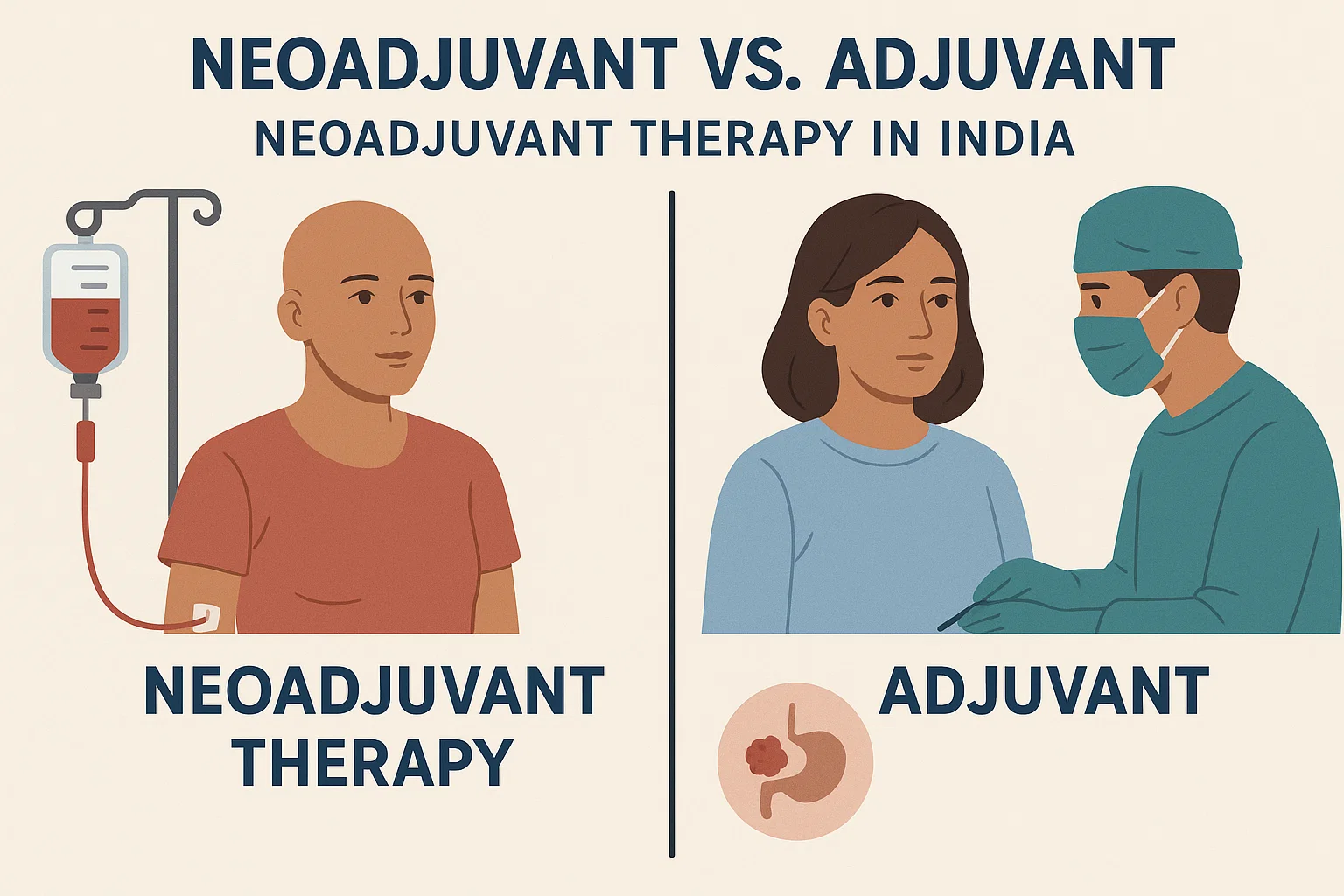
Neoadjuvant Vs. Adjuvant- Neoadjuvant Therapy in India
|
Feature |
Neoadjuvant Therapy |
Adjuvant Therapy |
|
Timing |
Before surgery or main treatment |
After surgery or main treatment |
|
Purpose |
Shrink the tumour, make surgery easier |
Kill remaining cancer cells, prevent recurrence |
|
Common Use Cases |
Breast, rectal, lung, and bladder cancers |
Breast, colon, ovarian, and many other cancers |
|
Treatment Types |
Chemotherapy, radiation, hormone or targeted therapy |
Same as neoadjuvant |
|
Tumour Response Check |
Helps assess tumour sensitivity to treatment |
No immediate way to assess response |
|
Impact on Surgery |
May allow less extensive surgery |
No effect on surgery since it follows it |
|
Goal |
Downstage tumour improves the surgical outcome |
Improve long-term survival and reduce recurrence |
Neoadjuvant Therapy Procedure & Details
Neoadjuvant therapy involves a structured, step-by-step approach before the main cancer treatment, usually surgery. After neoadjuvant therapy shrinks the tumour or reduces local spread, surgery is performed to remove the remaining cancer. The goal is to achieve clear surgical margins, meaning no cancer cells are left at the edges of the removed tissue. This increases the chance of a cure and lowers the risk of recurrence. The type of surgery varies depending on the cancer location, type, and how well it responds to the neoadjuvant treatment.
- Breast Cancer: Lumpectomy or mastectomy – usually takes 1–3 hours
- Rectal Cancer: Low anterior resection or abdominoperineal resection – 3–6 hours
- Bladder Cancer: Radical cystectomy – 4–6 hours
- Lung Cancer: Lobectomy or pneumonectomy – 2–4 hours
Neoadjuvant Therapy in India Price
Neoadjuvant therapy in India is widely available at leading cancer hospitals and is tailored to each patient based on cancer type, stage, and overall health. The treatment typically includes chemotherapy, radiation, or targeted therapies, and is supervised by a multidisciplinary team. Costs vary depending on the hospital, medications used, and duration of treatment.
Book Appointment
GET A FREE QUOTE
Government hospitals and schemes offer subsidised options, while private centres provide advanced facilities and quicker access. Patients also have access to financial aid, insurance coverage, and support programs. With growing expertise and infrastructure, India offers high-quality neoadjuvant therapy comparable to international standards across major cities.
|
Cancer Type |
Type of Neoadjuvant Therapy |
Estimated Cost (INR) |
|
Breast Cancer |
Chemotherapy + Targeted Therapy |
₹1,50,000 – ₹4,50,000 |
|
Rectal Cancer |
Chemoradiotherapy |
₹1,00,000 – ₹2,50,000 |
|
Lung Cancer |
Chemotherapy |
₹1,20,000 – ₹3,00,000 |
|
Bladder Cancer |
Cisplatin-based Chemotherapy |
₹1,00,000 – ₹2,50,000 |
|
Esophageal Cancer |
Chemoradiotherapy |
₹1,50,000 – ₹3,00,000 |
|
Pancreatic Cancer |
Chemotherapy + Radiation (if used) |
₹2,00,000 – ₹4,50,000 |
|
Cervical Cancer |
Chemoradiotherapy |
₹90,000 – ₹2,00,000 |
|
Ovarian Cancer |
Neoadjuvant Chemotherapy |
₹1,20,000 – ₹3,00,000 |
Best Hospitals For Neoadjuvant Therapy in India
Neoadjuvant therapy in India is provided by several top-tier cancer centres equipped with advanced technology and experienced oncology teams. These hospitals offer personalised treatment plans based on cancer type, stage, and patient health. Multidisciplinary teams, including medical, surgical, and radiation oncologists, work together to deliver chemotherapy, radiation, or targeted therapy before surgery.
Book Appointment
GET A FREE QUOTE
The focus is on reducing tumour size, improving surgical outcomes, and increasing long-term survival. Patients receive continuous monitoring, pre-surgical assessments, and supportive care throughout the treatment. With well-organised systems and evidence-based protocols, these centres ensure safe, effective neoadjuvant therapy for various cancers, including breast, rectal, and bladder.
|
Location |
Type |
|
Tata Memorial Hospital |
Mumbai, Maharashtra |
|
All India Institute of Medical Sciences (AIIMS) |
New Delhi |
|
Adyar Cancer Institute |
Chennai, Tamil Nadu |
|
Rajiv Gandhi Cancer Institute & Research Centre |
Delhi |
|
Apollo Cancer Centre |
Chennai, Delhi, Hyderabad |
|
HCG Cancer Centre |
Bengaluru, Karnataka |
|
Max Super Speciality Hospital |
Delhi, NCR |
|
Fortis Memorial Research Institute |
Gurugram, Haryana |
|
Kokilaben Dhirubhai Ambani Hospital |
Mumbai, Maharashtra |
|
Christian Medical College (CMC) |
Vellore, Tamil Nadu |
We Care Health Services For Neoadjuvant Therapy
We Care Health Services offers expert guidance for neoadjuvant therapy across India’s top hospitals. They connect patients with leading oncologists, ensure personalized treatment plans, and assist with travel, appointments, and care coordination for a smooth and effective cancer treatment journey.
- Access to top hospitals and oncologists
- Personalised treatment coordination
- Assistance with travel and accommodation
- Support throughout therapy and recovery
- Multilingual patient support and second opinions
- High success rate for different surgeries
- 24*7 emergency support