
Medulloblastoma treatment in India combines advanced medical technology with skilled neurosurgeons and oncologists to offer comprehensive care at an affordable cost. As a fast-growing brain tumour, medulloblastoma requires timely intervention through surgery, radiation, and chemotherapy.
India’s top hospitals provide personalised treatment plans, pediatric neuro-oncology expertise, and access to clinical trials. With high success rates, modern infrastructure, and international-standard care, India has become a preferred destination for medulloblastoma treatment. Support services for patients and families ensure a compassionate healing journey. Early diagnosis and multidisciplinary care significantly improve outcomes, especially in children, who are most commonly affected by this condition.
What is Medulloblastoma?
Medulloblastoma is a fast-growing, cancerous brain tumour that originates in the cerebellum, the part of the brain responsible for balance and coordination. It most commonly affects children, but can also occur in adults. As a type of embryonal tumour, medulloblastoma tends to spread through the cerebrospinal fluid to other areas of the brain and spinal cord, making early diagnosis and aggressive treatment critical.
Book Appointment
GET A FREE QUOTE
Symptoms may include headaches, nausea, vomiting, difficulty walking, or balance issues. The exact cause is unknown, but genetic factors may play a role. Treatment typically involves surgery, radiation therapy, and chemotherapy for optimal outcomes.
Medulloblastoma Stages: Medulloblastoma Treatment in India
Medulloblastoma is not officially staged like many other cancers (with Stage I to IV), but doctors often categorise it based on risk level and spread within the central nervous system (CNS). Here’s how it is typically classified:
Medulloblastoma Initial Stage
- No metastasis (M0): The tumour has not spread beyond the brain.
- Tumours are mostly removable via surgery.
- Patient is usually older than 3 years.
- Prognosis is generally favourable with combined treatment.
High-Risk Medulloblastoma
- Metastasis present (M1–M4): Tumour has spread to other parts of the brain or spinal cord.
- Residual tumour post-surgery is >1.5 cm².
- Patient may be younger than 3 years.
- Requires more aggressive treatment.
Recurrent medulloblastoma
- Cancer has returned after initial treatment.
- Often more difficult to treat and may need advanced therapies like clinical trials or stem cell transplant.
- M0: No spread.
- M1: Cancer cells found in cerebrospinal fluid (CSF).
- M2: Spread to the brain outside the original tumour site.
- M3: Spread to the spinal cord.
- M4: Spread outside the central nervous system (rare).
Brain Tumour or Medulloblastoma Symptoms
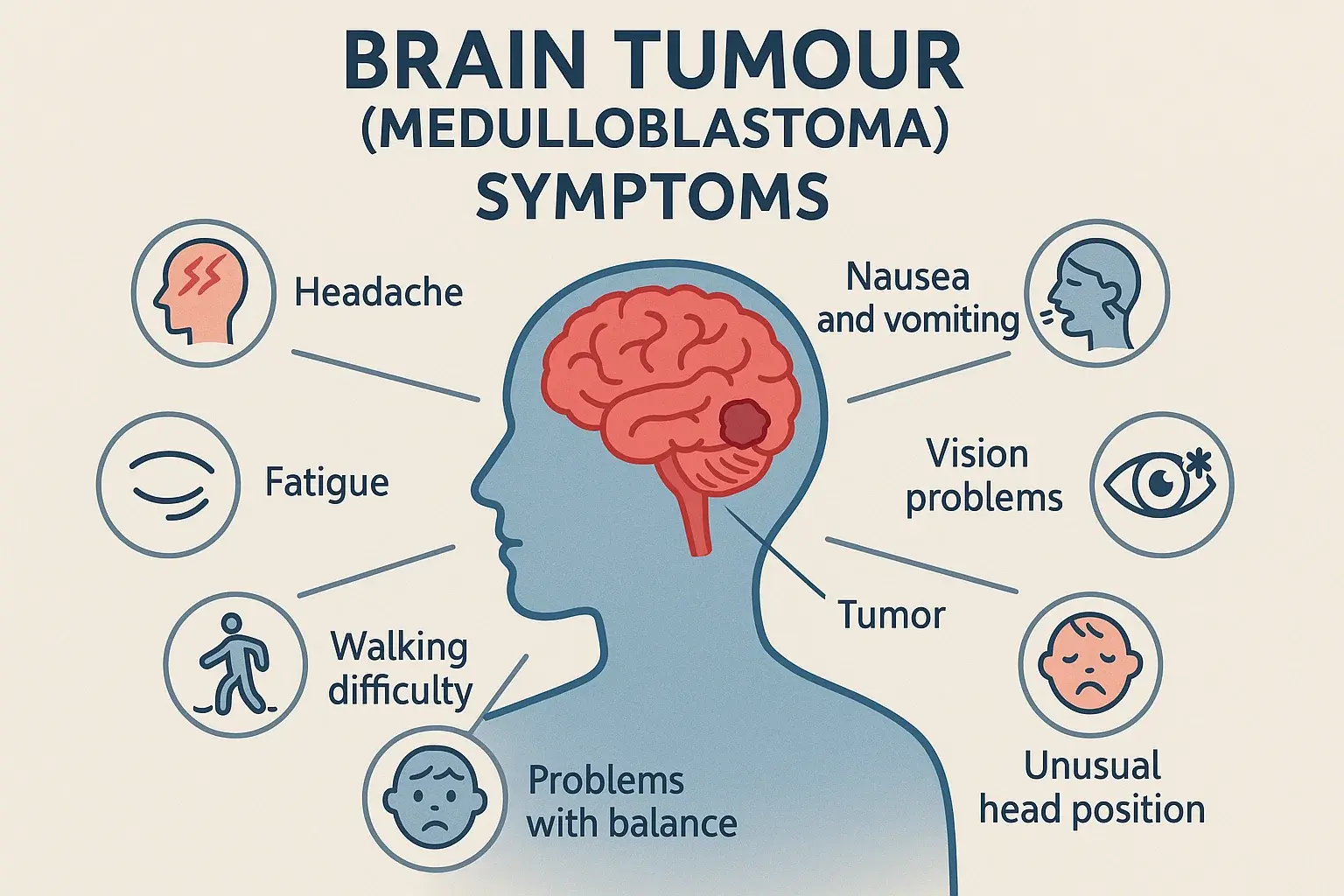
Medulloblastoma symptoms typically arise from increased pressure in the brain and interference with cerebellar functions like balance and coordination. These symptoms often develop quickly and are more common in children than adults. Early recognition is crucial for timely diagnosis and effective treatment in India, where pediatric neuro-oncology care is advanced and accessible. Here are the main points that will help in the recognition of medulloblastoma treatment in India:
Book Appointment
GET A FREE QUOTE
Brain Tumour or Medulloblastoma Symptoms
- Persistent headaches, especially in the morning
- Nausea and vomiting
- Difficulty with balance and walking
- Unsteady or clumsy movements
- Vision problems, such as double vision
- Fatigue or excessive sleepiness
- Irritability or behavioural changes in children
- Seizures (less common)
- Stiff neck or head tilt
- Swelling of the head in infants (due to hydrocephalus)
Success Rate of Medulloblastoma Treatment in India
Medulloblastoma treatment in India has shown significant advancements, with high success rates due to improved diagnostic tools, skilled neuro-oncology teams, and access to modern therapies. Early detection and a multidisciplinary treatment approach involving surgery, radiotherapy, and chemotherapy contribute to better outcomes.
Pediatric centres in India follow global protocols, offering personalised care plans that enhance survival and reduce recurrence. For standard-risk patients, especially children, the long-term survival rate can be quite promising, making India a trusted destination for affordable and quality care.
Book Appointment
GET A FREE QUOTE
- 70–85% survival rate for standard-risk patients
- 60–70% survival for high-risk cases
- Specialised pediatric neuro-oncology units available
- Affordable treatment compared to Western countries
- Access to advanced technologies like proton therapy
- Multilingual support and post-treatment rehabilitation
- High success rate in complete tumour resection surgeries
- India follows WHO-approved treatment protocols
Overall, medulloblastoma treatment in India offers a balance of quality, cost-effectiveness, and compassionate care. With growing infrastructure and experienced specialists, India provides hope to both domestic and international patients seeking advanced neuro-oncology treatment.
Medulloblastoma Treatment Side Effects
Medulloblastoma Treatment is designed according to the stage of the brain tumour. There are chances of recurring the whole disease if any stage is missing.
Medulloblastoma treatment in India involves surgery, radiation, and chemotherapy, all of which are essential for eliminating the tumour but may lead to side effects that vary based on the patient’s age, treatment intensity, and tumour location.
While Indian hospitals use advanced methods to minimise complications, side effects—both short- and long-term—can still occur. Pediatric patients are especially sensitive to neurocognitive and hormonal effects due to their developing brains. Understanding these potential issues helps families prepare for rehabilitation and supportive care post-treatment, which is widely available across top cancer centres in India.
- Fatigue and weakness following radiation or chemotherapy
- Hair loss during chemotherapy or cranial radiation
- Nausea and vomiting, especially during initial treatment cycles
- Balance and coordination issues due to cerebellar damage
- Cognitive changes such as memory loss or reduced attention span
- Hearing loss from platinum-based chemotherapy drugs
- Endocrine problems like growth hormone deficiency or thyroid issues
- Fertility issues in adolescent patients receiving radiation
- Increased risk of infections due to low immunity
- Emotional and behavioural changes, particularly in younger children
- Secondary cancers (rare but possible long-term side effects)
Medulloblastoma Treatment Cost
Medulloblastoma treatment cost in India is significantly more affordable compared to Western countries, without compromising on quality. The overall cost varies depending on the hospital, patient’s condition, treatment approach, and duration of care. Treatment usually involves a combination of surgery, chemotherapy, and radiation therapy, along with follow-up rehabilitation.
Book Appointment
GET A FREE QUOTE
Top hospitals in India offer advanced neuro-oncology care at transparent pricing, making it a preferred destination for international patients. Financial assistance and support services are also available at many leading centres to ease the burden for families.
|
Treatment Component |
Estimated Cost (INR) |
|
Neurosurgery (Tumour Removal) |
₹3,00,000 – ₹6,00,000 |
|
Chemotherapy (Full Cycle) |
₹2,00,000 – ₹4,00,000 |
|
Radiation Therapy |
₹1,50,000 – ₹3,00,000 |
|
Proton Therapy (if recommended) |
₹15,00,000 – ₹25,00,000 |
|
Hospital Stay & ICU |
₹50,000 – ₹1,50,000 |
|
MRI & Diagnostic Tests |
₹30,000 – ₹60,000 |
|
Follow-up & Rehabilitation |
₹20,000 – ₹50,000 |
Best Hospital For Brain Tumour Surgery
Best hospitals for brain tumour surgery in India offer world-class neurosurgical care with cutting-edge technology, expert neurosurgeons, and multidisciplinary teams. These hospitals specialise in complex brain tumour cases, including medulloblastoma, using advanced techniques like microsurgery, stereotactic surgery, and neuronavigation.
Many centres are accredited by NABH and JCI, ensuring international quality standards. Patients benefit from affordable treatment, high success rates, and personalised care. Whether you seek pediatric or adult neurosurgery, India provides some of the most trusted institutions for brain tumour surgery with excellent infrastructure and recovery support.
|
Hospital Name |
City |
|
All India Institute of Medical Sciences (AIIMS) |
New Delhi |
|
Tata Memorial Hospital |
Mumbai |
|
Apollo Hospitals |
Chennai |
|
Fortis Memorial Research Institute |
Gurugram |
|
Medanta – The Medicity |
Gurugram |
|
Christian Medical College (CMC) |
Vellore |
|
PGIMER |
Chandigarh |
|
Kokilaben Dhirubhai Ambani Hospital |
Mumbai |
|
Max Super Speciality Hospital |
Delhi |
|
NIMHANS |
Bengaluru |
|
BLK-Max Super Speciality Hospital |
New Delhi |
|
Artemis Hospital |
Gurugram |
|
Narayana Health City |
Bengaluru |
|
Manipal Hospital |
Bengaluru |
|
Sri Ramachandra Medical Centre |
Chennai |
Treatment Options For Medulloblastoma or Brain Tumour
Treatment for medulloblastoma or other brain tumours depends on the tumour’s size, location, spread, and the patient’s age. The main goal is to remove or destroy the tumour while preserving brain function. Treatment typically involves a multimodal approach including surgery, radiation, chemotherapy, and supportive therapies. India’s leading hospitals offer advanced technologies and specialised neuro-oncology teams to ensure comprehensive and effective care.
Book Appointment
GET A FREE QUOTE
Neurosurgery (Brain Tumour Removal)
Neurosurgery (Brain Tumour Removal)
Neurosurgery is often the first step in treating medulloblastoma or brain tumours. The goal is to safely remove as much of the tumour as possible. Modern techniques like neuronavigation, intraoperative MRI, and microsurgery enhance precision and minimise damage to surrounding tissue. In India, expert neurosurgeons perform these surgeries with high success rates, significantly improving survival outcomes and reducing neurological side effects in both children and adults.
Radiation Therapy
Radiation Therapy
Radiation therapy uses high-energy rays to target and kill cancer cells left after surgery. For medulloblastoma, craniospinal irradiation is often used due to the tumour’s tendency to spread via cerebrospinal fluid. Advanced methods like intensity-modulated radiation therapy (IMRT) and proton therapy, now available in India, allow for more targeted treatment with fewer side effects, especially important for children to protect their developing brains and reduce long-term complications.
Chemotherapy
Chemotherapy
Chemotherapy involves the use of anti-cancer drugs to destroy remaining tumour cells or prevent recurrence. It is especially important in treating high-risk or metastatic medulloblastoma. In India, chemotherapy regimens are tailored to each patient, with supportive care to manage side effects. Pediatric oncologists ensure that young patients receive age-appropriate doses, helping improve long-term outcomes while minimising toxicity to other developing organs and systems.
We Care Health Services For Medulloblastoma Treatment
We Care Health Services is one of the most trusted facilitators for medulloblastoma treatment in India, offering access to top hospitals, expert neurosurgeons, and personalised care plans. Their comprehensive support ensures timely diagnosis, advanced treatment options like surgery, radiation, and chemotherapy, and world-class recovery programs. With multilingual coordination, affordable packages, and 24/7 patient support, We Care bridges the gap between patients and India’s best neuro-oncology care. Their experience with both pediatric and adult medulloblastoma cases makes them a preferred choice for domestic and international patients.
Why Choose We Care Health Services for Medulloblastoma Treatment in India – Key Highlights
- Access to Top Hospitals:
Collaborates with India’s best neurosurgery and oncology centres like AIIMS, Apollo, Medanta, and Tata Memorial.
- Experienced Specialists:
Connects patients with leading pediatric and adult neuro-oncologists experienced in treating complex medulloblastoma cases.
- Personalised Treatment Plans:
Tailors care based on tumour type, risk level, and patient age for better outcomes.
- Advanced Technologies:
Facilitates treatment using microsurgery, proton therapy, and neuronavigation where needed.
- End-to-End Support:
Offers complete assistance from diagnosis to discharge and follow-up, including travel and visa help.
- Affordable Pricing: Ensures competitive treatment packages without compromising quality.
Frequently Asked Questions:
- WNT (Wingless): Best prognosis; rare metastasis; excellent response to treatment.
- SHH (Sonic Hedgehog): Intermediate prognosis; often seen in infants and adults.
- Group 3: Most aggressive; common in young children; often metastatic at diagnosis.
- Group 4: Most common type; variable prognosis; often involves spinal spread.