
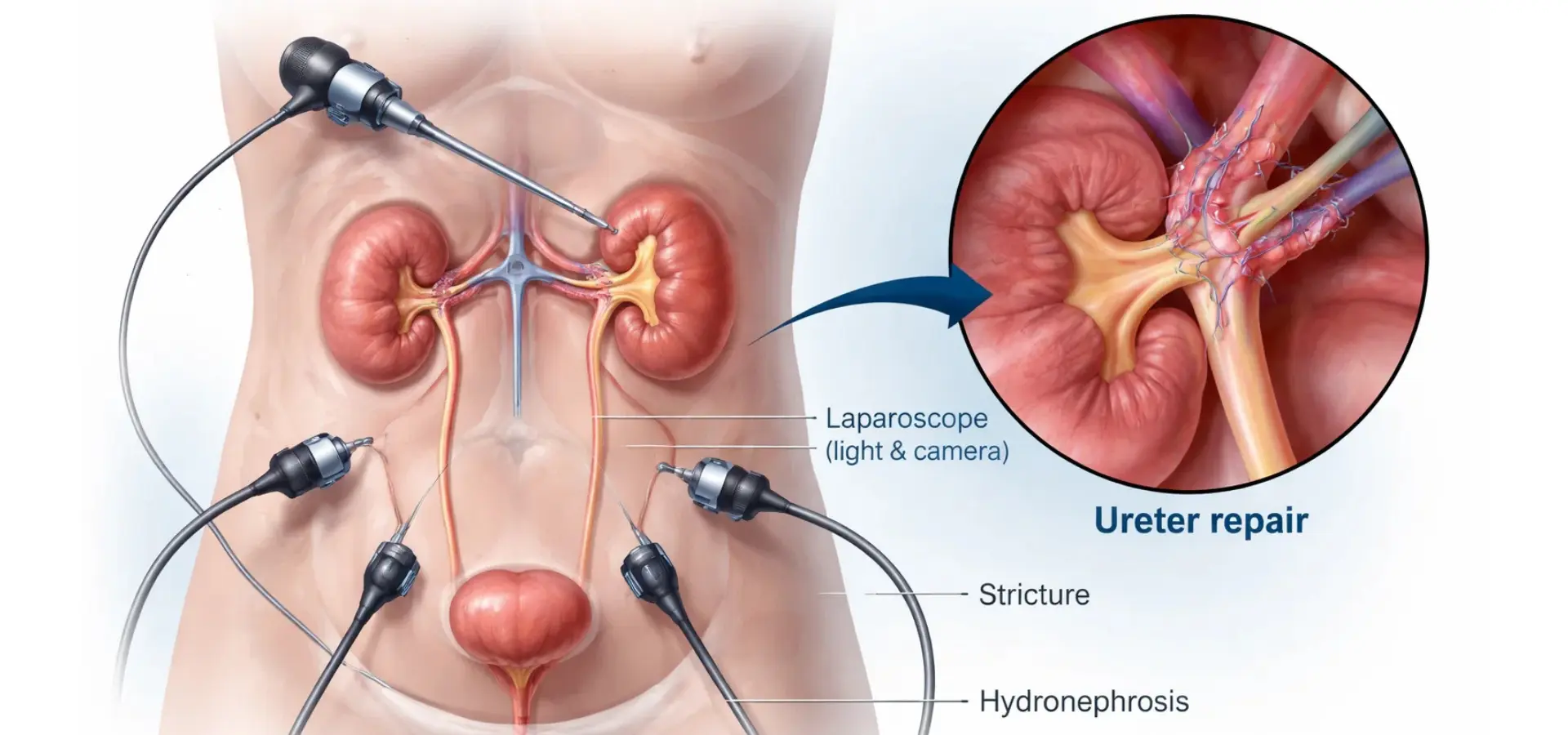
Laparoscopic pyeloplasty in India is available to patients from the following countries. The benefits are: low cost, the best doctors with technical surgery. This is a minimally invasive method of surgery without any damage to the organ, and clearing the blockage. Surgeons in India helping people with sudden issues in the kidney tract.
Generally, treatment is for the ureteropelvic junction obstruction, and it is removed with the help of laparoscopy which is a minimally invasive method of surgery. The success rate of this surgery is high, which is more than 90 per cent. The surgery offers less invasion, no blood loss, and faster recovery. Before performing this diagnosis procedure, it is performed with the help of abdominal ultrasound and MRI.
What is Laparoscopic Pyeloplasty?
The main function of this surgery is to remove an obstruction in the ureteropelvic kidney junction, where urine passes from the kidney to the urinary bladder. If you have developed an obstruction in the area where your kidney connects to your ureter (known as the ureteropelvic junction), a laparoscopic pyeloplasty can help correct this obstruction so that urine can flow from your kidney into your ureter without obstruction. Untreated obstructions may lead to pain, recurrent urinary tract infections, swelling of the kidney, and eventually gradual loss of function of the affected kidney (damage).
Consult Now
GET A FREE QUOTE
The laparoscopic pyeloplasty is performed through small incisions in the abdominal wall. For the actual operation, a camera and specialized instruments are used to remove the obstructed (narrow) section of the ureteropelvic junction. The healthy ends of your ureter (not blocked) will be reconnected so that urine will flow freely from the kidney into the ureter again. Many times, following your operation, a stent will be placed inside your ureter as a temporary measure to help support your healing process; it will be removed by your physician in a few weeks after your surgery.
Procedure of the Laparoscopic Pyeloplasty Surgery
If you have obstruction of the ureteropelvic junction (UPJ) which can be caused by congenital abnormalities like horseshoe kidney, fibrous scarring due to stone or previous operation, or if you have a blood vessel which may cause your ureteropelvic junction (UPJ) to kink or if you have a stone that gets impacted in the upper part of ureter, then you are an ideal candidate for Laparoscopic Pyeloplasty Surgery. The first part of the operation is to give you an anaesthetic (put you to sleep) so that you will not be aware of anything whilst the operation is being performed.
Understanding Ureteropelvic Junction Obstruction (UPJO)
UPJO happens at the spot where your kidney's pelvis meets the ureter. This narrow point can block urine. It leads to swelling in the kidney and pain over time.
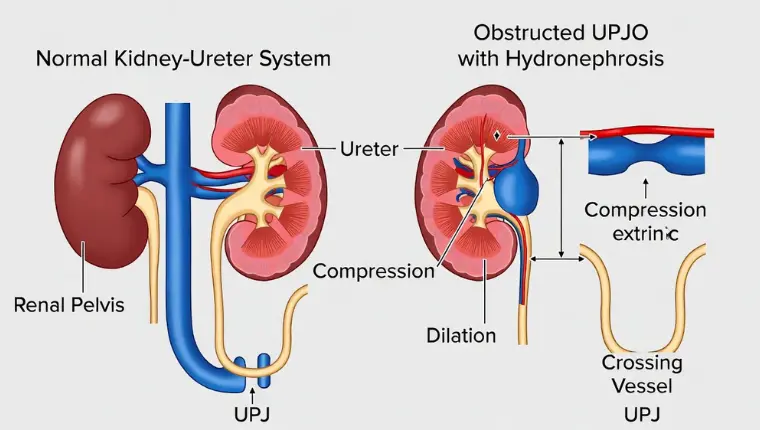
Understanding Ureteropelvic Junction Obstruction (UPJO)
What Causes UPJO?
The junction sits right below the kidney. Urine builds up if it's too tight. Most cases start at birth from faulty tissue growth. Crossing blood vessels can press on it too. Scars from stones or infections cause others later in life. Kids often face congenital types, while adults deal with secondary blocks.
Symptoms and Diagnosis
Flank pain comes first, sharp and sudden like kidney stones. You might get urinary tract infections that won't quit. Blood in urine shows up now and then. Poor kidney function sneaks in, causing fatigue. Doctors start with a renal ultrasound to spot swelling. CT urography gives clear images of the block. A DMSA scan checks kidney damage, and a Lasix renogram tests drainage speed. These tools help confirm UPJO fast.
Consult Now
GET A FREE QUOTE
Laparoscopic Pyeloplasty: The Minimally Invasive Technique
This surgery fixes the UPJ with small incisions. It beats open methods by cutting pain and scars. Patients bounce back quicker. The first part of the operation is to give you an anaesthetic (put you to sleep) so that you will not be aware of anything whilst the operation is being performed.
A tube (catheter) is placed into your bladder to allow urine to drain whilst you recover from your operation. The urine may have blood in it but this is normal and will clear in a day or two. The tube (catheter) will be removed once you are walking around, in a day or two. You may also have a wound drain in your stomach to drain away any blood. This will be removed when there is little or no fluid draining from it.
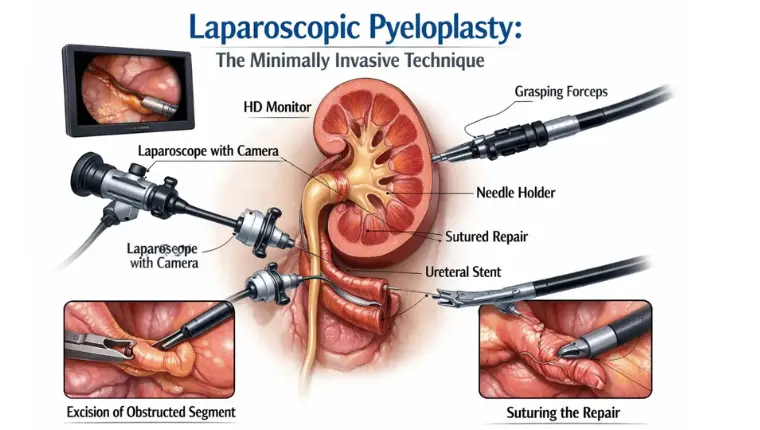
Laparoscopic Pyeloplasty The Minimally Invasive Technique
Laparoscopic Pyeloplasty Surgery in India
Indications and Candidate Selection for Laparoscopic Pyeloplasty Surgery makes sense when UPJO hurts your life. Watchful waiting works for mild cases. But action comes if things worsen. If you have obstruction of the ureteropelvic junction (UPJ) which can be caused by congenital abnormalities like horseshoe kidney, fibrous scarring due to stone or previous operation, or if you have a blood vessel which may cause your ureteropelvic junction (UPJ) to kink or if you have a stone that gets impacted in the upper part of ureter, then you are an ideal candidate for Laparoscopic pyeloplasty in India.
Consult Now
GET A FREE QUOTE
Absolute Criteria for Surgical Intervention
Go for it if hydronephrosis grows on scans. Bad pain that meds can't touch calls for repair. If one kidney loses over 20% function, act soon. Failed past treatments push for this too. Complex setups, like odd vessel paths, fit laparoscopy well. It shines after open surgery flops.
Contraindications and Special Considerations
Heavy scars from old operations make it tough. Extra weight can limit tool reach. Active infections delay the cut. In those spots, open surgery might win. For high-risk folks, place a stent first to drain the kidney. This eases swelling before the main fix. Talk to your doc about your build and history.
Success Rates and Long-Term Outcomes
Laparoscopic pyeloplasty hits high marks. Most patients see full relief. Studies back its strong track record. The success rate of the surgery is measured in terms of the survival of the patients after the surgery and checking for the obstruction. There are different scenarios in every case; most of the time, surgery is successful upto 90%.
Quantifying Surgical Efficacy
Success tops 90% to 95% in skilled hands. That means no block returns and pain fades. Good stitching and vessel moves boost results. Follow-ups show kidneys drain better in nine out of ten cases. Long-term data from the American Urological Association notes durable fixes last for decades. Factors like low tension at the joint keep it solid.
Identifying and Managing Failure
Failure looks like pain in the back or new swelling. Restenosis clogs it again in under 5% of tries. Spot it with ultrasound or renogram. First, try an endoscopy to slice the scar. If that skips, redo the surgery open or by scope. The AUA journal states, "With expert care, repeat rates stay low under 10%." Quick catch prevents kidney harm.
Comprehensive Post-Operative Recovery Protocol
Recovery starts in the hospital. It builds to a normal life at home. Follow the steps to heal smooth. Although this procedure has proven to be very safe, as in any surgical procedure, there are risks and potential complications. The safety and complication rates are similar when compared to the open surgery.
Immediate Post-Surgical Management (Hospital Stay)
You wake up with mild belly pain. Docs use pills and shots for relief. A mix of drugs cuts opioid need. Watch urine output and any drainage fluid. Blood tests check kidney function. Most leave in two to three days. Stent removal happens four to six weeks out, often painlessly in the office.
At-Home Rehabilitation and Restrictions (Weeks 1-6)
Rest easy the first week. No heavy lifts over ten pounds. Walk short bits to stir blood flow. Back to desk work in two weeks. Skip sports till month two. Clean cuts daily with soap and water. Watch for leaks or fever, signs of trouble. Drink plenty to flush the stent.
- Week 1: Light walks, no driving.
- Weeks 2-4: Ease into chores, see doc for check.
- Weeks 5-6: Ramp up activity, but test with doc.
Long-Term Follow-Up and Surveillance
See your surgeon at one month. Ultrasound at three and six months tracks flow. Yearly scans if needed. Blood work spots late issues. Most feel great by year one. Guidelines say watch for strict signs like pain. Early checks catch problems fast.
Consult Now
GET A FREE QUOTE
Guidance from We Care Health Services: Common Symptoms and Initial Assessment
We Care Health Services is the best option for surgery and treatment in India. Flank pain hits hard with UPJO, often after you drink lots of fluids. Blood in your urine, or hematuria, shows up too. Recurrent urinary tract infections add to the trouble. A urologist starts with your medical history. They ask about past pains or family kidney issues. Then comes a physical exam to check for swelling or tenderness. You can say that We Care Health Services is Best Hospital for Pyeloplasty Laparoscopy. Watch for these warning signs that demand quick doctor visits:
- Suddenly, severe side pain that spreads to your back.
- Fever with chills from an infection.
- Nausea or vomiting tied to the ache.
- Urine that looks pink or red.
Catching these early helps avoid kidney damage. Many people ignore mild symptoms at first. Don't wait—get checked soon.
Essential Imaging Studies for Definitive Diagnosis: What We Offer
Ultrasound tops the list for spotting UPJO. It shows hydronephrosis, where your kidney swells from backed-up urine. This quick scan uses sound waves; no radiation is involved. In about 80% of cases, imaging uncovers the blockage's shape.
For some, an intravenous pyelogram, or IVP, gives more details. Dye goes into your vein, and X-rays track urine flow. Doctors use it less now, but it helps in tough spots. These tools confirm the narrow spot at the ureteropelvic junction. We offer our best services in the form of diagnosis procedure and our staff will be available to assist you in every procedure.
Functional Assessment: The Role of Diuretic Renography (MAG3 Scan)
Anatomy alone isn't enough—you need to check how well the kidney works. That's where the MAG3 scan steps in. It measures drainage after a diuretic pushes urine out. The T1/2 time shows if blockage slows things down past 20 minutes.
You lie still for the scan, which takes about an hour. A camera tracks the radioactive tracer. This test decides if surgery fixes the issue or if you can watch and wait.
Laparoscopic Pyeloplasty in India
Pyeloplasty removes the blocked part and reconnects the ureter to the kidney. It's the main fix for UPJO surgery. Success rates hit 95% in skilled hands. Open pyeloplasty suits complex cases, like kids or twisted anatomy. Surgeons make a cut on your side. It takes longer to heal, but it works well.
Consult Now
GET A FREE QUOTE
Laparoscopic or robotic pyeloplasty cuts recovery time. Tiny tools go through small incisions. Robots give steady views, like a video game, with precision. Most adults pick this now—back to work in weeks, not months. Picture rebuilding a kink in a garden hose. That's pyeloplasty in action. Your surgeon chooses based on your build and the blockage's spot.
Here's a quick checklist to prep:
- Stop blood thinners a week ahead, per your doctor's okay.
- Fast from midnight before the op—no food or drink.
- Arrange a ride home; you'll feel groggy.
- Pack loose clothes for comfort post-surgery.
Stay hydrated until fasting starts. This cuts infection odds. Your team reviews allergies and meds one last time.
Cost of Laparoscopic Pyeloplasty
Surgeon fees for pyeloplasty range $5,000-$10,000, tied to time and skill. Hospital bills cover the OR at $2,000-$5,000 per hour. Anesthesia adds $1,000-$2,000. Robotic setups cost more upfront but save on stays. Total for laparoscopic runs $15,000-$25,000 without insurance. Open might hit $20,000-$30,000. These vary by location—urban spots charge higher. Always ask for itemized bills.
Stents run $500-$1,500 each, plus placement fees. Post-op ultrasounds cost $200-$500. Pathology on removed tissue adds $300-$800. Don't forget pre-op MAG3 scans at $1,000-$2,000. Follow-up cystoscopies for stent removal? Another $1,000. These extras pile up fast. Plan for them in your budget. Insurance covers most, but deductibles hit $1,000-$5,000. Co-pays for surgery could be 20%. Out-of-pocket max caps yearly spends.
Conclusion
Laparoscopic pyeloplasty fixes UPJO with a top success rate over 90%. It suits many with pain, infections, or kidney risks. Recovery runs quickly, from hospital to home in steps. You gain less pain and a faster life return. Skilled teams make outcomes shine long-term. If UPJO bugs you, chat with a urologist soon. This surgery could set you free.
UPJO surgery starts with a solid diagnosis—symptoms lead to an ultrasound, and MAG3 scans for proof. Pyeloplasty, often robotic, clears the block with high success. Hospital stays run short for minimally invasive paths, easing back to life. Costs break into surgeon fees, facility charges, and extras like stents—plan with insurance details and estimates. Recovery means pain management and follow-ups to spot issues.