
Conventional LASIK Surgery in India is a treatment that is based on the focal length or lens prescription of the patient. This type of treatment is good for most patients as it includes a personalised approach. There are visual aberrations too, like halos, blurred light vision, glare, etc. If the success rate of the surgery is high, then it will be a more supportive way for the patient.
The full name of LASIK is Laser-Assisted In-Situ Keratomileusis. It is a minimally invasive method. It is not an ideal treatment for people with a thin cornea. A laser is used to correct vision problems such as hypermetropia or myopia. People with a thin cornea get blurred vision after surgery and may get halos.
What is Conventional LASIK?
Conventional LASIK (Laser-Assisted In Situ Keratomileusis) is a standard form of laser eye surgery used to correct refractive errors like nearsightedness (myopia), farsightedness (hyperopia), and astigmatism. It involves reshaping the cornea to help light focus correctly on the retina, improving vision.
For Free Online Consultation
GET A FREE QUOTE
In this procedure, a corneal flap is created using a microkeratome blade or laser. The surgeon then uses an excimer laser to reshape the inner layers of the cornea based on a fixed, average correction profile. The flap is then placed back in position.
Unlike advanced LASIK techniques, conventional LASIK does not customize treatment based on the patient’s unique corneal irregularities. It is effective, fast, and affordable, making it a popular choice for basic vision correction.
Conventional LASIK Surgery in India-Overview
Conventional LASIK Eye Surgery in India is a widely performed and cost-effective procedure to correct vision problems such as myopia, hyperopia, and astigmatism. It involves creating a thin corneal flap and reshaping the underlying corneal tissue using an excimer laser, based on standard vision correction profiles. Unlike customised LASIK, it does not address higher-order aberrations or individual eye irregularities but still delivers excellent results for many patients. The procedure is quick, painless, and offers rapid recovery with minimal downtime.
India is known for its advanced eye care infrastructure, skilled surgeons, and affordable pricing, making Conventional LASIK surgery in India a popular choice for both domestic and international patients seeking safe, effective vision correction.
The success rate of the conventional LASIK Surgery is also high, and is based on the treatment system of glasses removal. There are cosmetic reasons also for removing lenses, so it is widely accepted as a treatment.
Why do people need LASIK surgery?
People opt for LASIK surgery to correct refractive errors that cause blurry vision. These include myopia (nearsightedness), hyperopia (farsightedness), and astigmatism. These conditions occur when the eye's shape prevents light from focusing directly on the retina.
LASIK reshapes the cornea to improve focus and reduce dependency on glasses or contact lenses. Conventional LASIK surgery in India is particularly popular due to its affordability, fast recovery, and high success rate, making it a reliable solution for individuals seeking clear, unaided vision.
- Corrects myopia, hyperopia, and astigmatism
- The procedure is quick and causes minimal discomfort
- Most patients see clearly within one to two days
- Short recovery time; daily activities can resume quickly
- Reduces or eliminates the need for glasses or contact lenses
- Affordable in India compared to many other countries
- Available at leading hospitals with experienced eye surgeons
- Uses advanced laser technology for precise correction
- Suitable for people with stable vision over the past year
- Long-lasting results with high success rates
- Minimal follow-up care is needed in most cases
- Common and well-established procedure across India
- Enhances quality of life by offering visual independence
- Safe for eligible candidates after proper screening
Types of LASIK Surgery in India
Conventional LASIK surgery is the most basic and widely used form of LASIK in India. It is designed to correct common refractive errors like myopia (nearsightedness), hyperopia (farsightedness), and astigmatism.
For Free Online Consultation
GET A FREE QUOTE
In this procedure, a thin flap is created on the cornea using a microkeratome blade or laser. Then, an excimer laser reshapes the cornea based on the patient's eyeglass prescription. The flap is repositioned, and the eye heals naturally without stitches.
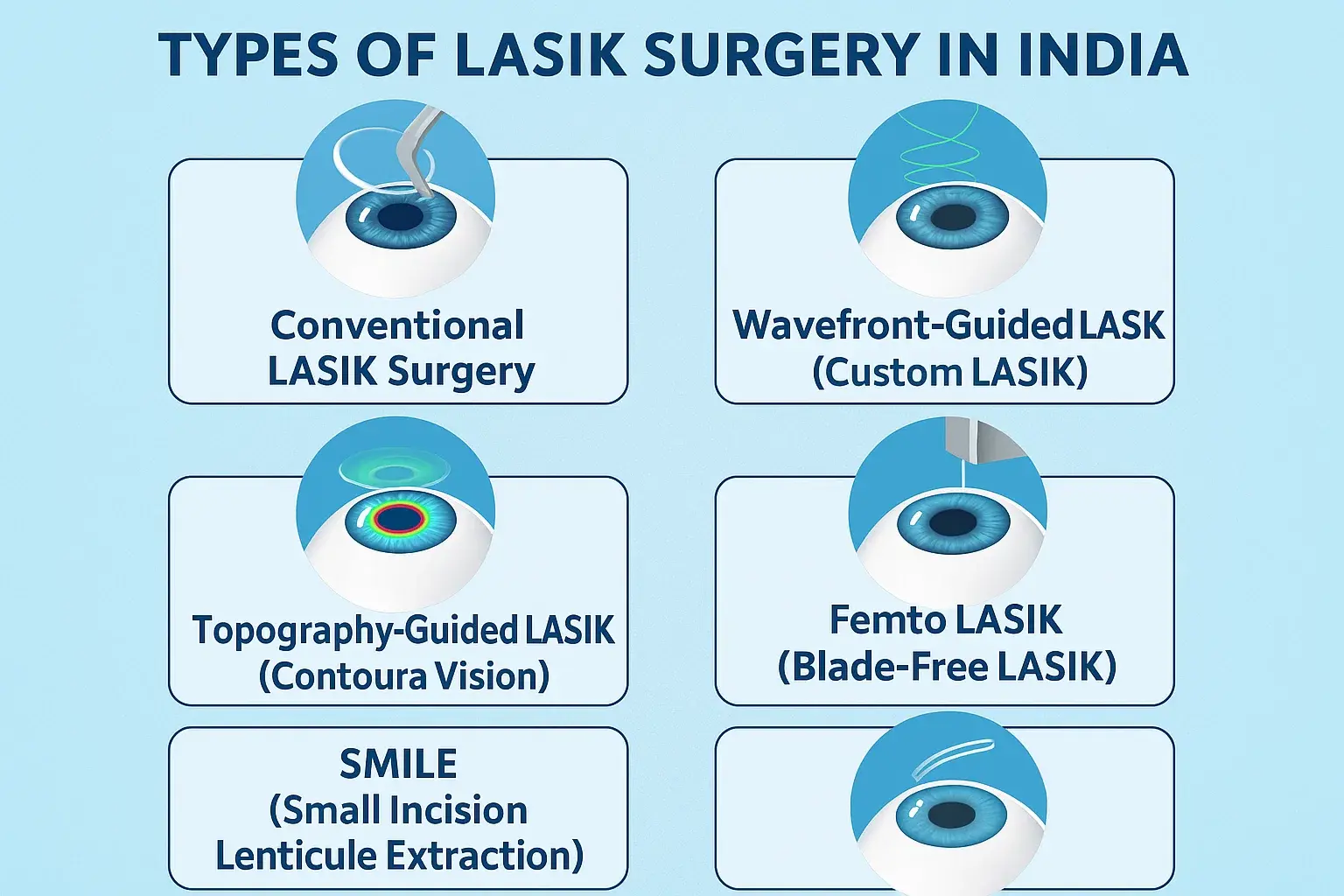
Types of LASIK Surgery in India
Conventional LASIK Surgery
- What it is: The most basic form of LASIK using a fixed treatment pattern based on your glasses prescription.
- Technology: Microkeratome blade or femtosecond laser to create a flap, followed by excimer laser ablation.
- Best for: People with standard, stable prescriptions and no major corneal abnormalities.
- Advantages: Affordable, fast, effective.
- Limitations: Does not correct higher-order aberrations (night glare, halos).
- Cost in India: ₹25,000 – ₹50,000 per eye
Wavefront-Guided LASIK (Custom LASIK)
- What it is: A personalised procedure based on the unique way light travels through your eye.
- Technology: Wavefront analyser maps eye imperfections; laser treatment is customised.
- Best for: People with irregular corneas or high-quality vision needs.
- Advantages: Improves contrast sensitivity, reduces glare and halos.
- Limitations: More expensive than conventional LASIK.
- Cost in India: ₹40,000 – ₹70,000 per eye
Topography-Guided LASIK (Contoura Vision)
- What it is: Uses corneal topography to create a highly detailed map and reshape the cornea precisely.
- Technology: Advanced mapping of over 20,000 corneal points.
- Best for: Patients with irregular corneal surfaces or previous corneal surgeries.
- Advantages: Offers sharper, more natural vision; FDA-approved.
- Limitations: Limited to certain corneal conditions.
- Cost in India: ₹45,000 – ₹85,000 per eye
Femto LASIK (Blade-Free LASIK)
- What it is: A fully laser-based procedure where both flap creation and corneal reshaping are done by lasers.
- Technology: Femtosecond laser (for flap) + excimer laser (for correction).
- Best for: Patients worried about blade use or with thinner corneas.
- Advantages: Greater precision, safer for sensitive eyes.
- Limitations: Higher cost than conventional LASIK.
- Cost in India: ₹60,000 – ₹90,000 per eye
SMILE (Small Incision Lenticule Extraction)
- What it is: A flapless, minimally invasive laser eye surgery suitable mainly for myopia and mild astigmatism.
- Technology: A Femtosecond laser creates and removes a tiny disc (lenticule) inside the cornea.
- Best for: People with dry eyes, active lifestyles, or thin corneas.
- Advantages: No flap, less dry eye risk, quicker recovery.
- Limitations: Not suitable for farsightedness.
- Cost in India: ₹70,000 – ₹1,00,000 per eye
How much does LASIK cost in India?
The cost of LASIK surgery in India varies based on the type of procedure, technology used, and the hospital’s location and reputation. Basic Conventional LASIK is the most affordable, while advanced techniques like SMILE and Contoura Vision are more expensive due to higher precision and customization.
Prices typically range from ₹25,000 to ₹1,00,000 per eye. Despite the variation, LASIK in India remains one of the most cost-effective options globally, with high success rates and quality care provided by experienced ophthalmologists at leading eye centers.
|
Type of LASIK Surgery |
Estimated Cost (INR) |
|
Conventional LASIK |
₹25,000 – ₹50,000 |
|
Wavefront-Guided LASIK |
₹40,000 – ₹70,000 |
|
Topography-Guided LASIK |
₹45,000 – ₹85,000 |
|
Femto LASIK (Blade-Free) |
₹60,000 – ₹90,000 |
|
SMILE Surgery |
₹70,000 – ₹1,00,000 |
Top 10 LASIK Surgery Hospitals in India
India is home to many advanced eye hospitals offering world-class LASIK surgery with experienced ophthalmologists and cutting-edge technology. These hospitals provide various LASIK types, including conventional, wavefront-guided, Contoura Vision, and SMILE, at affordable prices. Patients from across the country and abroad choose India for its high-quality care, safety, and success rates.
For Free Online Consultation
GET A FREE QUOTE
Leading centers like LV Prasad Eye Institute, Aravind Eye Hospital, and Narayana Nethralaya are renowned for excellence in refractive surgery. These hospitals combine precision, expertise, and technology, making them top choices for safe and effective LASIK surgery in India.
|
Hospital Name |
Location |
|
LV Prasad Eye Institute |
Hyderabad |
|
Aravind Eye Hospital |
Madurai (and branches) |
|
Sankara Nethralaya |
Chennai |
|
Shroff Eye Centre |
New Delhi |
|
Centre for Sight |
Multiple Cities |
|
Narayana Nethralaya |
Bangalore |
|
Dr. Agarwal’s Eye Hospital |
Chennai (and branches) |
|
Nethradhama Super Speciality Eye Hospital |
Bangalore |
|
Maxivision Eye Hospitals |
Hyderabad (and others) |
|
Eye7 Chaudhary Eye Centre |
New Delhi |
We Care Health Services for Conventional LASIK Surgery in India
We Care Health Services is a trusted medical facilitation company that connects patients with top eye hospitals and specialists for Conventional LASIK surgery in India. With a strong network of accredited hospitals across major Indian cities, We Care ensures that patients receive high-quality, affordable, and safe laser eye treatment tailored to their needs.
- Access to top LASIK hospitals and eye surgeons in India
- Affordable treatment packages with transparent pricing
- Personalized medical support before, during, and after surgery
- Assistance with travel, visas, and accommodation for international patients
- Use of proven technologies and standard surgical protocols
- Quick appointment scheduling and minimal waiting time
- Pre-surgery evaluation to determine LASIK suitability
- End-to-end coordination for a seamless medical journey
- High success rate with minimal recovery time
- Trusted by patients from over 20 countries
Conventional LASIK surgery in India is a widely performed vision correction procedure that reshapes the cornea to treat refractive errors such as nearsightedness, farsightedness, and astigmatism. We Care collaborates with reputed eye surgeons who use FDA-approved technology and follow global safety standards to deliver excellent outcomes.
For Free Online Consultation
GET A FREE QUOTE
Through personalized assistance, We Care guides patients from the initial consultation to post-operative care, ensuring a smooth and stress-free experience for both domestic and international patients.