

Deep Anterior Lamellar Keratoplasty (DALK) is an advanced corneal transplant surgery that replaces only the front layers of the cornea, preserving the patient’s healthy Descemet’s membrane and endothelium. It is primarily performed to treat corneal conditions like keratoconus, corneal scarring, or stromal dystrophies, where the deeper layers of the cornea remain unaffected.
By retaining the innermost corneal layers, DALK significantly reduces the risk of graft rejection and improves long-term outcomes. This procedure offers faster recovery and better structural integrity compared to full-thickness transplants, making it a preferred option for suitable candidates with non-endothelial corneal disorders.
What is deep anterior lamellar keratoplasty?
Deep Anterior Lamellar Keratoplasty (DALK) is a partial-thickness corneal transplant surgery that replaces the diseased front layers of the cornea while preserving the patient’s healthy Descemet’s membrane and endothelium. Unlike full-thickness corneal transplants (penetrating keratoplasty), DALK targets only the stromal layer, making it ideal for conditions like keratoconus, corneal scars, or stromal dystrophies where the deeper layers are unaffected.
For Free Online Consultation
GET A FREE QUOTE
This technique reduces the risk of endothelial rejection, a common complication in full transplants. DALK offers improved graft survival, fewer complications, and better structural integrity of the eye. The procedure is more technically demanding but provides long-term visual and safety benefits for patients with superficial or mid-stromal corneal diseases while maintaining the eye's natural inner layers.
Deep Anterior Lamellar Keratoplasty Surgery Indications
DALK is primarily indicated for corneal diseases that affect the anterior layers while preserving the endothelium. It is commonly used to treat keratoconus, corneal stromal scars, and certain dystrophies such as granular or lattice corneal dystrophy. Patients with healthy endothelium but impaired stroma benefit the most. DALK avoids complications related to endothelial rejection seen in full-thickness transplants. This surgery is also indicated in cases of anterior corneal opacities due to trauma or infection, provided Descemet’s membrane and endothelium are intact and functioning well.
DALK Surgery Indications
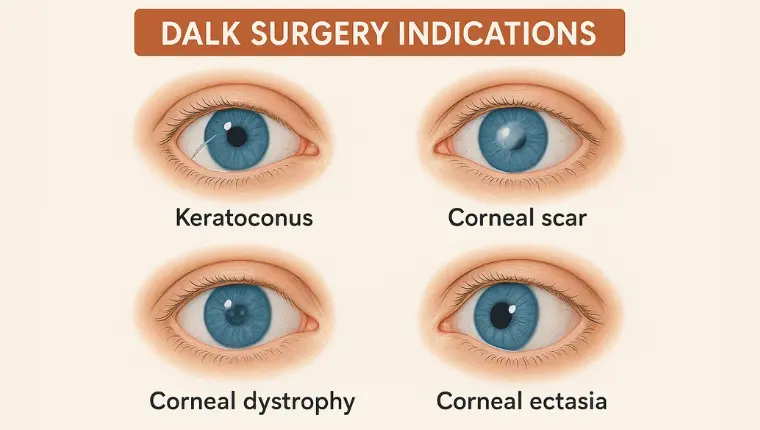
DALK Surgery Indications
- Keratoconus: Especially in advanced stages where the corneal shape is significantly distorted, but the endothelium is functional.
- Corneal stromal scars: Resulting from trauma, infections, or post-surgical haze, where the posterior layers are unaffected.
- Corneal dystrophies, Such as granular, lattice, or macular dystrophies, that affect the anterior stromal layers.
- Post-infectious opacities: Where scarring is limited to the front layers of the cornea.
- Anterior corneal degeneration: In conditions like Salzmann's nodular degeneration, with intact endothelium.
- Iatrogenic causes: Scarring or thinning post-refractive surgery, like radial keratotomy.
- No endothelial dysfunction: Ideal when the Descemet’s membrane and endothelium are healthy, eliminating the risk of rejection and preserving visual quality.
In Which Conditions Can DALK Be Performed?
DALK is ideal when Descemet’s membrane and endothelium are healthy, preserving natural corneal function and minimising graft rejection risks.
Deep Anterior Lamellar Keratoplasty (DALK) is suitable for conditions affecting the front layers of the cornea with a healthy endothelium. Common indications include keratoconus, corneal stromal scars, anterior corneal dystrophies (like granular or lattice), Salzmann’s nodular degeneration, and post-infectious opacities. It is also used in pellucid marginal degeneration and post-refractive surgery ectasia when the endothelium remains intact.
- Keratoconus – Most common indication: progressive thinning and bulging of the cornea with healthy endothelium.
- Corneal Stromal Scars – Due to trauma, previous infections (like herpes simplex or bacterial keratitis), or chemical injuries, when the endothelium is unaffected.
- Granular dystrophy
- Lattice dystrophy
- Macular corneal dystrophy (early stages)
- Salzmann’s Nodular Degeneration – When nodules distort vision but endothelial function remains intact.
- Terrien’s Marginal Degeneration – Thinning and opacification of the peripheral cornea.
- Post-LASIK or Post-RK Ectasia – Iatrogenic corneal weakening after refractive surgery.
- Pellucid Marginal Degeneration – Thinning of the inferior cornea, similar to keratoconus.
- Post-keratitis Opacities occur after the resolution of infections like Acanthamoeba or fungal keratitis.
- Anterior Corneal Tumours (Benign) – When located in superficial layers and not involving the endothelium.
For Free Online Consultation
GET A FREE QUOTE
Complications After DALK Surgery
Though safer than full-thickness transplants, DALK surgery can still have complications. These include perforation of Descemet’s membrane during surgery, interface haze, graft rejection (rare), infection, astigmatism, and delayed visual recovery. Intraoperative issues may require conversion to penetrating keratoplasty. Proper surgical technique and post-operative care are essential to minimise risks and ensure optimal visual outcomes.
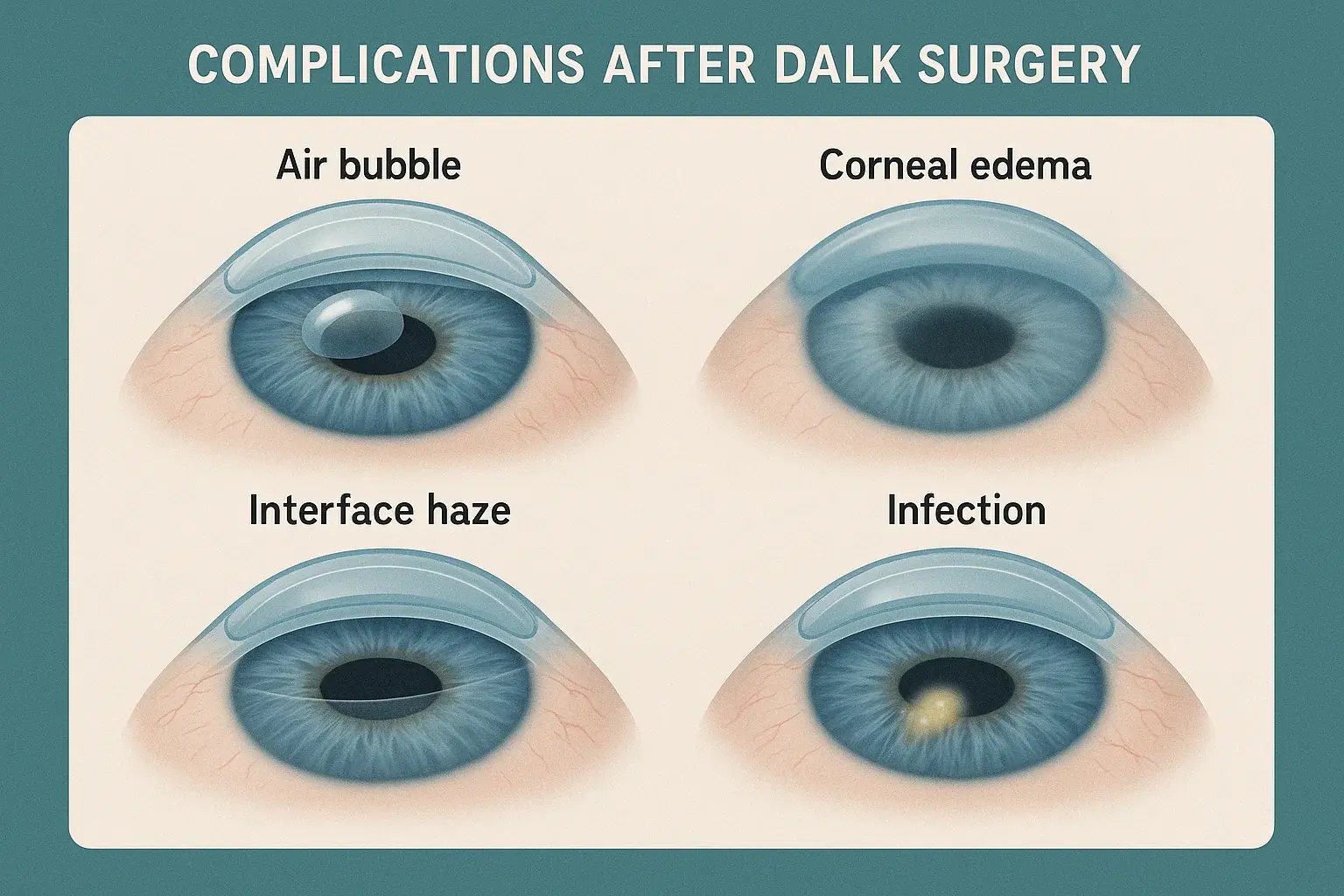
Complications After DALK Surgery
- Descemet’s Membrane Perforation: Most common intraoperative complication; may lead to conversion to full-thickness keratoplasty.
- Interface Haze or Scarring: Can reduce visual clarity due to irregular healing between donor and host tissue.
- Graft Rejection: Rare, since the host endothelium is preserved, but stromal rejection can still occur.
- Infection: Risk of microbial keratitis if asepsis is not maintained.
- High Postoperative Astigmatism: Irregular corneal surface may lead to distorted vision.
- Suture-related Problems: Can include vascularisation, irritation, or suture loosening.
- Epithelial Healing Delay: Slower corneal healing may occur in some patients.
- Descemet’s Detachment: Fluid may collect in the interface, affecting vision.
- Delayed Visual Rehabilitation: Takes longer compared to other corneal procedures.
Step-Wise Deep Lamellar Keratoplasty Surgery in India
Deep Anterior Lamellar Keratoplasty (DALK) involves replacing the diseased anterior corneal stroma while preserving the healthy Descemet’s membrane and endothelium. The procedure includes trephination, stromal dissection, exposure of Descemet’s membrane, donor tissue preparation (without endothelium), graft placement, and suturing. This technique reduces the risk of endothelial rejection and ensures better long-term graft survival and visual outcomes.
- Anaesthesia: Performed under local or general anaesthesia, depending on patient and surgeon preference.
- Trephination: A partial-thickness trephination (circular incision) is made on the recipient cornea to define the area of diseased cornea to be removed.
- Layer-by-Layer Stromal Dissection: The anterior stromal layers are carefully dissected down toward Descemet’s membrane using manual, viscoelastic, or pneumatic (big bubble) techniques.
- Descemet’s Membrane Exposure: Either full exposure or near-exposure of Descemet’s membrane is achieved without damaging it.
- Donor Tissue Preparation: A donor corneal button is prepared with the endothelium and Descemet’s membrane removed, leaving only healthy stroma.
- Graft Placement: The donor graft is placed over the recipient bed, matched for size and shape.
- Suturing: The graft is secured using interrupted or continuous 10-0 nylon sutures for positioning.
- Postoperative Care: Antibiotics, steroids, and lubricants are prescribed. Sutures may be selectively removed over time based on healing and astigmatism.
Cost of Deep Anterior Lamellar Keratoplsty
The cost of Deep Anterior Lamellar Keratoplasty (DALK) in India typically ranges between ₹40,000 to ₹1,20,000, depending on the hospital, surgeon’s expertise, city, and quality of donor tissue. Premium eye care centres or metro-city hospitals may charge higher due to advanced equipment and experienced corneal surgeons.
For Free Online Consultation
GET A FREE QUOTE
Additional costs may include pre-surgery evaluations, medications, post-operative follow-ups, and diagnostic tests. Government or charitable hospitals may offer DALK at subsidised rates. Patients should inquire about package inclusions to avoid unexpected expenses and ensure comprehensive post-surgical care.
|
Facility Type |
Estimated Cost (INR) |
|
Government Hospitals |
₹20,000 – ₹40,000 |
|
Charitable Trust Hospitals |
₹30,000 – ₹50,000 |
|
Private Hospitals (Tier 2 cities) |
₹50,000 – ₹80,000 |
|
Premium Private Hospitals |
₹80,000 – ₹1,20,000+ |
|
Additional Costs (medicines/tests) |
₹5,000 – ₹15,000 |
Hospitals for Deep Anterior Lamellar Keratoplsty
Several reputed eye hospitals in India offer advanced corneal surgeries like Deep Anterior Lamellar Keratoplasty (DALK), using state-of-the-art technology and experienced corneal specialists. These centres provide high success rates, quality donor tissues, and excellent post-operative care.
Most top-tier hospitals are equipped with lamellar surgery setups and eye banks, ensuring faster procedures and better visual outcomes. Cities like Chennai, Delhi, Hyderabad, and Mumbai are known for leading eye care institutions. Many of these hospitals also support international patients and offer affordable DALK surgery packages.
|
Hospital Name |
Location |
|
LV Prasad Eye Institute |
Hyderabad, Bhubaneswar, Vijayawada |
|
Sankara Nethralaya |
Chennai |
|
Aravind Eye Hospital |
Madurai, Coimbatore, Chennai |
|
Dr. Shroff’s Charity Eye Hospital |
Delhi |
|
Centre for Sight |
Multiple Cities (Pan India) |
|
AIIMS (Dr. R.P. Centre for Ophthalmic Sciences) |
New Delhi |
|
Narayana Nethralaya |
Bangalore |
|
Netrajyoti Eye Hospital |
Kolkata |
|
Dr. Agarwal’s Eye Hospital |
Multiple Cities |
|
Shankara Eye Hospital |
Bangalore, Coimbatore |
|
Vasan Eye Care |
Multiple Cities |
|
Fortis Memorial Research Institute (FMRI) |
Gurgaon |
|
Max Healthcare |
Delhi NCR |
|
Apollo Hospitals |
Chennai, Hyderabad, Delhi |
|
Disha Eye Hospitals |
Kolkata |
|
Ask ChatGPT |
We Care Health Services for Deep Lemellar Keratoplasty Surgery in India
We Care Health Services, a medical tourism company in India, provides Deep Anterior Lamellar Keratoplasty (DALK) through its network of hospitals in major cities such as Delhi, Mumbai, Bangalore, Chennai, and Hyderabad. Their approach includes comprehensive patient care, advanced diagnostic workup, and skilled corneal transplant surgeries, including partial-thickness grafts (like DALK) and full-thickness procedures when needed. They emphasise affordability, high-quality donor tissue, and favourable success rates, positioning themselves as a trusted option for international and domestic patients seeking corneal restoration.
For Free Online Consultation
GET A FREE QUOTE
- Trusted Hospital Network: Ties with renowned eye care hospitals in Delhi, Mumbai, Bangalore, Chennai, and Hyderabad offering high-quality DALK procedures.
- Specialist Surgeons: Access to experienced cornea surgeons skilled in lamellar techniques that preserve the eye’s natural endothelium.
- Affordable Surgery Packages: Offers cost-effective options without compromising on care, often covering surgery, medications, and follow-ups.
- Complete Patient Support: Helps with medical consultations, hospital bookings, and post-operative follow-up plans tailored to individual recovery.
- Support for International Patients: Includes help with visas, airport transfers, accommodation, and local coordination for overseas patients.
- Pre- and Post-Surgical Care: Ensures all necessary diagnostics, donor tissue arrangements, and healing plans are included.
- Minimally Invasive Procedure: DALK is provided through precise techniques that reduce rejection risks and improve long-term success.
- High Success Rates: Especially effective for keratoconus and anterior corneal scars, offering patients clear vision with lower complication risks.
- Transparent Process: Clear communication on costs, recovery expectations, and patient responsibilities, building trust and confidence.