
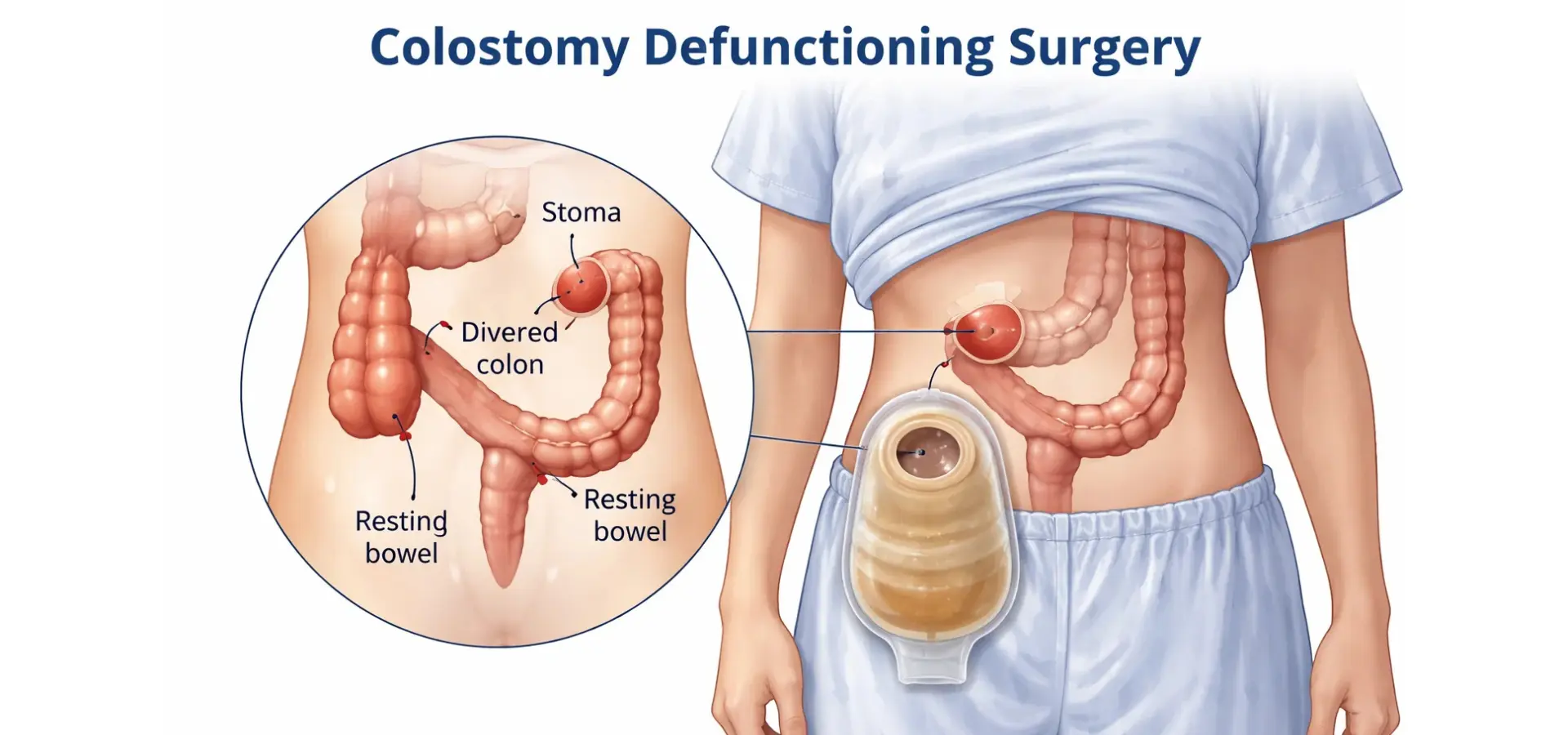
Colostomy Defunctioning Surgery in India is available for foreigners and native citizens in the best hospitals. The repair of bowel continuity following temporary colostomy in India is usually a planned procedure when it is done after all conditions related to it (i.e., Colorectal cancer, bowel trauma, infection, etc.) have resolved. Before the actual surgery, several evaluations have been performed by Indian hospitals to determine whether or not your health is stable enough to undergo a reversal surgery.
Depending upon the situation of the patient, their colostomy reversal can be accomplished using an open method or through a minimally invasive technique (Laparoscopic). After the surgery has been completed, the patient will be closely monitored for complications, and he/she will receive continued medical care to restore bowel function, promote healing of the surgical site, and resume a normal diet.
What is Colostomy Defunctioning?
The bowel is a tube of intestine that runs from the stomach to the back passage. Defunctioning a colostomy is described as a method of creating a passage that allows the removal of stool from the part of the digestive system. Especially, after surgical procedures (diagnostic and/or therapeutic) to remove cancer from the bowel. It is much longer than the inside of your belly (tummy). It fits in by coiling up in loops. The upper part of the bowel is called the small bowel. It joins the lower part of the bowel (the colon) just to the right of the waistline. Instead of allowing for stool to be passed through the anal opening (i.e., anus), the stoma (opening) is located on the abdominal wall and is used to pass faeces. This is where the appendix pouches out from the colon. The colon runs up to the right ribs and loops across the upper part of the belly. Then it passes down the left side to run backwards into the pelvis towards the back passage, where it is called the rectum.
For Free Online Consultation
GET A FREE QUOTE
Defunctioning Colostomy Procedure
Defunctioning colostomy procedures are carried out with the aim of diverting bowel contents and protecting a healing area of the intestines temporarily. Defunctioning colostomy procedures are typically part of colorectal surgery and follow well-defined surgical techniques. Colostomies are generally intended to be used temporarily and will usually be reversed once the intestinal lesion has healed.
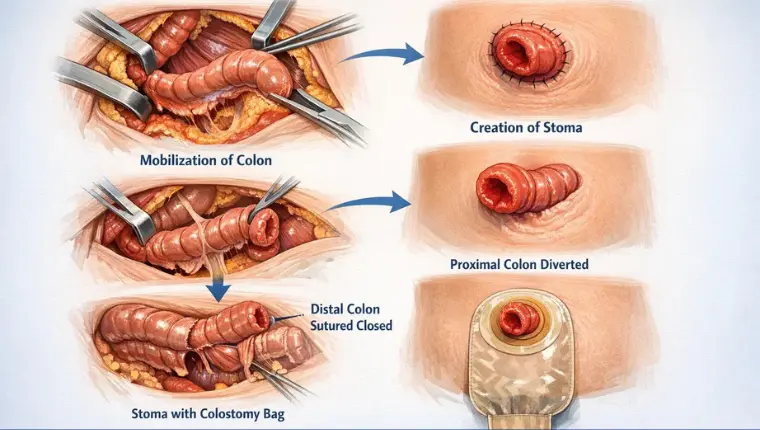
Defunctioning Colostomy Procedure
- Preoperative evaluation: The patient undergoes a thorough evaluation, including a comprehensive clinical assessment, radiological imaging, and blood work, to confirm the appropriateness of a diversion and assess the patient's surgical fitness. Additionally, bowel preparation and counseling will also occur.
- Patient positioning and anesthesia: General anesthesia will be given, and the patient will be placed on his/her back to provide adequate access to the abdomen for the procedure.
- Method of Surgery: The surgeon will use either an open or laparoscopic approach, depending on the patient's medical history and condition.
- How the Colostomy is Made: The surgeon will create an opening in the abdominal wall and pull a section of healthy colon through this opening, which will then be opened and turned inside out to form a stoma. This stoma will allow stool to flow out of the patient's body into a colostomy bag.
- Surgical Technique: The type of surgical approach used (open or laparoscopic) will depend on the patient's previous medical history.
- Creating a Colostomy: The surgeon makes an incision through the abdominal wall and brings healthy bowel out through this incision; this bowel is then cut open and turned inside out to form a stoma, which will enable waste products to exit the patient's body into a colostomy bag.
For Free Online Consultation
GET A FREE QUOTE
Diagnosis of Colostomy Defunctioning
Defunctioning colostomy diagnosis is dependent upon the identification of the conditions that necessitate the use of a temporary bowel diversion to prevent harm to either the lower portion of the intestine or to allow for surgical repair to occur. The physician assesses both the underlying disease and how well the patient is, and whether or not they are stable in regard to their overall well-being.
- Assessment will be made by a physician through clinical observation of any symptoms regarding bowel obstruction, perforation of the bowel, severe bacterial infection, or inadequate healing following colorectal surgery.
- A physician will perform diagnostic imaging using computed tomography (CT) or X-ray on the abdomen to diagnose the clinical symptoms, assess the integrity of the bowel, and ascertain if leaks, obstruction, or inflammation of the bowel exist.
- A physician will employ an endoscopic procedure, including a colonoscopy and/or sigmoidoscopy, to visually identify tumours, strictures, or anastomotic risks.
- Laboratory tests: Blood tests check infection markers, anemia, nutrition status, and organ function.
- Surgical judgment: The final decision depends on disease severity, healing risk, and patient safety.
Defunctioning Colostomy Indication
Defunctioning colostomy is a type of temporary diversion that protects the lower bowel from harm, provides a way to support healing, and reduces the risk for serious complications. The decision to use this type of diversion is made after thoroughly assessing the patient’s condition and the potential surgical complications associated with the procedure.
- Colorectal anastomoses should be created to protect the newly established intestinal anastomosis following removal of the rectum or sigmoid colon. In this case, due to the high likelihood of leakage, a precautionary colostomy is performed.
- Colorectal cancer has been identified as the most common indication for colostomy creation in patients with colonic obstruction or advanced tumors. Creating a colostomy provides immediate relief from intestinal obstruction and stabilises the patient until definitive treatment becomes available.
- If a bowel is perforated, it can be diverted below the point of perforation to avert contamination and infection risk.
- Complicated diverticulitis or inflammatory bowel disease (IBD) that has poor tissue healing indicates the use of ostomy intervention due to severe infection or inflammation.
- Traumatically injured bowel segments will benefit from ostomies during the healing process, following abdominal trauma that has caused bowel damage.
- Conditions of the anal or rectal area: In patients with complicated recto-vaginal fistulae, significant anal sepsis, or failure of wound healing, anal cleansing is indicated.
- Patients at great risk: Patients without proper nutrition and diabetic or immunosuppressed patients are candidates for anal cleaning when wound healing is expected to be delayed.
Colostomy Defunctioning Cost in India
Depending on the city, the type of hospital, and the surgeon's expertise, the cost of an ineffective colostomy (temporary intestinal diversion surgery) in India can differ significantly from one location to another. Additionally, it is important to remember that these are merely estimates. The true cost of a colostomy will vary based on your health status, duration of the hospital stay, any diagnostic tests performed, and if there were any complications arose from the surgery involving the colostomy. To get an accurate estimate for your own situation, check with the individual hospital or surgeon for the exact pricing information.
|
Cost Component |
Estimated Cost Range (INR) |
|
Surgeon’s fee |
₹15,000 – ₹40,000 |
|
Operation theatre charges |
₹10,000 – ₹30,000 |
|
Anesthesia charges |
₹5,000 – ₹15,000 |
|
Hospital stay (3–7 days) |
₹15,000 – ₹60,000 |
|
Diagnostic tests & imaging |
₹5,000 – ₹20,000 |
|
Medicines & consumables |
₹5,000 – ₹15,000 |
|
Stoma care supplies (initial) |
₹3,000 – ₹10,000 |
|
Total estimated cost |
₹45,000 – ₹2,20,000 |
Best Hospitals for Colostomy Defunctioning in India
There are numerous reputable hospitals across India where one can safely and effectively undergo defunctioning colostomy surgery. The following hospitals are:
For Free Online Consultation
GET A FREE QUOTE
- Apollo Hospitals - A chain of hospitals located in major cities throughout India, Apollo offers a variety of minimally invasive techniques as well as state-of-the-art surgical facilities.
- Medanta The Medicity - Found in Gurugram, Medanta is a leading healthcare facility and an industry leader for complicated colorectal and gastrointestinal surgeries.
- Fortis Healthcare - Offers a complete array of services after a surgical procedure, including post-operative care and stoma management.
- BLK-Max Super Speciality Hospital (Delhi) - Recognized for safely performing high-risk bowel surgeries.
- Manipal Hospital - Practices consist of holding consistency in outcomes through their skilled surgeons and modern operating room design, aiding in a rapid recovery of the patient.
India has emerged as a popular choice for individuals looking to have this type of surgery performed abroad.
|
Hospital Name |
City |
Known For |
|
Apollo Hospitals |
Multiple cities (Delhi, Chennai, Mumbai, Bengaluru) |
Strong colorectal surgery programs |
|
Medanta – The Medicity |
Gurugram |
Advanced GI and colorectal care |
|
Fortis Memorial Research Institute |
Gurugram |
Comprehensive surgical and postoperative support |
|
BLK-Max Super Speciality Hospital |
New Delhi |
Experienced colorectal surgery teams |
|
Manipal Hospitals |
Multiple cities (Bengaluru, Jaipur, etc.) |
Skilled surgeons with modern facilities |
We Care Health Services for Colostomy Defunctioning Surgery
We Care Health Services helps patients plan defunctioning colostomy surgery through simplification of the complexities that may seem overwhelming to patients when they first enter into this journey. The first contact with the patient includes an assessment of the patient's medical, emotional, and logistical needs. Once identified, We Care staff will begin identifying hospitals (s) and/or colorectal surgeon(s) that fit the following criteria: medical diagnosis, urgency, and financial capability. As a result, patients will receive care that meets their unique circumstances.
Pre-treatment consultations, Medical reports review, and Presidents' Appointments are all coordinated through We Care Health Services to assist patients in eliminating delays and confusion. When patients travel from other states or other countries, We Care Health Services can assist them with Travel Planning, Hotel Arrangements (close to the hospital), and using Local Support During Their Hospital Stay to provide additional support. The Communication to patients and their families remains open throughout the entire process so they clearly understand their Surgical Procedure, anticipated Recovery Time, and Postoperative Care Requirements.
Once surgery has been performed, We Care Health Services provides continued support in development of follow-up plans, providing guidance on the proper care of a stoma, and coordinating a reversal surgery when it is deemed appropriate by the physician. Additionally, We Care Health Services assists patients in understanding billing from hospitals, documenting their insurance information accurately, and provides patients with full transparency regarding their costs, which is frequently a major concern for patients.
For Free Online Consultation
GET A FREE QUOTE
What makes We Care Health Services unique is the individualized care that is provided to each case. Rather than a generic approach to providing care to all patients, the services offered by We Care Health Services are tailored to the specific medical status, comfort level, and recovery objectives of each patient. This patient-centered approach provides a means for patients to focus on recovery, while We Care Health Services handles the logistical and coordination aspects of recovery in a professional and empathetic manner.
Conclusion
The defunctioning colostomy surgery in India procedure is a critical intervention for maintaining bowel health and facilitating recovery for existing colorectal disease. India has many reliable alternatives for performing this operation, with qualified surgeons, modern equipment, and organized post-care systems in place. Coupled with coordinated support through organizations such as We Care Health Services, patients experience clarity regarding their therapeutic journey from beginning to end; therefore, they are able to proceed with more confidence and less anxiety because they know they have adequate support. In addition to these supportive measures, a detailed approach to diagnosis, continued monitoring and follow-up, and regular check-up appointments allow for a greater degree of safety and satisfaction throughout the healing process, which ultimately results in the patient being able to return to a normal lifestyle and regain their self-esteem as they recover from their illness and prepare for the subsequent reinstatement of terminal bowel function through colostomy reversal.