
Highly trained oncologists with years of experience are giving bone cancer treatment in India. After technology entered the medical field, it was observed that there is a high chance of successful treatment. Whether it is cancer or any heart problem, all kinds of facilities are accessible to the common people in hospitals.
Bone cancer is a type of cancer that originates from the ectodermal tissue of the bone. They may be primary or secondary based on the origin. They are known by three names: osteosarcoma, chondrosarcoma, and Ewing’s sarcoma.
What is Bone Cancer Known As?
There are different names based on the tissue from which bone cancer originates. Secondary bone cancer is usually more rebellious than primary and spreads more. Localised bone cancer has a high survival rate, and it could be treated easily. Four names come to our mind when we think of bone cancer:
Book Appointment
GET A FREE QUOTE
- Osteosarcoma – the most common type, usually found in the long bones like arms and legs.
- Ewing’s Sarcoma – often affects children and young adults, found in bones or soft tissue.
- Chondrosarcoma – arises in cartilage cells, typically in adults.
- Fibrosarcoma – develops in the fibrous tissue of bones.
What are the 7 warning signs of bone cancer?
Bone cancer always starts in a silent form and then spreads aggressively. Bone cancer often begins silently but may show several warning signs as it progresses. Being aware of these symptoms can help in early diagnosis and better outcomes. There are three things that you can do after noticing these symptoms: one is detecting it, and the other is consulting to doctors in online or offline mode.
If the mentioned symptoms persist beyond a few weeks, especially in children or adolescents, immediate medical attention is advised. Early diagnosis significantly improves treatment success.
- Persistent Bone Pain – The most common symptom, especially worsening at night or with activity.
- Swelling or Lump – A noticeable lump or swelling near the affected bone.
- Fractures – Bones weakened by cancer may break easily from minor injuries.
- Fatigue – Constant tiredness despite rest, due to the body fighting cancer.
- Unexplained Weight Loss – Losing weight without changes in diet or exercise.
- Reduced Mobility – Difficulty moving a limb or joint if cancer is near it.
- Numbness or Tingling – If the tumour presses on nearby nerves.
What is the main cause of bone cancer?
The exact cause of bone cancer is still not fully understood, but certain factors increase the risk. Genetic mutations, either inherited or acquired, can trigger abnormal cell growth in bone tissue. Conditions like Paget’s disease of bone, previous radiation therapy, and rare genetic syndromes such as Li-Fraumeni syndrome may also contribute.
In most cases, there’s no identifiable cause. Bone cancer may be primary (starting in the bone) or secondary (spreading from other cancers). Early detection and understanding of risk factors are essential for effective treatment and improved survival outcomes.
- Genetic mutations can cause the uncontrolled growth of bone cells, leading to primary bone cancer.
- Inherited genetic disorders like Li-Fraumeni syndrome or hereditary retinoblastoma increase the risk.
- Previous radiation therapy to bones, especially at a young age, may trigger cancerous changes.
- Paget’s disease of bone, a chronic bone disorder, is linked to a higher risk in older adults.
- Exposure to carcinogens or chemicals (though rare) can contribute to bone cell mutations.
- In many cases, no clear cause is identified, making awareness of symptoms crucial.
- Early diagnosis and access to quality bone cancer treatment in India significantly improve recovery chances.
What Detects Bone Cancer?- Diagnosis of Bone Cancer
The presenting symptom is usually pain. Pathologic fracture may be present and is more common in the lower than the upper extremity. The presenting radiologic finding on X-ray is often destruction of bone. In a patient with a known primary malignant tumour presenting with a painful, destructive lesion of bone, a diagnosis of metastatic cancer can be made with some assurance.
Book Appointment
GET A FREE QUOTE
However, there are individuals in whom the primary cancer is not yet recognised at the time when the early metastatic lesion in bone becomes painful. A CT scan, MRI, radionuclide bone scan or a skeletal survey may be done to pinpoint which bones have been affected. Bone cancer treatment in India is performed based on the diagnostic result:
- X-rays – The First step to detect unusual bone growths or fractures.
- Blood tests – Check for elevated alkaline phosphatase levels, common in bone disorders.
- MRI (Magnetic Resonance Imaging) – Provides detailed images of bone and soft tissues.
- CT Scan (Computed Tomography) – Detects tumour size, location, and metastasis.
- Biopsy – Confirms cancer by analysing a tissue sample under a microscope.
- Bone Scan – Detects bone abnormalities throughout the skeleton.PET Scan – Identifies cancer spread and monitors treatment response.
- These methods are widely available during bone cancer treatment in India for accurate and early diagnosis.
Bone Cancer Treatment Options in India
Bone cancer treatment in India is comprehensive and tailored to the type and stage of cancer. Major hospitals offer advanced therapies like surgery, chemotherapy, and radiation, guided by multidisciplinary oncology teams. With cost-effective options and high success rates, India has become a reliable destination for both domestic and international patients seeking quality bone cancer care.
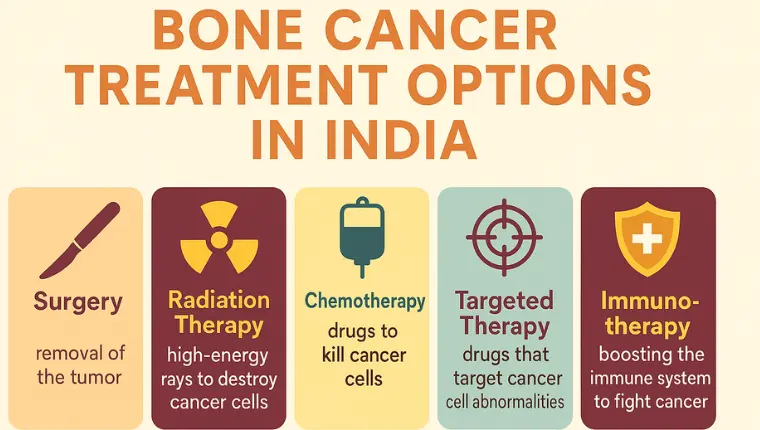
Bone Cancer Treatment Options in India
Best Hospital for Bone Cancer Treatment in India
Bone cancer treatment in India is not possible without the best technology and facilities in hospitals. With the development of private sector technology in hospitals is increasing. In the present scenario, there are more than thousands of foreigners who choose Indian treatment above others.
Book Appointment
GET A FREE QUOTE
The second thing because of which choosing the best hospital is necessary is fraud cases and the absence of transparency in the system. The hospitals in India or foreign countries that are supported by the government are more trustworthy and affordable. In such hospitals, government schemes are also valid, thus providing more facilities.
|
Hospital Name |
City |
|
Tata Memorial Hospital |
Mumbai |
|
All India Institute of Medical Sciences (AIIMS) |
New Delhi |
|
Fortis Memorial Research Institute |
Gurgaon |
|
Medanta – The Medicity |
Gurgaon |
|
Apollo Cancer Centre |
Chennai |
|
Max Super Speciality Hospital |
Delhi, Noida |
|
Rajiv Gandhi Cancer Institute |
Delhi |
|
BLK-Max Super Speciality Hospital |
New Delhi |
|
HCG Cancer Centre |
Bangalore |
|
Manipal Hospitals |
Multiple Cities |
|
Christian Medical College (CMC) |
Vellore |
|
Kokilaben Dhirubhai Ambani Hospital |
Mumbai |
|
Amrita Institute of Medical Sciences |
Kochi |
|
Narayana Health City |
Bangalore |
|
MGM Healthcare |
Chennai |
Bone Cancer Treatment Cost in India
The treatment of cancer of the bone, especially metastatic cancer, has two goals: management of the neoplasm and management of the symptoms produced by the local lesion. Prognosis is affected by a patient's age, the size of the primary tumour, grade and stage, degree of lymphatic and blood vessel invasion, the duration of symptoms and the location of the tumour on the arm, leg or trunk.
There are two ways bone metastasis is treated. Systemic therapy, aimed at cancer cells that have spread throughout the body, includes chemotherapy, hormone therapy, and immunotherapy. Local therapy, aimed at killing cancer cells in one specific part of the body, includes radiation therapy and surgery.
Book Appointment
GET A FREE QUOTE
The cost of bone cancer is defined according to treatment methods:
|
Treatment Type |
Estimated Cost (INR) |
Estimated Cost (USD) |
|
Surgery |
₹2,00,000 – ₹5,00,000 |
$2,400 – $6,000 |
|
Chemotherapy (per cycle) |
₹30,000 – ₹70,000 |
$360 – $850 |
|
Radiation Therapy |
₹1,50,000 – ₹3,00,000 |
$1,800 – $3,600 |
|
Targeted Therapy |
₹80,000 – ₹2,50,000 |
$1,000 – $3,000 |
|
Immunotherapy |
₹2,00,000 – ₹6,00,000 |
$2,400 – $7,200 |
We Care Health Services For Bone Cancer Treatment in India
We Care Health Services is a trusted medical tourism facilitator that connects patients worldwide to top hospitals offering bone cancer treatment in India. With over a decade of experience, We Care ensures seamless coordination between international patients and India’s leading oncologists, surgeons, and cancer hospitals.
Bone cancer is a complex and serious condition that requires timely and precise treatment. We Care understands this urgency and helps patients access comprehensive bone cancer treatment in India, including surgery, chemotherapy, radiation therapy, and advanced options like targeted therapy and immunotherapy. From diagnosis to post-treatment recovery, the team provides personalised support at every step.
Why Choose We Care Health Services?
One of the major advantages of choosing We Care is its network of NABH and JCI-accredited hospitals across India. These hospitals are equipped with state-of-the-art technology, skilled orthopaedic oncologists, and specialised rehabilitation teams. Patients can expect world-class care at costs significantly lower than in the US, UK, or Europe.
Book Appointment
GET A FREE QUOTE
Moreover, We Care assists with visa arrangements, travel, accommodation, interpreter services, and follow-up care, making it easier for international patients to focus entirely on healing. The organisation also provides second opinions and treatment plans before arrival, ensuring transparency and confidence in the decision-making process.
For anyone seeking high-quality yet affordable bone cancer treatment in India, We Care Health Services stands as a compassionate, professional, and reliable partner. Their commitment to patient-centric care makes them a preferred choice for thousands of patients seeking cancer treatment in India each year.