
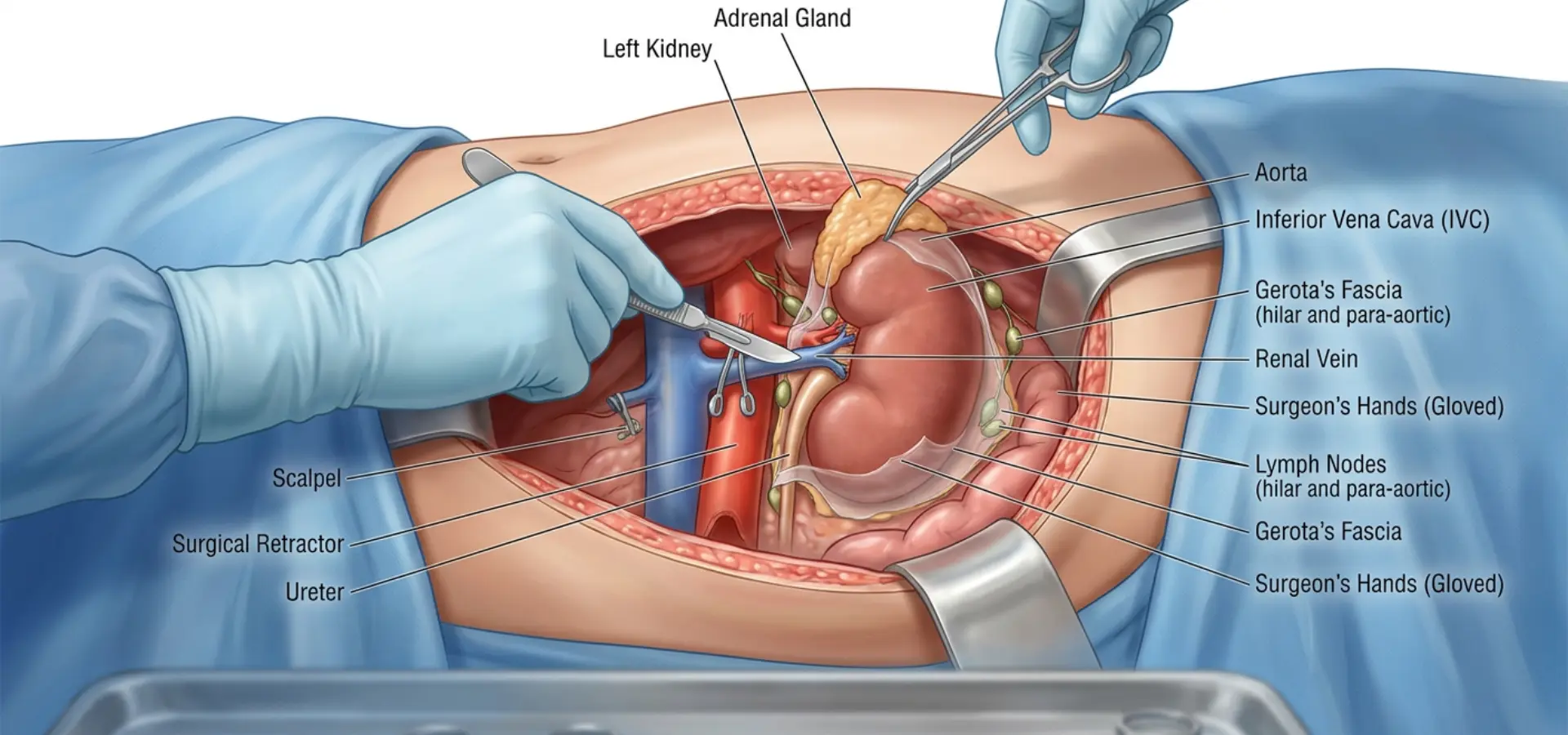
Radical nephrectomy surgery in India is performed by expert surgeons to prevent cancer from spreading to the surrounding tissues. There are different tissues, such as the adrenal gland and lymph nodes, which need to be removed in some cancer cases. Malignancy is the name of spreading cancer to different parts of the body.
Radical nephrectomy is performed with the help of laparoscopic instruments. Robotic-assisted surgery is also performed for treating kidney cancer. Radical nephrectomy is a surgical procedure in which an entire kidney is removed, usually to treat conditions like kidney cancer, large tumors, or severe kidney damage.
What is Radical Nephrectomy?
A radical nephrectomy is a procedure to remove cancer in and around one of your kidneys. The surgeon removes the kidney, ureter (the tube connecting the kidney to the bladder), and surrounding connective tissue, lymph nodes, and adrenal gland. Also, adjacent tissues (lymphatic nodes, adrenal glands, and surrounding tissues) may be removed to lessen the chance of metastasis or disease spread.
The more advanced hospitals in India perform this procedure using either laparoscopic (minimally invasive) or open techniques. The laparoscopic and robotic-assisted surgical approaches generally require smaller incisions than open surgical approaches, result in less postoperative pain, and have faster recoveries than the open technique.
What Are The Different Kinds Of Nephrectomy Procedures?
The outcome of Radical Nephrectomy depends on the size and type of the cancer. The survival rate for stage I Renal Cell Carcinoma (RCC) following Radical Nephrectomy is 93%. This is for the tumour that is confined to the kidney and has not spread to the outside tissues.
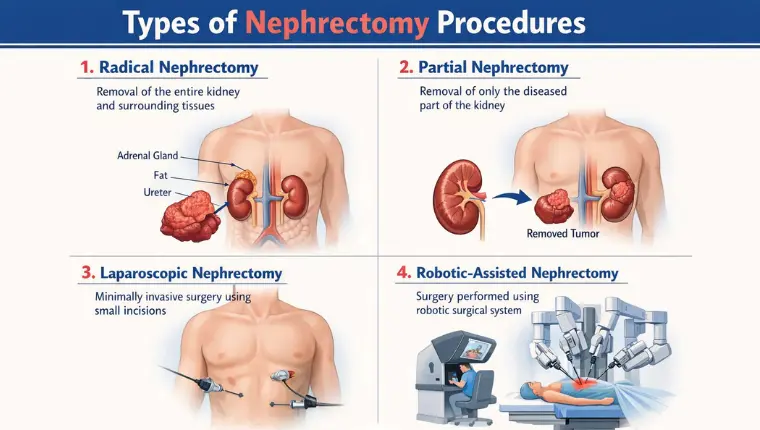
What Are The Different Kinds Of Nephrectomy Procedures
- Partial Nephrectomy or Hemi-Nephrectomy - In this procedure, a small part of one kidney is removed.
- Simple Nephrectomy - In this procedure, all of one kidney is removed.
- Radical Nephrectomy - This procedure involves the surgical removal of one kidney along with the neighbouring adrenal gland and lymph nodes on the same side.
- Bilateral Nephrectomy - This procedure entails the surgical removal of both kidneys.
- Unilateral Nephrectomy - In this procedure, only one kidney is removed.
What is the Purpose of Radical Nephrectomy?- Procedure Overview
Radical nephrectomy means taking out the entire kidney along with the adrenal gland on top, the fat around it, and some nearby lymph nodes. Doctors pick this for kidney cancer when tumors grow large or sit in tough spots. Unlike partial nephrectomy, which saves part of the kidney, RN clears the cancer fully.
Surgeons use three main ways to do it. Open surgery cuts a big incision on your side. It gives clear views but means longer healing. Laparoscopic nephrectomy uses small cuts and a camera. This cuts pain and speeds recovery. Robotic-assisted takes it further with tools that move like a human hand. It boosts precision, especially for tricky cases. Each method has trade-offs. Open works best for huge tumors. Minimally invasive ones lower blood loss but need skilled teams.
Patient Selection and Surgical Candidacy
Doctors suggest RN for tumors over 7 cm, or stage T2 and up. They check if the tumor hugs the kidney's center or blood vessels. Your other kidney's health matters too. If it's weak, partial might not work. Before surgery, you get scans like CT or MRI to map the tumor. A biopsy confirms it's cancer. Tests check your heart, lungs, and overall fitness. A team of urologists, oncologists, and others reviews your case. This ensures RN fits your needs.
When is Radical Nephrectomy Preferred Over Partial Nephrectomy?
Choosing RN when saving kidney tissue risks leaving cancer behind. Think of large tumors that fill most of the organ. Or if cancer hits the renal pelvis or the big veins. Multiple spots in one kidney also tip the scale to full removal. Partial nephrectomy shines for small, outer tumors. It keeps more kidney function. But for aggressive kidney cancer, RN offers better odds of no return. Studies show it matches or beats partial cure rates for big cases.
Top Kidney Cancer Surgeons for Radical Nephrectomy in India
Radical nephrectomy surgery in India is best for the patient who wants company during their treatment. Doctors at We Care Health Services are giving you the best treatment and giving you counseling after treatment. There are well-coordinating staff and taking care of your food and other needs. We are making sustainability at our treatment place.
Our doctors are helping everyone within the boundaries of disease. We ensure your safety, and a team of doctors with us will be your caretaker and counsellor. We have trained doctors from international centres and can work with robotic-assisted methods. You will find all facilities and treatment off course, with advanced technologies.
The Step-by-Step Surgical Process of Radical Nephrectomy
You fast for eight hours before the cut. Stop blood thinners days ahead. The anesthesia team plans for heavy bleeding risks in the kidney work. General anesthesia puts you to sleep. They watch your vitals closely. For some, an epidural helps with post-op pain. Quit smoking at least four weeks prior. It cuts infection odds. Eat light, balanced meals to build strength.
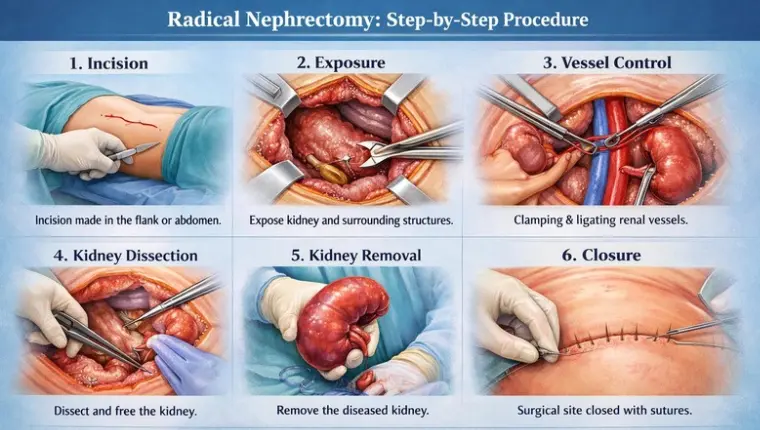
The Step-by-Step Surgical Process of Radical Nephrectomy
Executing the Resection: Dissection and Tumor Removal
The surgeon starts by finding the kidney through the chosen cuts. They tie off the renal artery first to stop blood flow. Then the vein follows. This keeps things dry. Next, they free the kidney from the ureter and nearby parts. Careful cuts avoid harm to the bowels or spleen. If needed, they sample lymph nodes for spread checks. To limit damage, they clamp vessels briefly. Warm saline flushes the area. Data shows this approach leads to 95% success in clear margins for localized cancer.
Reconstruction and Closure
After removal, they check for bleeds. In RN, no big rebuild happens like in partials. They just seal vessels and drain if fluid builds. Layers close with stitches or staples. Skin gets neat seals. Drains stay in to pull extra blood or lymph.
Recovery Time after Radical Nephrectomy Surgery in India
In India, recovery from a radical nephrectomy is generally based on the type of surgery performed and how healthy the patient was before surgery. If the surgery was done using laparoscopic techniques, most patients can resume most light activities between 2 to 3 weeks after the surgery; but if it was done through the open method, most patients will probably take between 4 to 6 weeks to return to doing everything they could before the surgery. Most people can expect to spend 3 to 7 days in the hospital after their surgery.
As time passes after surgery, the amount of pain and fatigue will decrease. Physicians recommend that patients avoid doing any heavy lifting for at least 1 month following surgery. Patients with kidney cancer who undergo a radical nephrectomy will require follow-up visits for ongoing monitoring of the healing process and proper function of the kidneys.
Potential Risks, Complications, and Managing Outcomes
Bleeding hits in about 5% of cases right after. Infections follow in 2-3%. Bowel or spleen injury occurs rarely but needs quick fixes. Lung issues like clots or pneumonia add worry. Stats peg major problems at under 10% with modern care. If your other kidney struggles, function drops fast. Watch creatinine levels close. Dialysis might step in short-term.
Long-Term Concerns Following Kidney Removal
Losing one kidney ups chronic kidney disease risk by 20-30%. Blood pressure often climbs, so meds help. You adjust your diet with less salt and protein. Stay active to protect the good kidney. Regular checks track the glomerular filtration rate. A urologic oncologist notes: "After successful RN for stage II cancer, five-year survival nears 80%. Staging guides long-term watch."
Managing Surgical Side Effects
Pain eases with pills like acetaminophen first. Move your legs in bed to fight clots. Call your doc if your fever spikes or your wounds swell. Walk short distances soon after surgery. It boosts circulation. Hydrate well to aid healing.
Best Hospitals For Radical Nephrectomy Surgery in India
We Care Health Services is an established health care facilitator that assists patients in obtaining safe and efficient treatment throughout India. In addition to providing referrals for hospital care, We Care Health Services offers complete, seamless assistance to patients for complex medical procedures such as radical nephrectomy.
We Care Health Services collaborates with major urological hospitals and experienced surgeons specializing in the advanced treatment of diseases such as kidney cancer. We Care Health Services works with patients to develop individualized treatment plans based on the patient's medical history.
- Access to excellent hospitals and highly skilled urologists in the major cities of India.
- Providing prospective patients with transparent cost estimates so that they understand all their expenses. No hidden costs.
- Helping prospective patients with travel, hotel, and hospital admission.
- Providing continuous support before, during, and after the surgical procedure.
- Designating a full-time patient coordinator to facilitate and promote ongoing communication.
With their patient-centered service model, pathway/curriculum, and dependable network of providers, We Care Health Services has developed a reliable method for reducing the anxiety of individuals traveling from long distances and across state lines or national borders to receive quality kidney transplantation. - Providing prospective patients with transparent cost estimates so that they understand all their expenses. No hidden costs.
Conclusion
Radical nephrectomy stands as a key tool for beating localized kidney cancer. It removes the threat fully, with modern methods easing the burden. Recovery varies, but most folks regain strength. Key points: Pick an experienced surgeon for best results. Stick to follow-up scans. Care for your remaining kidney with smart habits. Armed with this info, you make strong choices. Talk to your team soon. Your health journey starts with action.