

The need for doctors, the cost of the surgeries, and various issues are all covered under the eye care surgery overview in India. Eye care surgery is not only a single type; there is LASIK, cataract correction, squint eye operation, and many others, which give a safe choice to the patient. The cost of the Indian hospitals is affordable to most patients.
The hospital is welcoming foreigners too for surgery and treatment. The clinic has the best facilities to support all the needs of the patients. Most of the time, we look for the technical facility and affordable options of surgeons. With 26,000-27,000 ophthalmologists, approximately 1.8-1.9 per 100,000 people, Indian hospitals are serving the best.
Eye Care Surgery in India
Eye care surgery in India has both perspectives for doctors' consideration and clinical considerations. While choosing a hospital or clinic for eye surgery, you have to check for verified credentials. Although technical advancements are changing things like AI diagnostics services, detecting problems early, especially diabetic retinopathy, glaucoma, etc. The following things need an emergency update:
Book Appointment
GET A FREE QUOTE
- Scaling up human resources: More ophthalmologists, trained technicians, rural deployment, and incentivizing work in less-served areas.
- Strengthening rural infrastructure: Vision centres, satellite clinics, linkages to tertiary centres.
- Making surgeries affordable: Subsidies, insurance coverage, and cost standardization where possible.
- Increasing public awareness: That vision loss from cataract or other treatable causes is reversible; the importance of early diagnosis and follow-up.
- Ensuring quality & regulation: Make sure standards are upheld in both public and private sectors (sterility, quality of lenses, surgeon qualifications).
Challenges and Barriers in the Eye Surgery Department
There are different variations in the quality of surgery, the technical facilities geared up the treatment system, but they can’t handle human psychology. If you are not having surgery at the best hospital and not checking their facilities, that will be your problem. But some people used to think that it would be a long, painful story after the surgery.
Some think they’ll wake up blind, or that the recovery’s gonna be this long, miserable slog. Wild how these rumors just float around and freak people out, right? Honestly, it scares people off from getting the help they need, and stuff gets way worse by the time they do something about it. Classic.
Now, if you’re chilling in a major city, sure, you’ve got options. Fancy tech, surgeons who know their stuff, the whole shebang. But take a step outside the metro bubble, and, whoops, suddenly the choices dry up. Smaller towns and rural spots? Good luck finding a top-notch eye doc or the latest gadgets.
And here’s the kicker: not every surgery is created equal. It’s not just “have the op, get your sight back, happy ending.” Depends a ton on who’s holding the scalpel, how good the hospital is, and whether you’re getting proper care after. Sometimes, even after going through the whole thing, people don’t see much better—or at all—if the quality’s lousy.
Money’s another beast. You’d think cost would be the main dealbreaker, but surveys say it’s not always top of the list. Still, let’s not kid ourselves: private surgery prices are brutal for a lot of people. Sure, public programs and charities are pitching in, but not everyone gets to cash in on those.
And here’s where it all comes crashing down: wait too long, and it’s game over for your eyes. Delaying surgery ‘til things are really bad? That just cranks up the risk for all sorts of complications and makes the chances of bouncing back way slimmer. Procrastination strikes again.
What to Check If You’re Considering Eye Surgery
If you are considering eye surgery, then stop moving on to the traditional facts and figures. There are different types of surgeries, and you have to choose one; no, it is not your choice, first of all, you will be diagnosed, and then one will be chosen accordingly. Here are some checkpoints:
- Surgeon’s credentials/experience: How many surgeries of this kind has the surgeon done; what are their outcomes?
- Technology used: The kind of laser, precision tools, type of intra-ocular lens (for cataract), whether it’s bladeless, etc. More advanced tech usually costs more but may offer quicker recovery, fewer side effects.
- Clinic/hospital quality: Sterilization, follow-up care, handling of complications, customer reviews, and infrastructure.
- Total cost package: Not just the surgery itself, but pre-surgical tests, anesthesia or numbing drops, post-surgery medication, follow-up visits, and any “hidden” charges.
- Realistic expectations and timing: How soon full vision stabilizes, possible side effects (dry eyes, glare, etc.), and whether glasses might still be needed for reading or night driving.
- Public/charity options: Especially for cataract, there are large government/outreach/charitable programs (NPCB&VI, etc.) that offer low-cost or free services. Checking eligibility can save costs.
Book Appointment
GET A FREE QUOTE
Need for Eye Surgeries
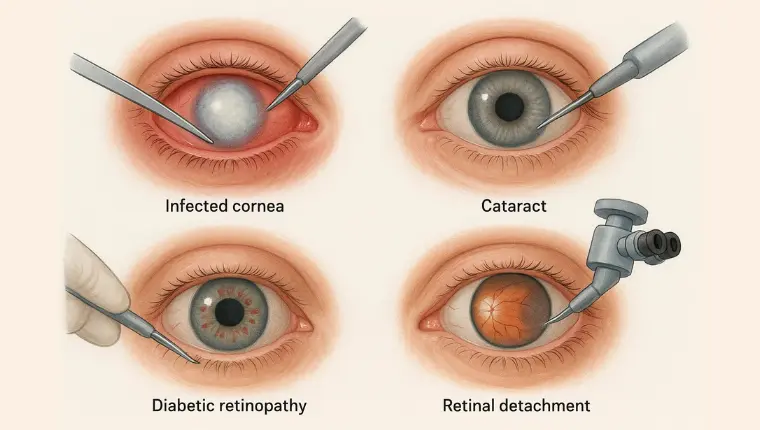
Different eye issues demand surgical options; some are infectious diseases, others are due to the lens and vision issues. Timely surgical intervention is necessary in most cases. The effects or symptoms of the surgery are suddenly visible, and an emergency is also noticed for eye surgeries. In India and worldwide, a significant share of blindness and visual impairment is caused by conditions that are either treatable or preventable through timely surgical intervention. Here are some conditions that could be corrected through eye surgery options:
Need for Eye Surgeries
- Cataracts remain the leading cause of blindness, especially among older adults.
- Beyond cataracts, refractive errors such as myopia and astigmatism are also on the rise due to increased screen exposure and lifestyle changes.
- With millions affected in India alone, diabetic retinopathy is becoming a major reason for sight-threatening complications that often require retinal surgeries.
- Glaucoma, often called the “silent thief of sight,” can lead to irreversible blindness if not managed through timely medical or surgical care.
- Corneal blindness, whether from injury, infection, or degeneration, highlights the ongoing need for corneal transplants in many parts of the country.
- Poor vision can directly affect education, productivity, and quality of life.
Types of Eye Surgery to Correct Vision- Ophthalmology Eye Surgery
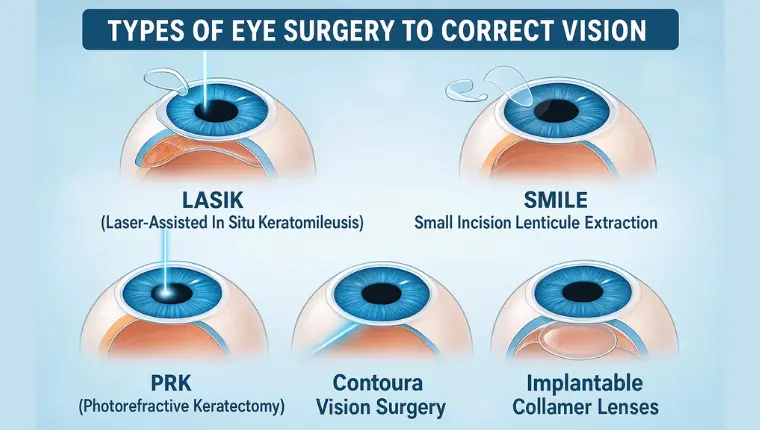
Advances in ophthalmology have made it possible for people with common refractive errors—such as myopia (nearsightedness), hyperopia (farsightedness), and astigmatism—to reduce or even eliminate their dependence on glasses or contact lenses. Today, several types of corrective eye surgeries are available, each suited to different eye conditions, corneal structures, and lifestyle needs.
Types of Eye Surgery
Each of these surgeries has its benefits and limitations, and the best choice depends on factors such as corneal thickness, the degree of refractive error, overall eye health, and the patient's expectations. A thorough evaluation by an experienced ophthalmologist is essential before deciding on surgery.
Vision correction surgery has transformed the lives of millions, offering freedom from the need for glasses and contacts. With proper screening and modern technology, most people achieve excellent, long-lasting results.
Technological Advancements in Eye Surgery
The past few decades have seen a big change in eye surgery. Advances in technology have made operations safer, faster, and more accurate. Alongside better surgical results, patient comfort and recovery have also been increased.
One of the most far-reaching innovations has been lasers. For instance, in cataract surgery, technology like phacoemulsification and FLACS (Femtosecond Laser-Assisted Cataract Surgery) allows the surgeon to make tiny openings in the white part of the eye to rid it of their opaqueness. Patients so treated often experience shorter recovery times, clearer vision, and freedom from glasses.
Book Appointment
GET A FREE QUOTE
Different Surgeries with Technological Advancements
In the field of vision correction, procedures such as LASIK, SMILE, and Contoura Vision have become increasingly sophisticated. Surgeons today use so-called bladeless femtosecond lasers to create corneal flaps that are more accurate and that can minimize side effects for better long-term results. Topography-guided and wavefront-guided LASIK procedures, fitting the surgery to each patient's unique corneal irregularities, are how vision becomes clearer and more natural.
Diagnostic Methods
Over the years, the development of micro-instrumentation and high-definition imaging systems has extended our capabilities in retinal surgery. Nowadays, doctors can operate with much greater precision on the slenderest and most delicate structures. This is making treatment of diabetic retinopathy and maculas (macular disorders that much more efficacious.
Structural Optimisation
Similarly, glaucoma care has advanced with the introduction of minimally invasive glaucoma surgeries (MIGS), which reduce intraocular pressure with fewer complications compared to traditional methods.
Robotic-Assisted Surgeries and Artificial Materials
Another important shift is the integration of artificial intelligence and teleophthalmology. AI-driven diagnostic tools can detect early signs of diabetic eye disease or glaucoma, allowing for quicker referral to surgery before irreversible damage occurs. Remote imaging and digital platforms are expanding access, especially in rural areas where specialists are scarce.
Finally, research is moving towards bioengineered corneas, smart contact lenses, and robotic-assisted eye surgery, which could define the next generation of treatment. These innovations aim not only to restore vision but also to make eye care more accessible and personalized.
Cost of Eye Surgery in India
Getting your eyes fixed up in India? It’s all over the map, price-wise. You’ve got your budget-friendly cataract fixes at government or charity places—sometimes they’ll even do it for free if you catch the right scheme. On the flip side, if you’re going for the fancy stuff, like SMILE or ICL (and honestly, those names sound like weird startup apps), you’ll need to cough up way more, especially at those shiny private clinics.
What really messes with the cost? The tech they use, which lens or implant you pick, and where the hospital’s parked (big city? You’re paying more). Cataract surgery’s the most chill on your wallet, thanks to government programs, but once you start talking about the high-tech eye wizardry, the bill gets steep.
Book Appointment
GET A FREE QUOTE
|
Type of Surgery |
Approximate Cost Range (per eye) |
Notes |
|
Cataract Surgery |
₹20,000 – ₹1,20,000 |
Depends on lens type (monofocal, multifocal, toric) and whether laser is used |
|
LASIK Surgery |
₹20,000 – ₹45,000 |
Standard LASIK; higher in metros |
|
SMILE Surgery |
₹50,000 – ₹80,000 |
Advanced, flapless laser surgery |
|
Contoura Vision LASIK |
₹60,000 – ₹90,000 |
Customized corneal mapping for sharper results |
|
PRK Surgery |
₹25,000 – ₹40,000 |
Older but still effective for thin corneas |
|
ICL (Implantable Lens) |
₹80,000 – ₹1,50,000 |
Suitable for high-power, thin cornea patients |
|
Corneal Transplant |
₹70,000 – ₹1,50,000 |
Cost varies with donor availability and hospital setup |
Success Rate of Eye Surgery in India
The success rate of eye surgeries in India is high in comparison to other treatments. Overall, most eye surgeries today are highly successful, provided the patient is carefully evaluated beforehand and follows post-operative care instructions. Success also depends on the surgeon's expertise, the hospital's quality, and the stage at which the disease is treated. Eye surgeries today are among the most successful medical procedures, thanks to advanced techniques and skilled ophthalmologists.
- Cataract Surgery: This is the most commonly performed eye surgery in India, with a success rate of over 98% in modern setups. Complications are rare when performed in well-equipped hospitals, and most patients regain clear vision within days.
- LASIK Surgery: Success rates average 95–98%, with the majority of patients achieving 20/20 or near-normal vision. Some may still need glasses for fine tasks like night driving or reading, but satisfaction levels remain high.
- SMILE Surgery: Considered one of the safest refractive procedures, SMILE has a success rate of around 95–97%. It tends to cause fewer dry-eye issues compared to LASIK.
- PRK (Photorefractive Keratectomy): With proper screening, PRK offers a success rate of 90–95%, though recovery is slower compared to LASIK. It is still a good choice for thin corneas.
- Implantable Collamer Lens (ICL): Success rates are above 95%, especially for patients with very high myopia who are unsuitable for laser-based surgeries.
- Corneal Transplant: Success depends on the condition being treated. For keratoconus and certain corneal diseases, survival rates of grafts are 85–90% after five years, though infections or rejection can affect outcomes.
- Retinal and Glaucoma Surgeries: These have more variable outcomes, often depending on how early the condition was diagnosed. Early-stage interventions offer better chances of preserving vision.
Best Hospitals For Eye Surgeries
There are different hospitals with all kinds of facilities. We prefer We Care Health Services, where you will find the best surgeons and staff. The coordination by the hospital staff and care in the emergency ward will leave you surprised. With different problems, you will find personalized care from the doctors. Cost transparency is one of the best approaches of the Indian Hospitals. With all these qualities, we are preferring ourselves, but there are other hospitals too, which are working with excellence.
For the convenience of your location, we are already operating our services in the nearby cities. There are multiple branches of the hospital. Also, if you are choosing by yourself, you can check for NABH accreditation.
|
Hospital |
City / Region |
|
L. V. Prasad Eye Institute (LVPEI) |
Hyderabad (and campuses in other states) |
|
Sankara Nethralaya |
Chennai (also in Kolkata etc.) |
|
Aravind Eye Hospital |
Madurai and other branches |
|
Dr. Rajendra Prasad Centre for Ophthalmic Sciences, AIIMS |
New Delhi |
|
Centre for Sight / Dr. Agarwal’s Eye Hospital / Narayana Nethralaya / Vijaya Nethralaya |
Bangalore / Pan-India / Chennai etc. |
|
Sankara Eye Hospital (Sankara Foundation) |
Coimbatore, Shimoga, Guntur, etc. |
Book Appointment
GET A FREE QUOTE
We Care Health Services For Eye Surgery
We Care Health Services is one of the best hospital coordinators in India. Allowing surgeries from different countries, and patients are satisfied with the services. We show cost Transparency in our work and give you a proper idea of expenditure. You can check the website handle and the various services provided by us. This is not about eye surgery, cardiac surgery, or pediatric treatment is also available in the hospital.
We are assisting you with a minimum waiting list in case of transplantation. There are different centres in multiple Indian cities, so you can access us from anywhere. Although Delhi NCR is a hub, it does not mean that you have to come this far for surgery. You can contact us for further information regarding this aspect.
- Eye surgery in the hospital is supported by different doctors with expertise.
- Working on the patient satisfaction criteria.
- Available for you anytime, and the best care unit.
- Operating at present in more than one city.
- 24*7 present for the emergency services.
- Best staff team and management team.
- Cost transparency and affordability are guaranteed
- Known for the best treatment for eye care, fertility care, and cardiac treatment.
Best Eye Surgeons in India
Doctors are the basis of any treatment. Indian doctors are not just nice to their patients; they are easily approachable with minimal waiting lists. There are different facilities and technological advancements that came to India because of the Indian Doctors. With time, usage of the medical technology is increasing, and doctors are trained themselves for the best results. The outcomes of the surgery show it all. Here is a list of some best doctors with the name of the Hospital in which they are working.
Book Appointment
GET A FREE QUOTE