
Surrogacy in India: Legal Rules, Cost & Step-by-Step Guide

Patients from around the world choose to come to India for surrogacy treatment. From cost to medical treatments India is chosen for treatment. Since it is a treatment that should have both medical and emotional support. It is not just about the medical and technical treatment but includes legal procedures too.
There should be information regarding the whole procedure since that helps the patients to undergo the whole procedure smoothly. There are multiple stages that patients should know about. There are a number of clinics for surrogacy treatments in India.
How does Surrogacy work in India?
Patients are required to know about the law prior to the treatment since there are strict laws made around surrogacy treatment in India. It is strictly governed by law. In India, commercial surrogacy is not legal.
Consult Now
GET A FREE QUOTE
The following are the steps which patients should follow:
- Surrogacy begins with couples with initial fertility consultation and at the same time diagnosis is undertaken.
- Then they are required to undergo a check if the couple are legally eligible.
- A surrogate mother has to be selected and the requirement for that is they should be close relatives and then should have a healthy child of their own.
- One should check that the clinic has all the certifications and documents which allows the clinic to practise surrogacy and fertility treatments.
- There are medical and health screenings that are to be undertaken regarding the procedure.
- Legally only altruistic surrogacy is allowed in India and commercial surrogacy is not allowed.
- IVF is undertaken during surrogacy where the embryo is created and that is used for surrogacy.
- Embryo transfer is undertaken when embryos are ready for transfer and before that the uterus is prepared for the transfer.
- Then the surrogate mother is kept under observation after that.
Who can undergo Surrogacy in India?
💍 The couple should generally have been married for around 5 years.
👩 The female partner should be approximately 23–50 years old.
👨 The male partner should be approximately 26–55 years old.
🩺 The couple must have a certified medical reason establishing infertility, as required by law.
🇮🇳 NRI and OCI cardholders must meet the applicable Indian surrogacy eligibility rules and legal requirements.
👩🦳 Widowed or divorced women aged approximately 35–45 years may be eligible for surrogacy, subject to legal conditions.
⚖️ Only altruistic surrogacy is permitted in India. Commercial surrogacy, in which the surrogate mother receives payment beyond legally permitted expenses and insurance, is prohibited.
Patients who are not allowed to undergo surrogacy in India
The patients who are not allowed to undergo surrogacy in India are the following:
💍 Couples who are unmarried are not legally eligible for surrogacy in India.
🚫 Same-sex couples are not eligible for surrogacy under current Indian law.
👨 Unmarried single men are not legally eligible for surrogacy in India.
- 🌍 International patients who are not eligible under Indian surrogacy laws, including foreign nationals without qualifying OCI status, cannot pursue surrogacy in India.
- 👶 Couples who already have a child are generally not eligible for surrogacy, except in certain legally permitted circumstances.
Legalities in India For Surrogacy in 2026
The legalities in India for surrogacy in 2026 are the following:
Documents Required for Surrogacy
Prepare the following documents for the surrogacy process.
Photo ID Proof
Proof of Marriage
Document Proof for Age
Document Proving That the Surrogate Has a Healthy Child of Her Own
Medical Reports of the Surrogate Mother
Consent Form
Other than the documents that the couple and the surrogate mother is required to have there are documents that too are required:
- An official legal agreement for surrogacy.
- Medical insurance should be covered too and documented too.
- Documents proving parental rights.
Surrogacy Treatment Cost In India
The cost of surrogacy in India consists of different stages of treatments since it includes IVF that has its multiple treatment stages. And that has its separate treatment cost, medication cost and legal documentation cost. It is important that it has to be known by the couple who is coming for treatment.
Consult Now
GET A FREE QUOTE
Cost component | Estimated cost (INR) |
Initial consultation and medical evaluation | ₹10,000–₹30,000 |
IVF and embryo creation | ₹1,50,000–₹3,00,000 |
Fertility medications | ₹40,000–₹70,000 |
Additional embryo freezing and storage | ₹15,000–₹40,000 |
Surrogate medical screening | ₹15,000–₹50,000 |
Frozen embryo transfer (FET) | ₹40,000–₹80,000 |
Antenatal care and pregnancy monitoring | ₹1,00,000–₹3,00,000 |
Delivery and hospital charges | ₹80,000–₹2,50,000 |
Legal documentation and approvals | ₹50,000–₹1,50,000 |
Permitted incidental expenses | ₹30,000–₹80,000 |
Indicative total budget | ₹6,55,000–₹14,50,000 |
Step-by-Step Surrogacy Process in India Explained
The procedure of Surrogacy consists of various steps and one should keep a note of this so that the procedure becomes easier for them and they can easily undergo the whole process without stressing over every detail. It is important that they meet the eligibility and they have the knowledge regarding the process.
Consult Now
GET A FREE QUOTE
- The first remains the eligibility that they are required to follow. It is important that the couple meets the requirement, as the law mandates.
- Choose a clinic that is ART registered and one should confirm with the clinic.
- Check for the medical certification that the couples should carry.
- There will be legal documents for both the surrogate and the couples.
- The surrogate is required to submit the medical health reports to confirm that the surrogate is healthy.
- The consent and agreement documents are required.
- IVF and the embryo transfer is the stage in the process.
- Then there are delivery and post-delivery procedures that have to be undertaken.
- The timeline is around 14 to 20 months.
Timeline of Surrogacy
If one has to know regarding the timeline of surrogacy in India the table provided below can be used as a reference for understanding an approximated timeline. Since this is a multi-step process which requires planning and if the patients are travelling nations for the treatments it is always suggested that they plan prior.
Since the patients who are travelling from other countries have to plan not only for the treatment but accommodation, and the time for travelling too which adds to the overall timeline. And given this condition they are required to know prior to the treatment so that they can plan prior.
Stage | Approximate timeline |
1. Initial consultation | 1–2 weeks |
2. Medical evaluation and testing | 2–4 weeks |
3. Legal documentation and approvals | 1–3 months or longer |
4. IVF and ovarian stimulation | 10–14 days |
5. Egg retrieval and fertilisation | 1 day for retrieval; 3–7 days for embryo development |
6. Embryo freezing or genetic testing, if indicated | 2–6 weeks or longer |
7. Surrogate preparation and embryo transfer | 2–4 weeks |
8. Pregnancy confirmation | About 10–14 days after transfer |
9. Pregnancy monitoring | Approximately 9 months |
10. Delivery and post-birth formalities | Delivery plus subsequent administrative processing |
🩸 Hormone blood tests
🩺 Uterine scans and diagnostic tests
🔬 Semen analysis tests to evaluate male reproductive health
🦠 Infectious disease testing
🧬 Genetic tests to help avoid the transfer of genetic disorders
🏥 Medical evaluations for surrogacy
🩻 Uterine tests for surrogate mothers
🧪 Infectious disease tests for surrogate mothers
💪 Fitness tests for surrogates
🧠 Psychological evaluation tests for the surrogate
❤️ Health screening tests for the surrogate
How are the embryos being created during surrogacy?
The embryos are being created during surrogacy with the help of IVF procedure.
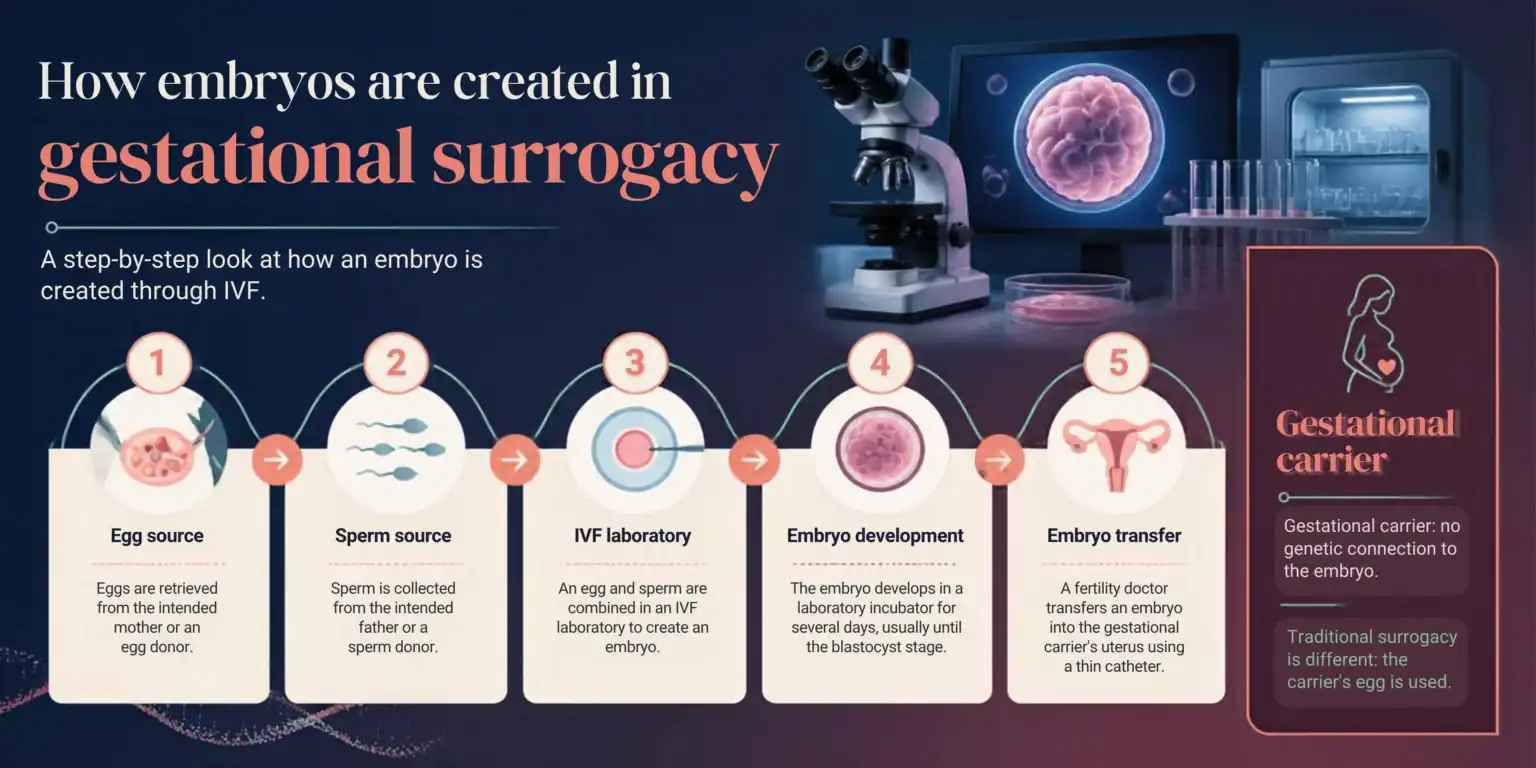
- The process begins with ovarian stimulation and then egg retrieval is undertaken
- Then the sperm collection is undertaken
- Then the eggs are fertilized with the sperm in the lab
- Then the embryo growth is monitored and when it is ready for transfer then is transferred to the uterus.
How is the stage of delivery planned in a surrogacy pregnancy?
It is the part of the whole procedure which has to be planned way before, since it is the most crucial part of the procedure. This is something that doctors get most concerned about. The planning for this remains crucial not only for the doctors but for the concerned couples too.
Consult Now
GET A FREE QUOTE
The arrangements are essential for the process, as it is not a one day thing from which can be planned and arranged in a day rather it takes months and for that reason it is important that planning regarding that should be undertaken in a systematic and structured manner. And the arrangement should be made in advance.
Medical Planning
Medical planning is important for delivery, since the doctors have to make decisions prior to delivery. There is no fixed timing of delivery that is estimated prior. One more thing that is important to note here is that the couple cannot decide or dictate C-section.
A healthy pregnancy is undertaken spontaneously where induction is initiated prior almost 39 weeks as per the Obstetrician advises.
The delivery is undertaken in a lab that is registered under ART regulations.
Legal Aspects
There are parentage rights and custody that has to be documented and and should have for the practise of the rights and for that it becomes very important.
It is strictly advised that the couple should have these documents since surrogacy is not just a medical treatment but a legal procedure too.
There should be a document proving the biological child is legally the child of the intended mother.
It has to be noted as per the law the intended parents cannot disown or abandon the child.
The surrogate can only terminate the surrogacy with her written consent and if that is authorized by the concerned authority.
Maximum age for surrogate mother for surrogacy in India
The maximum age for surrogacy in India is around 35 years. The age limit for the surrogate mother in India is between 25 and 35 years. It is important that the surrogate mother should be ever-married. She must have a child of her own. And there should be a consent of the surrogate mother and they should be a close relative of the patient.
Consult Now
GET A FREE QUOTE
The surrogate mother can only go for surrogacy once in her lifetime. And as per Indian law the surrogate mother is not allowed to undergo surrogacy more than once in her lifetime.
Medical care provided to the surrogate mother in India
The medical care provided to the surrogate mother in India are as follows:
🩺 Pre-Pregnancy Screening: A health screening is conducted to assess the surrogate mother’s overall physical and psychological health.
🧬 IVF and Embryo Transfer: Fertility treatments and hormonal medications are used to prepare for IVF. Once the embryo is ready, it is transferred into the surrogate mother’s uterus.
🤰 Antenatal Care: After conception, regular check-ups and ultrasound scans are performed to monitor the pregnancy and identify potential medical conditions.
🧪 Lab Tests and Medications: Necessary laboratory tests are conducted, and prescribed medications are provided to support the surrogate mother’s health during pregnancy.
- 🏥 Delivery and Hospitalization Care: Medical care is provided during labor, delivery, hospitalization, and the postpartum period to support the surrogate mother’s recovery.
Surrogacy Success Rate in India
The surrogacy success rate in India is mentioned below that gives an estimate of the surrogacy success rate in India which is a verifiable data which helps patients getting a trusted and accurate data.
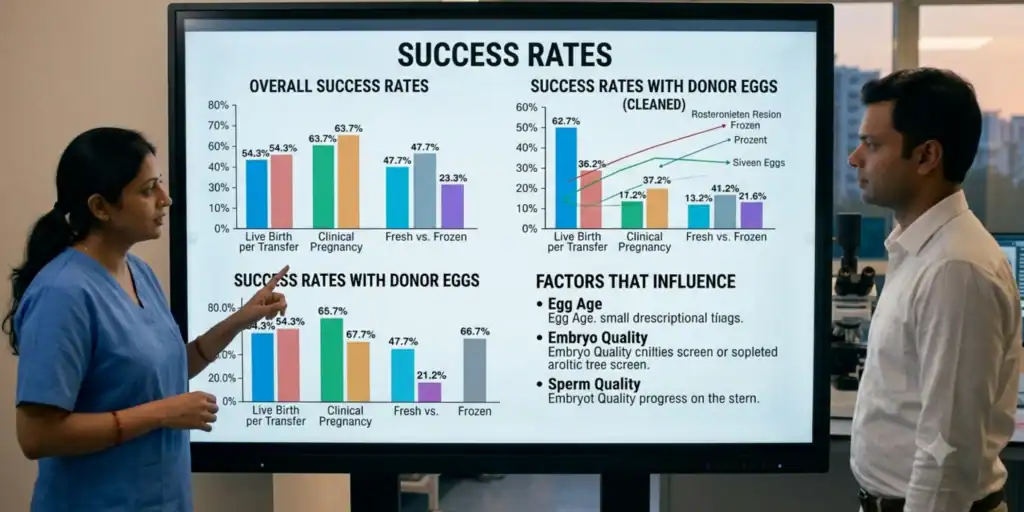
Specific interpretation for each result or the factors for surrogacy after it is mentioned below. The interpretation of this helps you understand. All the interpretations are mentioned here.
| Outcome or Factor | Success-Rate Data / Expected Influence | Interpretation |
|---|---|---|
| Live Birth per Embryo Transfer | 54.3% in a large US study of gestational-carrier cycles | International reference; not an India-specific estimate. Source: PMC |
| Clinical Pregnancy per Embryo Transfer | 63.7% in the same US study | Clinical pregnancy does not guarantee live birth. Source: JAMA Network |
| Pregnancy Rate with Donor Eggs | Published US data reported live-birth rates of 47.7% with fresh donor eggs and 46.1% with frozen donor eggs in gestational-carrier cycles | These results should not be directly transferred to Indian clinics. Source: PMC |
| Intended Parents’ Egg Age | Younger egg age generally improves embryo-related prospects. | The surrogate’s age is not a substitute for the age of the person providing the eggs. |
| Embryo Quality | Influences implantation and pregnancy outcomes. | Embryo grading alone cannot guarantee a live birth. |
| Fresh vs. Frozen Embryo Transfer | Outcomes depend on clinical circumstances and embryo characteristics. | Neither approach is universally more successful. |
| Number of Transfer Attempts | Cumulative chance may increase over multiple attempts. | The cumulative rate is not the same as the success rate per transfer. |
| Surrogate’s Health | Medical fitness and appropriate pregnancy care matter. | Screening helps assess risk but cannot eliminate complications. |
Best surrogacy centres in India
If looking for surrogacy centres in India for treatments that are trusted and safe for which the couple do not have to take any stress and can easily choose from it is important that the couple should have the right information regarding the surrogacy centres in India.
It is especially helpful for the patients who are travelling from other nations. It is important that they should refer to the list from the following list to have a better understanding regarding the centres operating in India.
List of Best Doctors for surrogacy in India
The best doctors for surrogacy in India are the following who hold experience over a decade each of them. They are the ones who have experience as well as expertise and that helps in building trust and safe treatments.
Consult Now
GET A FREE QUOTE
It is important that they are consulted for treatments which are as sensitive as surrogacy. This is a treatment that requires special care and attention.
How to Choose a Surrogacy Centre in India?
One should keep a few things in mind while choosing a clinic for surrogacy in India. Since without planning and knowing about the clinics is important. There are certain things that should be paid heed to since that helps in making the process a lot more easier. And they are as follows:
Consult Now
GET A FREE QUOTE
- First of all one should check for the certifications and the registration of the surrogacy clinics in India.
- Check if altruistic surrogacy is practised in the clinic and one should check if the commercial surrogacy is practised then those clinics should not be chosen for treatment.
- One should have checked if the couple has official documents required for surrogacy.
- Then check if the surrogacy clinic has doctors specialised and have practical experience of the doctor.
- Should check for the success rate of the clinic which should be relevant and not advertised data or inflated data.
- Check for treatment costs of surrogacy clinics, check for the treatment cost is not exceptionally high.
- Check for advertised costs of treatment, there can be different advertised costs which can be less prior but once you consult the centre the cost of treatment can be exceptional.
Conclusion
Couples planning to look for surrogacy should be aware of all the aspects and information regarding surrogacy. For understanding regarding surrogacy in India, it is important that one should know about all the different factors such as success rates, costs and all about the doctors who perform surrogacy.
Frequently Asked Questions
Surrogacy is completely legal in India under the Surrogacy (Regulation) Act, 2021. Only altruistic surrogacy is legal in India and commercial surrogacy is completely illegal in India.
The surrogate is not associated with any compensation or remuneration for undergoing surrogacy. It is important that one should know prior that commercial surrogacy is not legal in India.
The altruistic surrogacy means that the surrogate is not associated with any compensation or monetary exchange for undergoing surrogacy. And if they are provided any compensation or any monetary exchange then that refers to commercial surrogacy.
A surrogate mother must be married and have a child of her own which is healthy. A surrogate mother should be aged around 25-35 and it is mandatory that she should be a surrogate mother only once in her lifetime.
Foreign nationals are not legally permitted to undergo surrogacy in India but rules for NRIs and OCIs can be different and the rules regarding that must be checked for the treatment. The treatment is mostly restricted to the Indian intended parents.
The legal parental rights of the child who is born through surrogacy remains with the intended parents or intended mother with. And they are legally bound to keep the baby and they cannot disown the child or abandon the child.
The documents which are required for approval are the following:
- One must have a document stating the medical need for surrogacy.
- Document of proof for eligibility for intended parents
- For parental rights and custody
- Treatment at a registered surrogacy clinic.
The primary requirement is that the embryos have to be created by the intended couple’s gametes only but after a few amendments one donor gamete is allowed for use.
There is no fixed surrogacy timeline for undergoing surrogacy in India. But there are data around different sites which state it is around 12-24 months.