
IVF Success Rate in India 2026 – Age-Wise & City-Wise Data
If going for an advanced fertility treatment such as IVF success rate should be taken into consideration, since the more well-researched and informed the patients, the more it helps them understand the treatment. Success rate helps in understanding and building trust in the treatment. India is mostly chosen for its affordability and experienced medical professionals. But another most important factor due to which there is a rise of medical tourism in India is because of the success rate.
IVF success rate in India remains quite high as compared to other countries around the world. Not only is India affordable for people from western countries, but it also has a high success rate, due to which it is chosen by both local as well as international patients. And incorporation of advanced technology and experienced staff works as an added advantage.
What is the IVF success rate in India?
The India success rate is quite high and mostly in the metro cities since they carry practical experience and they know how to handle complex cases since they have handled these cases before.
Fertility Clinics have a high IVF success rate in India, since they incorporate the latest treatment methods and have multiple fertility specialists who are experienced.
IVF Success Rate by Age
Age is a major determinant in the success of IVF treatment. The chances of success are higher when undertaken in younger age and lower when undertaken in older age. IVF success rate by age is mentioned below, which helps provide an age-specific success rate.
There are higher chances of IVF success rates under 35, since the quality and quantity are comparatively higher then success rate of IVF at 40.
Book Consultation
GET A FREE QUOTE
| Patient Category | Success Rate per Cycle |
| Women below 30 years | 80%–90% |
| Women aged 30–34 years | 65%–75% |
| Women above 40 years | Below 15% |
| Donor Egg IVF | 50%–70% |
| Frozen Embryo Transfer | 40%–60% |
IVF Success Rate in First Attempt and Cumulative Success Rate
The IVF success rate in the first attempt is generally lower compared to the cumulative success rate, since after around 3- 4 cycles the chances of success increase, resulting in a higher overall success rate. And if the IVF success rate in India by age in first attempt while younger is relatively higher than an advanced age.
| IVF Attempts | Estimated Live-Birth Success Rate | What It Means |
| 1st attempt | 35%–45% | Chance of a live birth from the first IVF cycle/retrieval |
| After 2 attempts | 50%–65% | Combined chance after two IVF attempts |
| After 3 attempts | 65%–75% | Cumulative chance after three attempts |
| After 4 attempts | 70%–80% | Cumulative chance after four attempts |
IVF Success Rates in Major Cities of India
There are multiple cities in India which accommodate modern technology, better medical infrastructure and a high success rate in major cities of India.
| City | Approximate IVF Success Rate |
| Mumbai | 85%–90% |
| Delhi NCR | 85%–90% |
| Bangalore | 80%–88% |
| Chennai | 80%–88% |
| Hyderabad | 80%–87% |
| Pune | 78%–85% |
| Ahmedabad | 78%–85% |
| Kolkata | 75%–85% |
IVF Success Rates in Different Countries
The success rates in different countries is mentioned below which helps give comparison
| Country | Estimated IVF Success Rate |
| India | 85%–90% |
| Cyprus | 82%–92% |
| UAE | 80%–90% |
| USA | 78%–88% |
| Spain | 76%–86% |
| Denmark | 75%–85% |
| Belgium | 74%–84% |
| Czech Republic | 72%–82% |
| Australia | 70%–80% |
| Greece | 68%–78% |
| UK | 65%–75% |
| Germany | 60%–70% |
Success rates of leading IVF centers in India for women over 40
Women over 40 are generally suggested IVF since the quality and quantity both decline with an advancing age. Here is a list of a few clinics which provide fertility treatments in India.
| IVF Centre | Approximate/Reported IVF Success Rate |
| India Health Tour | 75–88% |
| We Care Nidus Fertility | 60–75% |
| World Fertility Services | 53% with self eggs; 65% with donor eggs |
| Select IVF | 45–62% with self eggs; 70–75% with donor eggs |
| Go IVF Surrogacy | 55–75% |
| ACME Fertility | 50–65% |
| Kiran Infertility Clinic | 50–70% |
| Zoi Fertility | 50–65% |
| Mediworld Fertility | Up to 87% successful pregnancies |
| Prime Fertility | 40–60% |
Quick Overview of Success Rate of IVF in India
IVF is a medical treatment which has helped multiple couples experience the joy of parenthood who are medically unfit for naturally conceiving and require medical assistance. And the rate of success is based on multiple factors and they are the condition of the patient, location, expertise of the doctor and so on.
What are the factors affecting the success rate of IVF in India?
- The age of the patient remains a major determinant since it ensures the quality and quantity of the gametes produced.
- There are various medical conditions such as PCOS, thyroid problems, blockage in tubes and so on.
- With changing lifestyles people tend to take the lifestyle less seriously and ignore proper sleep, start smoking, consume alcohol, take unhealthy diets all of which contributes in influencing the success rate of IVF in India.
- Look for a clinic that uses the latest technology and experienced medical and non-medical staff.
- The procedure of embryo selection is also an important factor that influences the success of the IVF treatment.
Book Consultation
GET A FREE QUOTE
IVF Treatments Success Rate in India
There are different procedures that are combined with IVF treatment which patients are prescribed as per the diagnosis and requirement of the patient.
Standard IVF Success Rate in India
It is a medical treatment which does not include multiple other treatments for instance genetic testing, donor programs, embryo transfers, fertility preservation programs, treatments for male-factor infertility.
The treatment only consists of stages such as ovarian stimulation, egg retrieval procedure, sperm collection, embryo culture and kept under observation, and different pregnancy tests.
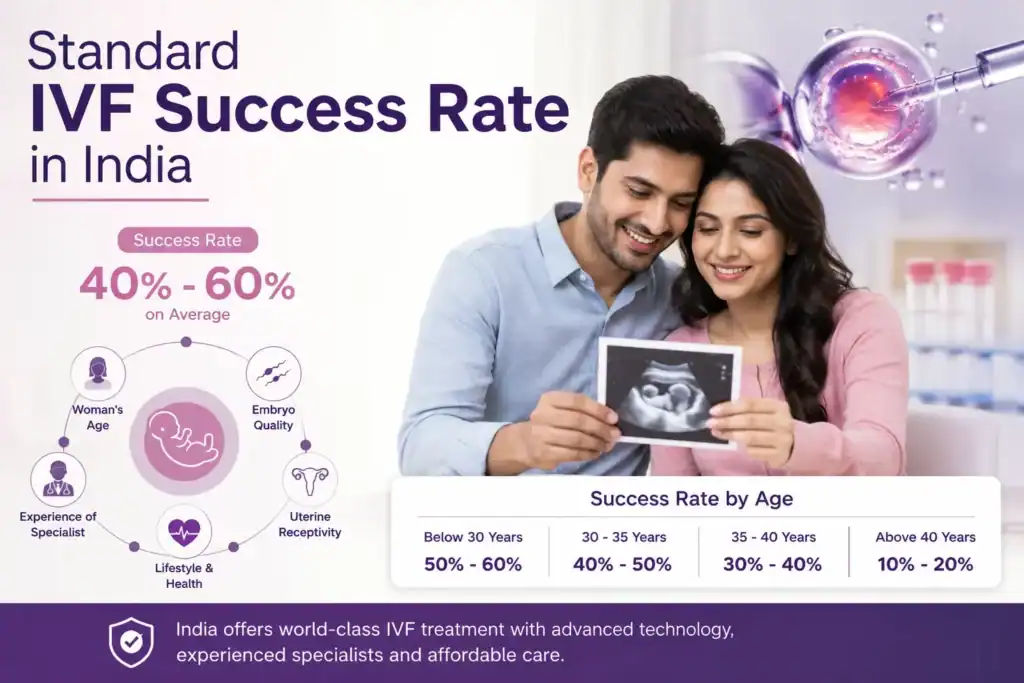
| Treatment | Approx. Success Rate |
| Standard IVF | 50%–60% |
| Natural Cycle IVF | 30%–45% |
| Stimulated IVF | 70%–80% |
| Minimal Stimulation IVF | 60%–70% |
IVF Treatment with ICSI
If the standard IVF treatment does not work then male-factor infertility may be a reason for the failure of treatment. IVF combined with ICSI where a single sperm is selected from the semen sample and injected directly to the mature egg. It is combined with IVF treatment due the following:✦ Low Sperm Count
✦ Poor sperm motility
✦ Irregular shape of sperm
✦ Previous IVF cycle failure
| Treatment | Approx. Success Rate |
| IVF with ICSI | 30%–50% |
| ICSI for Male-Factor Infertility | 30%–50% |
| ICSI with Surgically Retrieved Sperm | 25%–45% |
| ICSI with Good-Quality Embryos | 40%–60% |
Book Consultation
GET A FREE QUOTE
Embryo Transfer And Frozen Embryo Transfer
There are multiple types of embryo transfer procedures that are combined with IVF.
- Fresh Embryo Transfer – In this procedure an embryo created during the IVF cycle is transferred to the uterus for implantation.
- Frozen Embryo Transfer(FET) – Extra embryos created during the IVF cycle are kept aside for the future cycles. They are
- Blastocyst Transfer – The blastocyst is the stage when an embryo is grown in the lab for 5-6 days and then it is ready for placing it to the uterus.
- Embryo Freezing (Cryopreservation) – It is a medical procedure which is used for freezing embryos then they are used for IVF or kept for future preservation of pregnancy.
- Embryo Thawing and Transfer – It is a procedure where the frozen embryo is warmed and then rehydrated and then it is placed into the uterus.
| Treatment | Approx. Success Rate |
| Fresh Embryo Transfer | 30%–50% |
| Frozen Embryo Transfer (FET) | 35%–55% |
| Blastocyst Transfer | 40%–60% |
| Frozen Blastocyst Transfer | 45%–65% |
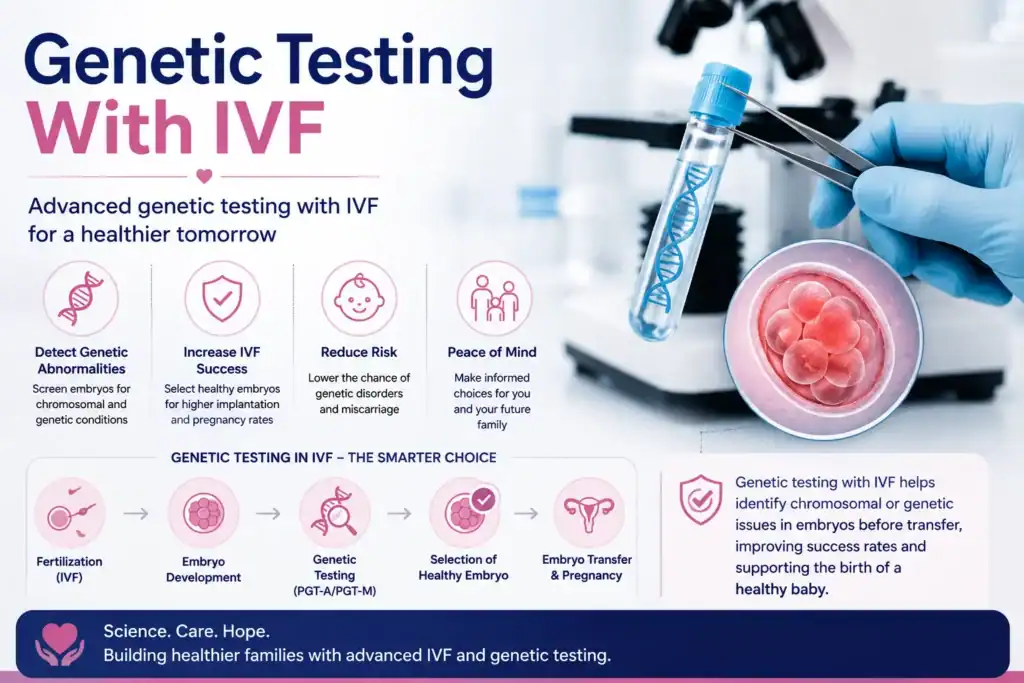
Genetic Testing With IVF
Genetic testing is combined with IVF treatment for checking if there are any genetic disorders and it is checked if there are any structural and if there is no normal count of chromosomes. There are the
- PGT-A: It helps by checking embryos for which has the right chromosome count before transfer, identifying issues that often lead to failed implantation or miscarriage.
- PGT-M: This medical procedure screens embryos, checking for a specific inherited disease which is a history of genetic disorders in the family, like thalassemia or cystic fibrosis.
- PGT-SR: This procedure helps in identifying chromosomal rearrangements in embryos when a parent carries a balanced translocation, lowering the odds of miscarriage.
- PGS: It was earlier called PGT-A clinics have changed it, but you’ll still spot it in older write-ups.
- PGD: The original term which covers which is now split into PGT-M and PGT-SR, still commonly called in everyday clinic conversations.
- NGS: This medical procedure is the sequencing technology behind modern PGT testing, prized for picking up mosaicism that older methods like FISH missed.
| Treatment | Approx. Success Rate* |
| Euploid Embryo Transfer | 70%–90% |
| PGT-A with Euploid Embryo | 70%–85% |
| IVF with PGT-A | 50%–70% |
| IVF with PGT-M | 45%–65% |
| IVF with PGT-SR | 45%–65% |
Donor Programmes With IVF
Patients who are medically unfit to provide their own eggs or sperm, or are single parents, have to undergo donor programmes. This programme involves using someone else’s eggs or sperm for IVF treatment.
➤ Donor Egg IVF – Donor eggs instead of the intended mother’s eggs are used for IVF.
➤ Donor Sperm IVF – Donor sperm instead of the intended father’s sperm is used for IVF.
➤ Egg Donation – The process in which the woman undergoes ovarian stimulation and egg retrieval for egg donation.
➤ Sperm Donation – This is a medical procedure in which a man provides sperm for IVF and IUI treatment.
| Treatment | Approx. Success Rate* |
| Donor Egg IVF + FET | 70%–90% |
| Donor Egg IVF + ICSI | 70%–85% |
| Donor Egg IVF | 60%–80% |
| Donor Embryo Transfer | 40%–60% |
| Donor Sperm IVF/ICSI | 40%–60% |
Fertility Preservation Programmes
Fertility preservation programmes are mainly undertaken to save and protect gametes, embryos and ovarian tissues for future pregnancies, and for that there can be multiple reasons.
- Egg Freezing – Unfertilized eggs are extracted after the ovarian stimulation procedure and stored after vitrification.
- Sperm Freezing – Sperm is collected, then tested, treated with an antifreeze substance and then stored in liquid nitrogen for fertility treatments.
- Embryo Freezing – This medical procedure is where eggs are fertilised with sperm in a lab and developed into embryos, which are frozen for various medical purposes.
- Ovarian Tissue Freezing – The cortex, or the outer layer of the ovary, is collected and preserved in this procedure.
| Treatment | Approx. Success Rate |
| Egg Freezing → IVF | 30%–60% |
| Frozen Egg + ICSI | 30%–60% |
| Embryo Freezing → FET | 35%–65% |
| Frozen Embryo Transfer | 35%–55% |
| Ovarian Tissue Cryopreservation | Variable; highly individualised |
Male-Factor IVF Treatments
There are treatments that are undertaken for treating male-factor infertility, conditions such as low count, poor motility, abnormal shape, or DNA fragmentation; these remain the primary conditions for which different treatments are suggested.
Book Consultation
GET A FREE QUOTE
- Surgical Sperm Retrieval – This is an umbrella term which covers all surgical sperm retrieval methods when there is an absence of ejaculation.
- TESA (Testicular Sperm Aspiration) – It is a procedure where, with the help of a needle, it is inserted to the testicle to collect a small sample of sperm.
- TESE (Testicular Sperm Extraction) – A small incision is made which is for removing testicular tissue samples, giving a comparatively higher yield of sperm.
- Micro-TESE – It is a more advanced method where the healthiest sperm is selected with high magnification, causing the least damage.
- PESA (Percutaneous Epididymal Sperm Aspiration) – It is the procedure where a needle is used to collect sperm directly from the epididymis instead of the testicle.
- MESA (Microsurgical Epididymal Sperm Aspiration) – A microsurgical treatment in which sperm are retrieved from the epididymis.
| Treatment | Approx. Success Rate |
| IVF for Male Infertility | 30%–50% |
| IVF + ICSI | 30%–50% |
| IVF + TESA | 35%–45% |
| IVF + TESE | 35%–45% |
| IVF + Micro-TESE | 45%–50% |
| IVF + PESA | 35%–45% |
Conclusion
If researching IVF treatment or any fertility treatments, it is important to search for all information regarding the treatment. From doctors to location, accommodation, industry standards, and success rates. IVF success rate in India is higher, with ease of accommodation and a medical infrastructure that matches global standards.
Book Consultation
GET A FREE QUOTE
Frequently Asked Questions
Is IVF successful in the first attempt?
IVF treatment does not guarantee success on the first attempt; it is a medical procedure, and success can vary due to different conditions. There are a few patients who get success in the very first cycle. But usually 3-4 cycles for a successful live birth or pregnancy.
At what age is IVF most successful?
The age at which IVF is most successful is under 35, since at a younger age the ovarian reserve and quality of eggs are higher in women. And it can improve the chances of a successful pregnancy.
Does IVF fail the first time?
Yes, IVF may fail in the first attempt. Since it is a medical treatment and there are multiple factors that influence the success of the treatment, it is not guaranteed that it will be successful in the very first attempt. It has been observed most of the time that around 50%-70% do not result in a successful live birth.
Is IVF more successful the 2nd time?
The success of IVF is comparatively higher than the first time. The cumulative chance of pregnancy or a live birth is higher when the patient goes through a second cycle.
How many weeks of IVF pregnancy?
IVF pregnancy is around 40 weeks long, which is calculated similarly to a natural pregnancy. It is calculated on the basis of the standard rule, which is from the egg retrieval. If the patient had a 3-day embryo transfer after fertilisation, then the patient is considered to be 2 weeks and 3 days pregnant on the very day of the transfer. And if the patient had a 5-day blastocyst transfer after fertilisation, then the patient is 2 weeks and 5 days of the transfer.
What foods should I avoid during IVF?
When the patient is undergoing IVF treatment, they should avoid foods such as raw or any uncooked food, high-mercury fish, alcohol, trans fats and packaged refined sugar, and excessive caffeine. To have a more specific detail of the food which has to particularly avoided during IVF, it is advisable to consult the doctor.
What is the average IVF success rate in India?
An average IVF success rate in India is around 30% to 40% per cycle. The cumulative rate is higher since the chances of success rise around 3-4 cycles. It depends on multiple factors, such as age, egg and sperm quality, and the infrastructure of the clinic.
How does the IVF success rate in India compare to success rates abroad?
IVF success rates in India are compared with those in countries abroad, mostly for younger women and patients who are treated at experienced and trusted fertility centres. However, a direct country-to-country comparison can be false, since it depends on factors such as age, egg and sperm quality, infertility diagnosis, quality of embryos, and so on.
What factors affect IVF success rate in Indian fertility clinics?
The major factors that affect IVF success rate in Indian fertility clinics depend on certain major factors such as patient-related treatment plans by fertility specialists and laboratory factors. The experience of the doctors, lab standards and the treatment protocols they adhere to.
What is the IVF success rate for women over 35 in India?
IVF success rates under 35, taken collectively is around 60% to 70%. The quality and quantity of the eggs decline with advancing age. Under these conditions, IVF is suggested to patients who find difficulty conceiving naturally.
Is ICSI more successful than conventional IVF in India?
It is not important and does not assure that ICSI is more successful than conventional IVF in India. Rather, it raises the chances of success when there is male-factor infertility or if there is failure of fertilisation during previous conventional cycles.