
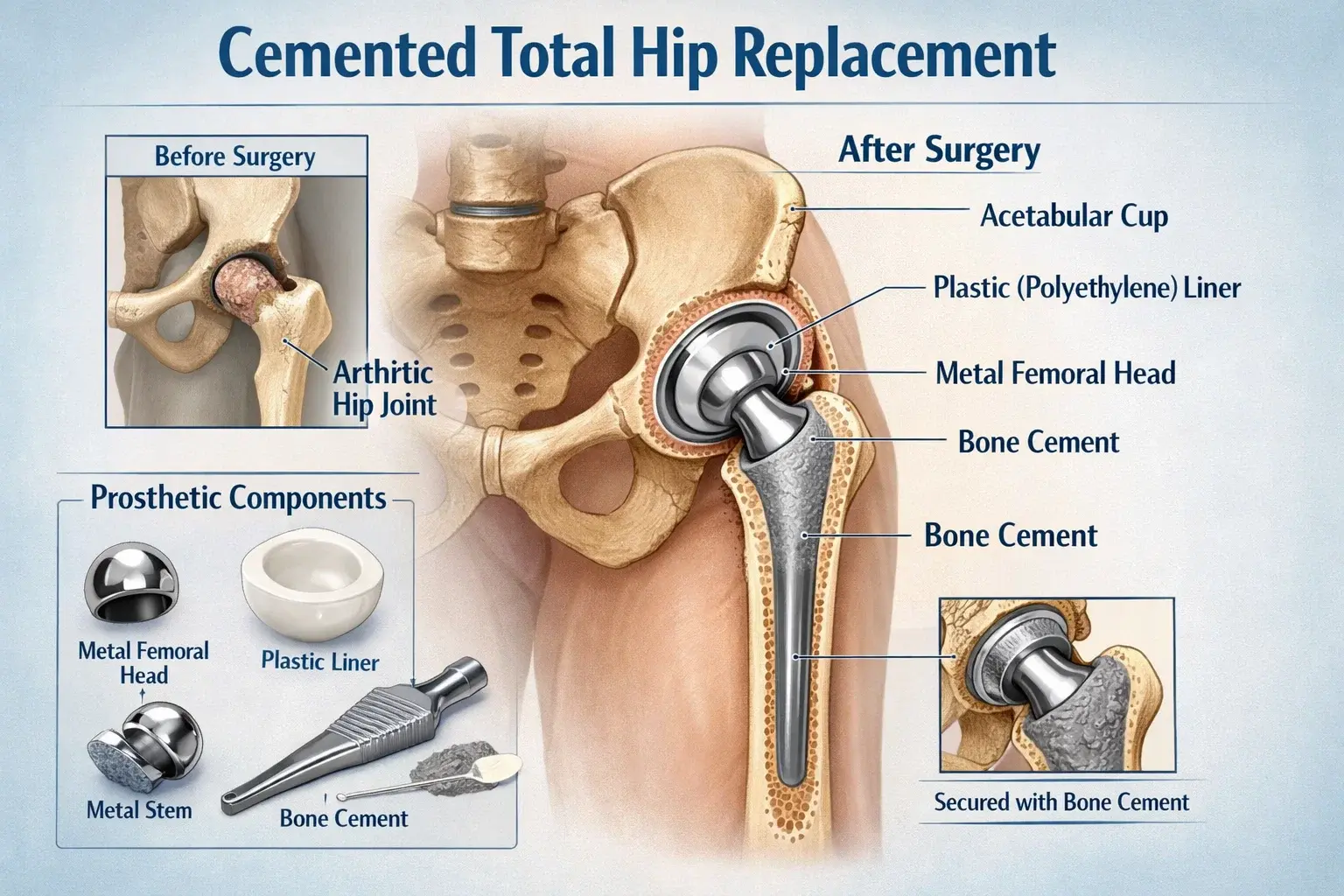
Cemented Total Hip Replacement Surgery in India has reduced failed surgeries, and there isa requirement for less time in recovery. The cemented hip replacement implant is designed to be implanted using bone cement (a grout that helps position the implant within the bone). Bone cement is injected into the prepared femoral canal. The surgeon then positions the implant within the canal and the grout helps to hold it in the desired position.
Cemented fixation relies on a stable interface between the prosthesis and the cement and a solid mechanical bond between the cement and the bone. Today's metal alloy stems rarely break, but they can occasionally loosen. Two processes, one mechanical and one biological, can contribute to loosening.
Consult Now
GET A FREE QUOTE
In the femoral component, cracks (fatigue fractures) in the cement that occur over time can cause the prosthetic stem to loosen and become unstable. This occurs more often with patients who are very active or very heavy. The action of the metal ball against the polyethylene cup of the acetabular component creates polyethylene wear debris. The cement or polyethylene debris particles generated can then trigger a biologic response that further contributes to loosening of the implant and sometimes to loss of bone around the implant.
Hip Replacement Indications: Why Cemented Hip Replacement
Hip replacement surgery will be required when there is damage to the hip joint that prevents you from performing daily activities without pain and limitations. The hip joint bears weight and has a direct impact on how you move in your daily activities, such as walking, sitting, and sleeping. If medications, physical therapy, and lifestyle changes are not providing relief, hip replacement surgery may be the next step to relieve the pain, restore comfort, maintain balance, and independence in the daily activities of your life.
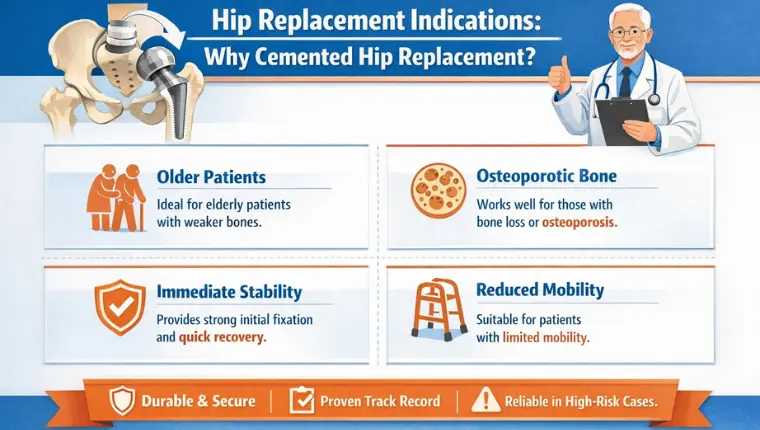
Hip Replacement Indications Why Cemented Hip Replacement
- Pain in the hip that persists and requires continued contact regularly, even while sleeping
- And/or Hip Joint Damage Caused By Advanced Osteoarthritis
- Painful Wear, Tear, and Erosion of the Hip Joint Caused by Osteoarthritis
- Hip Joint Deformities Caused by Osteoarthritis
- Rheumatoid Arthritis Causing Joint Pain and Deformity
- Decreased Blood Flow to the Hip Bone (Avascular Necrosis), Causing Damage to the Hip Bone
- Hip Fracture Will Not Heal Correctly (Especially in the Senior Population)
- Walking, Climbing Stairs, or Standing for Extended Periods Can Be Very Challenging
- Significant Shortening or Malalignment of the Legs Due to Hip Joint Damage
- Quality of Life is Significantly Affected Because of Constant Pain and Limited Mobility
What is Cemented Total Hip Replacement Surgery?
Computer-assisted navigation in hip replacement acts like a smart map for surgeons. It includes software for planning, trackers that follow movements in real time, and tools that link to the system. These parts work together to build a 3D picture of your hip based on scans, showing bones and joints in detail.
The system starts with images of your body. It then overlays data during surgery so the surgeon sees exactly where to cut and place implants. This setup cuts down on guesswork and boosts safety.
Many hospitals use optical trackers, like cameras that spot tiny markers on bones. Others pick electromagnetic ones that sense fields without lines of sight. Both help create that accurate 3D model, tailored just for you.
The Mechanics: How Navigation Guides the Surgeon
During the operation, the surgeon first registers key points on your bones. This matches the 3D model to your real body, using probes to mark spots like the pelvis edge. Once set, trackers on tools and bones send data to the computer screen.
Real-time feedback shows angles and depths as the surgeon works. In old-school methods, docs estimate from what they see and feel. But navigation flashes warnings if something's off, like a dashboard light in your car.
It shines in fixing leg length gaps and hip alignment. The system measures these with accuracy down to a millimeter. For acetabular cup placement— that's the socket part—it ensures the right tilt and twist, keeping your hip stable for years.
Navigation vs. Conventional (Freehand) Surgery
Navigation beats freehand surgery in key ways. First, accuracy: Studies show navigated procedures hit target alignments 95% of the time, while freehand ones manage about 50%. That's a big jump for lasting results. Operative time tells another story. New surgeons might add 15-20 minutes at first to set up the system. But with practice, times even out or shorten, thanks to fewer fixes later.
Consult Now
GET A FREE QUOTE
Radiation exposure stays low in both, but navigation often skips extra X-rays by using built-in checks. Freehand relies more on fluoroscopy—live X-ray—for checks, which can mean more doses.
- Accuracy: Navigation wins with sub-millimeter precision; freehand depends on skill.
- Time: Starts longer for navigation but levels off.
- Radiation: Similar overall, but navigation reduces intraoperative scans.
- Outcomes: Navigation links to better joint function and fewer issues down the line.
How We Care Health Services helps with Cemented Hip Replacement Surgery
We care health services is a multiple health work system, where technology meets medical standards. There are different problems with many patients, such as bone damage or depletion of the surface. Replacement is the plating of the surface so that it can remain stable for a long time. We Care Health Services provides a complete range of support to patients who decide to have hip replacement surgery performed via computer; safety, accuracy, and ease of recovery are the key components of the We Care Health Services process. Our philosophy is patient-centric, with a strong emphasis placed on providing both advanced surgical coordination and individual attention at every stage of the process.
- Working together with our partner hospitals and leading orthopedic surgeons throughout India, we ensure that our patients receive consistency in treatment and satisfactory results.
- Support in finding qualified orthopedic surgeons who are experienced with performing computer-assisted, robotic hip replacements
- Support in identifying accredited hospitals that provide navigation or robotic systems
- Clear information regarding surgery fees, types of implants used, and hospital packages
- Assist in preparing and supporting all pre-operative medical evaluations and documentation
- Customized travel, lodging, and admission plans for out-of-town patients
- Care coordinators will be your interface for ongoing communication and updates
- Follow-up care; physiotherapy instructions; guidance for recuperation
- Support for international patients, including visa help and translation assistance
Computer Assisted Surgery may seem confusing due to the tools used and the price of surgery, which adds to the confusion. We Care Health Services wants to make Computer-Assisted Surgery an easier experience by providing honest and guiding support for all patients and making high-quality care available without overwhelming stress.
Clinical Benefits and Patient Outcomes
Getting the hip implant just right matters a lot. If the cup sits outside the safe zone—usually 40 degrees inclination and 15-20 degrees version—it can loosen early or cause pain. Navigation helps surgeons nail these spots every time.
Research from major journals points to this edge. One study of over 1,000 cases found navigated THA achieved planned positions in 92% of patients, versus 70% in standard surgery. That means less wear on the parts and smoother movement. Patients feel it too. Better placement leads to hips that move naturally, without that "off" feeling. It's like fitting a puzzle piece perfectly instead of forcing it.
Improvements in Leg Length and Offset Restoration
Leg length mismatches after surgery can throw off your walk. A difference over 1 cm might cause back pain or a limp. Computer navigation spots these issues live and adjusts on the fly. By tracking hip center and femur length, the system restores your natural offset—the side-to-side distance. This keeps muscle pull balanced, so your gait stays even. Folks often report quicker recovery and less fatigue. Ask your surgeon these questions before surgery: "How will you measure my leg length? What's your goal for my offset?" Clear answers build trust and set expectations.
Potential Impact on Revision Rates and Longevity
Sharp placement from the start cuts revision needs. Revisions—second surgeries—happen in about 10% of standard THA cases within 10 years, often from misalignment. Navigation drops that risk by improving fit.
Long-term data is promising. A five-year follow-up on 500 patients showed navigated hips with 98% survival rates, compared to 94% for freehand. Less wear on plastic liners means the joint lasts longer. Think of it as building a house on a solid base. Strong foundations mean fewer cracks over time. Patients enjoy active lives longer, from hiking to daily chores.
Consult Now
GET A FREE QUOTE
Preoperative Imaging and Custom Planning: Diagnosis of Problem
Before the big day, you get CT scans or special X-rays of your hip. These feed into software that lets the surgeon pick the best implant size and spot. It's like custom-tailoring a suit for your bones.
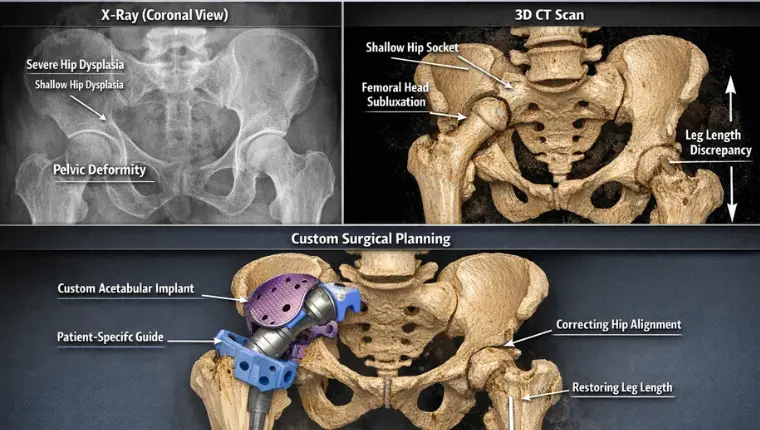
Preoperative Imaging and Custom Planning
Surgeons often favor low-dose CT for clear 3D views without excess radiation. In one common case, a patient with arthritis sees their worn joint mapped out, with plans for a posterior approach to minimize muscle cuts. This step personalizes everything. It flags issues like bone spurs early, so the team preps smart tools. You end up with a blueprint that guides the whole procedure.
Intraoperative Workflow and Registration Challenges
In the operating room, setup takes about 10 minutes. The surgeon pins trackers to your pelvis and femur, then registers landmarks. The screen syncs the model, and surgery flows from there. Soft tissue can shift, causing small errors in tracking. Docs counter this by rechecking points midway and using rigid fixators. Leading groups like the American Academy of Orthopaedic Surgeons stress double verification for safety. If registration slips, the system alerts right away. This keeps things on track, blending human skill with tech backup.
Integration with Robotic Assistance Systems
Navigation lays the groundwork for robots in hip surgery. Robotic total hip arthroplasty (RTHA) uses the same 3D map to guide a robotic arm for precise cuts. It's like having a steady hand that never tires. Many systems, such as those from big med-tech firms, start with navigation data. The robot haptically blocks over-cuts, ensuring bone prep matches the plan. This combo is gaining ground, with over 20% of THA cases now robotic-assisted. Patients benefit from even tighter tolerances. Early results show faster rehab, as alignments stay spot-on.
Addressing Concerns and Limitations: Cost of Cemented Hip Replacement Surgery
Switching to navigation takes time for surgeons. Early on, procedures might run 20% longer while they master the setup. But after 20-30 cases, speeds match or beat freehand. Costs add up too. The system hardware runs $500,000 upfront, plus disposables per surgery at $1,000 or so. Hospitals offset this with better outcomes that cut long-term care bills. For patients, insurance often covers it as standard THA. Weigh the investment against the potential for fewer follow-ups.
While it is difficult to estimate the precise cost of computer-assisted hip replacement surgery, they are typically higher than a traditional method because they use advanced navigation/robotic systems for accurately placing the implants.
|
Type of Procedure |
Estimated Cost Range |
|
Computer Assisted Single Hip Replacement |
₹4,00,000 – ₹6,50,000 |
|
Computer Assisted Bilateral Hip Replacement |
₹7,50,000 – ₹9,50,000 |
|
Robotic Navigation Charges Add-on |
₹1,00,000 – ₹2,00,000 |
|
Government Hospital Package |
₹3,50,000 – ₹5,00,000 |
|
International Patient Package |
USD 7,000 – USD 10,000 |
Consult Now
GET A FREE QUOTE
The average cost of this procedure will range from ₹4,00,000 to ₹9,50,000, depending on many factors such as the hospital category, the surgeon's experience, the type of implant used, and whether the patient has undergone unilateral or bilateral surgery. The cost of Computer Assisted Hip Replacement surgery at private metro hospitals is generally higher than in government/trust hospitals, due to the use of high-tech equipment and greater length of the rehabilitation support provided.
Best hospitals for Computer- Assisted Hip Replacement Surgery
The best hospitals in India offering hip replacement surgery with the assistance of robots or computer systems have a good reputation for the combination of robotic and computer navigation technology, along with very experienced orthopedic teams. Apollo Hospitals is the leader in robotic and computer-navigated joint replacements in multiple cities in India. Medanta - The Medicity is considered a leader in the area of complex and bilateral hip replacement surgeries based on precision technology.
|
Hospital / Service Name |
City / Coverage |
|
Apollo Hospitals |
Multiple cities |
|
Medanta – The Medicity |
Gurugram |
|
Fortis Healthcare |
Multiple cities |
|
Manipal Hospitals |
Multiple cities |
|
Kokilaben Dhirubhai Ambani Hospital |
Mumbai |
|
We Care Health Services |
Pan India |
Fortis Healthcare provides computer-navigated hip replacement surgery in conjunction with structured rehabilitation post-surgery. Manipal Hospitals has a strong reputation as a provider of robotic-assisted joint replacement surgery, along with its focus on providing exceptional patient care.
Technical Complications Specific to Navigation
Tech glitches happen. Trackers can lose signal from blood or drapes, pausing the flow. Hardware fails rarely, but backups like manual checks keep surgery safe. Calibration eats time if not smooth, shifting focus from the patient. Yet, modern systems minimize this with user-friendly interfaces. Overall complication rates stay under 2%, similar to freehand. Surgeons train to handle these hiccups, ensuring the benefits outweigh the snags.
Patient Selection and Appropriateness
Not every hip suits navigation. Twisted bones from old fractures might confuse the model, making freehand better. Heavy obesity can block tracker views, dropping accuracy. For straightforward cases like osteoarthritis, it's ideal. Docs pick based on your build and health. If you're unsure, discuss your anatomy— it helps tailor the choice.
Consult Now
GET A FREE QUOTE
Conclusion
Computer navigation total hip replacement surgery marks a big step toward exact, custom results in THA. It shines in aligning parts right and fixing your body's balance, leading to stronger outcomes and happier patients.
Key perks include top-notch precision that boosts implant life and cuts revision odds. You'll walk better and worry less about early wear.
Looking ahead, tools like augmented reality glasses will layer data right in the surgeon's view. This isn't just a fad—it's becoming the go-to way to replace hips. If hip pain plagues you, talk to your doctor about navigation options. It could change your steps for the better.