
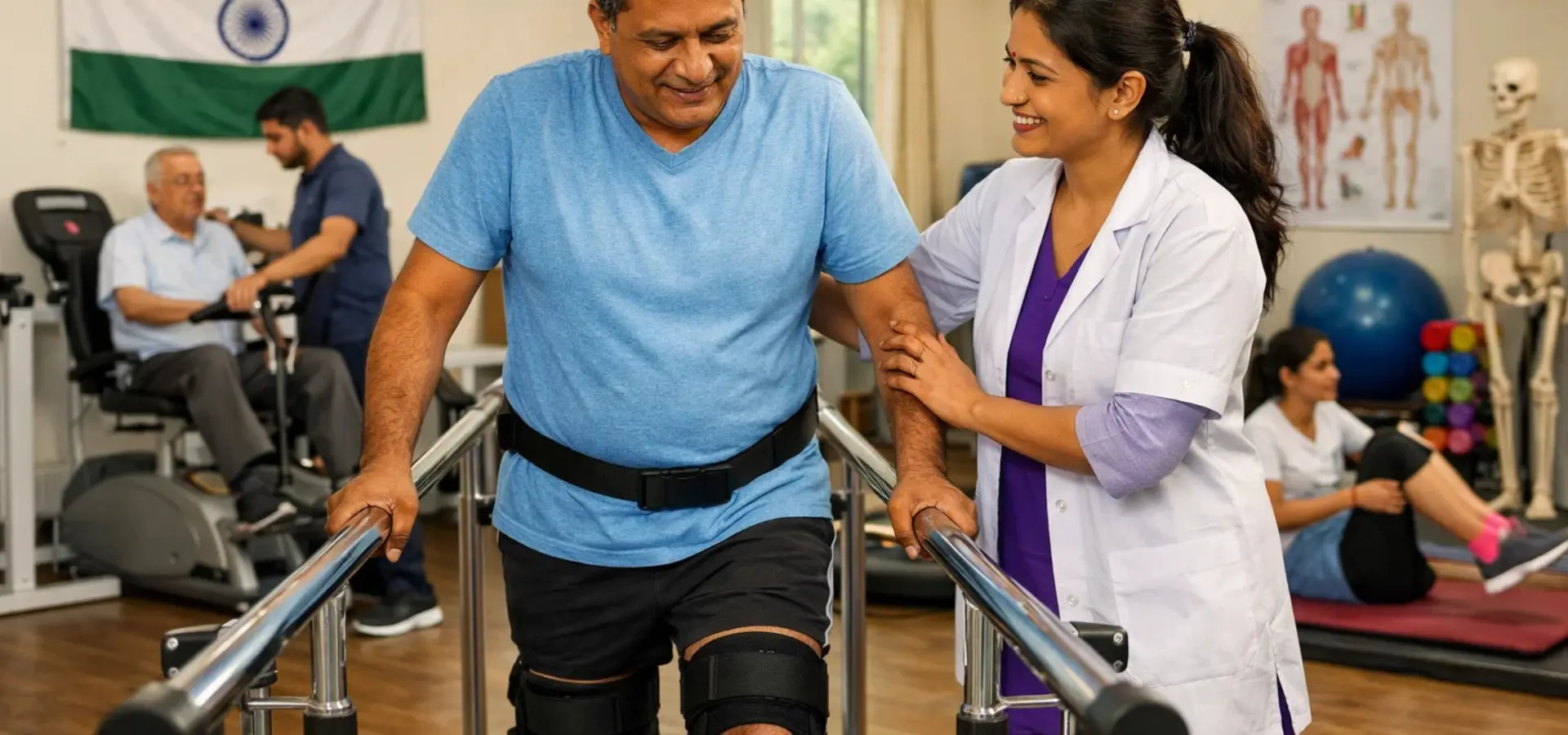
There you will find the best hospitals for orthopedic rehabilitation in India, which include technological standards and operating theatres. Orthopedic rehabilitation aims to help people with bone or joint issues (including injuries or surgical treatments for these) achieve the maximum level of function and independence again. Individuals who have undergone joint replacement, experienced a musculoskeletal injury, sustained bone trauma, or have been diagnosed with a degenerative joint disease often have limited function and mobility, pain, and other complications.
For Free Online Consultation
GET A FREE QUOTE
The introduction of modern healthcare facilities in India provides patients with efficient orthopedic rehabilitation services with skilled and knowledgeable staff to assist the patient in developing skills that help maximize recovery time while providing them with optimal functional results in the future.
Orthopedic Treatment in India
Orthopaedic treatment in India is possible for the replacement surgeries and types of fractures. There are different types of fractures, like comminuted fractures, spiral fractures, and complete fractures with avulsion. They can be treated with the bone setting and physiotherapy exercises. On the other hand, there are different joint replacements that is a result of long-term chronic diseases or autoimmune disorders.
The only substitute for them is replacement, and in India, all those surgeries with different types of implants are possible. There are different questions about the treatment, hospital stay, and facility on weekdays. We are going to clarify them by giving you complete guidance about the treatment options.
What are the Different types of Orthopedic Problems?
There are different conditions, most of which are accidental harm to the bone. These types of orthopedic problems typically impact the bones, joints, muscles, ligaments, and tendons, and they can happen at any age. In general, these conditions form as a result of an individual's injury, aging process, lifestyle adaptations, and/or other medical reasons. Some orthopedic conditions develop over time but eventually resolve themselves after they are properly treated for a short amount of time, while many orthopedic issues require an individual to receive long-term care and management. The different types of orthopedic problems most often seen in clinical practice include the following:
- Injuries to the bone, or fractures, result from accidents, falls, and trauma by causing pipe breaks. Fractures can be either simple (closed), complex (open), or related to overuse (stress).
- Common forms of joint disorders include osteoarthritis (OA), rheumatoid arthritis (RA), and gout, which characterize pain, stiffness, swelling, and decreased movement at the joints.
- Spinal issues, including herniated disks, scoliosis, spinal stenosis, sciatica, and chronic lower back pain, negatively affect posture and mobility.
- Perils of Sports and Overuse
- Common injuries from either repetitive movement or sudden motion include ligament tears, meniscus injuries, "Tennis Elbow," and Rotator Cuff Disorders.
- Muscle and Tendon Injury- Muscle injuries include muscle strains and tendonitis and are typically associated with weakened muscles that can restrict daily living and functional capabilities.
- Congenital Orthopedic Disabilities- Some children are born with congenital orthopedic conditions, such as clubfoot, limb length discrepancies, and hip dysplasia.
- Degenerative Bone Diseases- Degenerative bone diseases are diseases, such as osteoporosis, which cause the degradation of bone density and lead to a higher risk of fracture, particularly among elderly patients.
- Orthopedic Nerve-Related Disorders- Orthopedic nerve-related disorders, such as Carpal Tunnel Syndrome, are associated with bone/joint abnormalities, leading to nerve compression within the affected area.
Different Types of Orthopedic Treatment
Most orthopedic conditions will initially be treated non surgically. The goal here is pain relief, maximizing mobility, and preventing further injury/damage. Typical forms of treatment for this type of injury include: physical therapy; medication for both pain/inflammation; lifestyle modifications and weight control; and certainly the use of braces or support devices. All of these types of treatments help treat early-stage arthritis, muscle strains, mild disc issues, and joint immobility/stiffness.
For Free Online Consultation
GET A FREE QUOTE
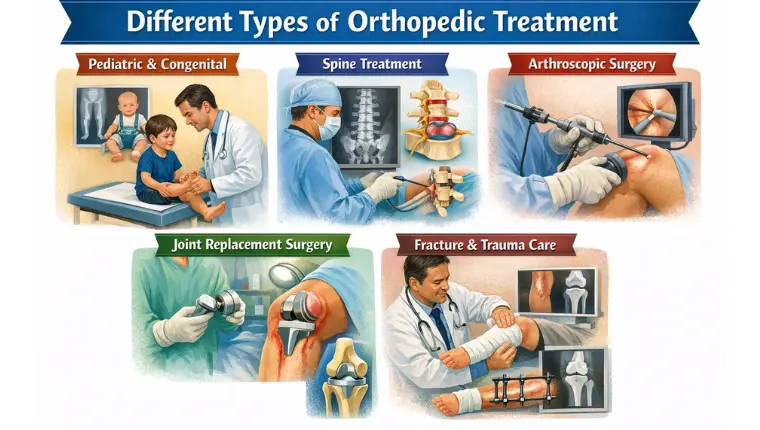
Different Types of Orthopedic Treatment
Best Treatment for Orthopedic Surgery
The type of orthopedic surgery performed will vary depending on your specific diagnosis, how severe your condition is, and your general health. Newer and improved surgical methods have provided athletes with options that allow them more precision and faster recovery times, such as arthroscopy and minimally invasive joint replacement solutions. The patient will also undergo a rehabilitation program that is tailored specifically for them; this will aid in restoring their strength and mobility after surgery.
For Free Online Consultation
GET A FREE QUOTE
The success of any orthopedic surgery depends greatly upon proper pain control, infection prevention, and physiotherapy following surgery. A surgeon with extensive experience and knowledge utilizing modern technology can perform effective orthopedic surgeries to relieve pain and restore function, vastly improving a patient's quality of life and their ability to function over time.
Diagnosis of Orthopedic Conditions
The diagnosis of orthopedic problems occurs sequentially and systematically to determine the underlying reason for pain, stiffness, deformity, or loss of mobility. The first step is collecting a thorough medical history from the patient; the physician will ask questions regarding their symptoms, prior injuries, types of everyday occupation and activities, and if they have had any chronic medical conditions. This allows for the identification of the tissues involved (bones, joints, muscles, nerves) in the patient's orthopedic condition.
- The physical examination is essential in making the diagnosis of orthopedic conditions.
- The orthopedic surgeon assesses a person's posture, walking pattern, alignment of their joints, how far they can move each of their joints, how strong their muscles are, and where their pain and swelling are located.
- Basic clinical tests to evaluate the stability of ligaments, involvement of nerves, or function of joints may also be conducted.
- Imaging studies are frequently needed to confirm the diagnosis.
- Commonly, X-rays are used to diagnose the type and location of a fracture as well as the presence of cartilage destruction (such as osteoarthritis), changes in the size of a joint, and any associated deformity or injury of the bone.
- MRI scans provide an in-depth evaluation of the soft tissues (such as ligaments and tendons) surrounding the joint or in the area of the spine.
- MRI scans are typically utilized to evaluate a potential sports injury or an injury affecting the spine.
- CT scans provide a detailed assessment of bone structure and are valuable in evaluating complex fractures or other conditions requiring surgical intervention.
In cases where an individual's symptoms suggest the presence of infection, inflammation or an immunological disorder, laboratory testing may be required. Blood tests will help determine if a patient has any of the following problems: rheumatoid arthritis, a bone infection, or metabolic disease of the bone.
Diagnostic testing is sometimes required to diagnose the site of pain. For example, a nerve conduction study or moderate joint aspiration can identify the cause of a patient's pain. A proper diagnosis leads to the physician's decision-making process on how best to treat a patient, which helps to improve the effectiveness of the recovery process.
We Care Health Services for Orthopaedic Rehabilitation
We Care Health Services helps patients plan defunctioning Biliopancreatic surgery through simplification of the complexities that may seem overwhelming to patients when they first enter into this journey. The first contact with the patient includes an assessment of the patient's medical, emotional, and logistical needs. Once identified, We Care staff will begin identifying hospitals (s) and/or colorectal surgeon(s) that fit the following criteria: medical diagnosis, urgency, and financial capability. As a result, patients will receive care that meets their unique circumstances.
Pre-treatment consultations, Medical reports review, and Presidents' Appointments are all coordinated through We Care Health Services to assist patients in eliminating delays and confusion. When patients travel from other states or other countries, We Care Health Services can assist them with Travel Planning, Hotel Arrangements (close to the hospital), and using Local Support During Their Hospital Stay to provide additional support. The Communication to patients and their families remains open throughout the entire process so they clearly understand their Surgical Procedure, anticipated Recovery Time, and Postoperative Care Requirements.
Once surgery has been performed, We Care Health Services provides continued support in the development of follow-up plans, providing guidance on the proper care of a stoma, and coordinating a reversal surgery when it is deemed appropriate by the physician. Additionally, We Care Health Services assists patients in understanding billing from hospitals, documenting their insurance information accurately, and provides patients with full transparency regarding their costs, which is frequently a major concern for patients.
Best Hospitals for Orthopedic Rehabilitation
Orthopedic rehabilitation hospitals in India are integral to the process of assisting patients in recovering from surgery, injury, or long-term (chronic) conditions involving bones and joints. These hospitals provide structured rehabilitation programmes that primarily focus on pain management, muscle strengthening, mobility training, and restoration of the patient's ability to perform activities of daily living. Each patient's care is typically delivered by a multidisciplinary team, which includes an orthopedic surgeon, physiotherapist, occupational therapist, and a rehabilitation specialist.
For Free Online Consultation
GET A FREE QUOTE
|
Hospital Name |
City |
|
Sancheti Institute for Orthopaedics & Rehabilitation |
Pune |
|
MIOT International |
Chennai |
|
Apollo Hospitals Rehabilitation Centre |
Chennai |
|
Medanta – The Medicity |
Gurugram |
|
Fortis Memorial Research Institute |
Gurugram |
|
HCAH SuVitas Rehabilitation Centre |
Bengaluru |
|
Kokilaben Dhirubhai Ambani Hospital |
Mumbai |
|
Max Super Specialty Hospital |
Delhi |
|
CARE Rehabilitation Centre |
Hyderabad |
|
Punarvaas Rehabilitation Hospital |
Bengaluru |
|
Type of Treatment |
Cost Range (INR) |
|
Orthopedic Consultation & Diagnosis |
1,500 – 5,000 |
|
Physiotherapy & Rehabilitation (per session) |
800 – 2,500 |
|
Fracture Treatment (Casting / Fixation) |
25,000 – 1,20,000 |
|
Arthroscopic Surgery |
80,000 – 2,50,000 |
|
Knee or Hip Replacement Surgery |
2,00,000 – 4,50,000 |
|
Spine Surgery |
2,50,000 – 6,00,000 |
|
Post Surgical Rehabilitation Package |
30,000 – 1,00,000 |
For Free Online Consultation
GET A FREE QUOTE
Advanced technology and resource based on the individual patient’s specific requirements, along with ongoing assessment of progress, provides increased recovery time and improved results. Several of the top hospitals in India offer a combination of both post-surgical and rehabilitation services, thus making India a destination for those seeking quality and low-cost services related to effective recovery following an orthopedic surgery and rehabilitation process.
Conclusion
In India, Orthopedic treatment and rehab provide patients with a range of clinical expertise, the latest in technology and affordable pricing. The services provided include conservative treatments (physiotherapy) and minimal invasive or complicated surgeries as well as detailed rehabilitation plans that provide patients with comprehensive care using a single platform. By utilising early diagnosis methods, highly qualified surgical specialists and custom rehabilitation plans, mobility is restored after surgery while allowing for a reduction of long-term complications. Compared to many other countries, the prices for orthopedic treatments in India are considerably lower whereas maintaining a high standard of care. Hence, patients looking for the highest level of orthopedic care, speed of recovery and enhanced quality of life should look at the options available in India.