
Soft tissue sarcoma surgery in India is performed with the help of preventive measures; otherwise, it could be malignant. There are different stages of cancer, which, when in the advanced stage, result in spreading to other parts, thus called malignant. There are different types of sarcomas, and they could be defined on the basis of the location at which they occur.
Sarcoma is a cancer of the connective tissue, such as muscle, cartilage, blood vessels, nerves, and bones. Soft tissue (non-bone) sarcomas are rare, but they can occur in many parts of the body, such as muscle or fat of the extremities or the trunk. They can also occur in the abdomen, pelvis, or chest. There are many types of soft tissue sarcomas, but most are treated in the same way. Some common soft tissue sarcomas include fibrosarcoma, liposarcoma, malignant fibrous histiocytoma, rhabdomyosarcoma, and synovial sarcoma.
What is Soft Tissue Sarcoma?
A soft tissue sarcoma is a malignant (cancerous) tumor that develops in mesenchymal tissue. Mesenchymal tissues encompass all the muscles, connective tissues, and bones of the body.
Soft tissue sarcomas can invade surrounding tissue and can metastasize (spread) to other organs of the body, forming secondary tumors. The cells of secondary tumors are similar to those of primary (original) cancer. Secondary tumors are referred to as "metastatic soft tissue sarcoma" because they are part of the same cancer and are not a new disease. The most common site of spread is to the lungs.
Soft tissue sarcomas can arise almost anywhere in the body. About 43 percent occur in the extremities (e.g., arms, legs) 34 percent occur in and around the internal organs (e.g., uterus, heart) 10 percent occur in the trunk (e.g., chest, back), and 13 percent occur in other locations. In very rare cases, these tumors develop in the gastrointestinal tract. A small percentage of these are GISTs. Malignant GISTs occur most commonly in the stomach and small intestine.
Symptoms of Soft Tissue Sarcoma
A soft tissue sarcoma is considered one of the tricky diseases because it doesn’t cause any noticeable discomfort in the body at the start. There are different types of symptoms based on the location of the tumour.
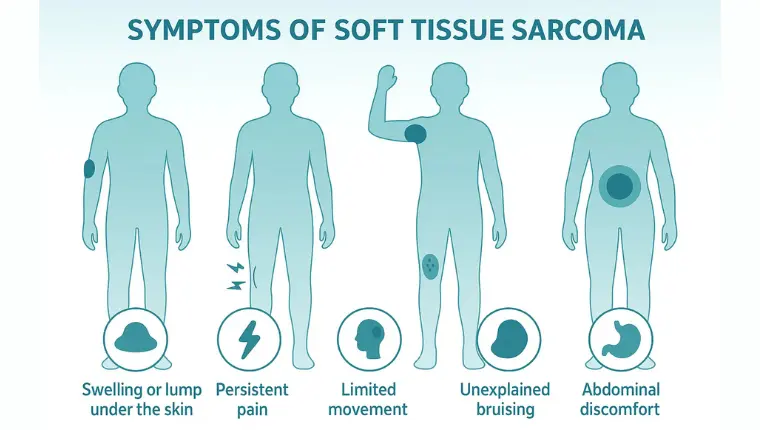
Symptoms of Soft Tissue Sarcoma
Depending on where the sarcoma develops, symptoms can be different. For example, if it grows in an arm or leg, movement may become difficult or uncomfortable. Sarcomas in the abdomen may cause stomach pain, loss of appetite, constipation, or a feeling of pressure. If the tumor is near the chest, it might cause breathing difficulty or a persistent cough.
- Sarcomas often don’t cause any symptoms for a long time. They can start in any part of the body, and the symptoms will depend on the part of the body that is affected.
- If the sarcoma is in an arm or a leg, the most common symptom is an uncomfortable swelling in the affected limb. Occasionally, this swelling may be painful or tender, but it may also be painless.
- If the sarcoma is in the central part of the body (the trunk), the symptoms will depend on which organ in the body is affected.
- A sarcoma in the lung may cause a cough and breathlessness
- A sarcoma in the abdomen could cause abdominal pain, vomiting, and constipation
- A sarcoma affecting the womb may cause bleeding from the vagina and pain in the lower part of the abdomen.
You can check for some noticeable symptoms through these points:
- Any lump, especially if it is increasing in size and is bigger than 5cm (2in)
- Any lump that is painful or tender
- Any lump that is deep in the body (ie, not just under the skin)
- Any lump that has come back after being surgically removed.
Cause of Soft Tissue Sarcoma
Although most soft tissue sarcomas do not have a clearly defined cause, researchers have identified several factors that increase the likelihood of developing these tumors. External radiation therapy is the most well-established risk factor for soft tissue sarcomas.
Patients treated with radiation therapy for cancers of the retina, breast, cervix, ovary, testes, or lymphatic system have a much higher chance of developing soft tissue sarcomas than the general population.
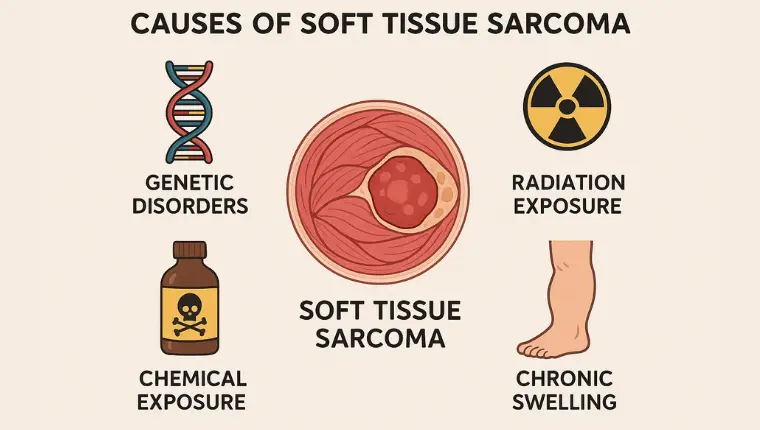
Cause of Soft Tissue Sarcoma
The risk appears to be related to the dose of radiation. To limit this risk, radiation treatment for cancer is planned to ensure that the greatest amount of radiation is delivered to diseased tissue while surrounding healthy tissue is protected as much as possible.
Another risk factor for soft tissue sarcomas is exposure to certain chemicals in the workplace, including vinyl chloride, arsenic, herbicides such as phenoxyacetic acids, and wood preservatives that contain chlorophenols. Chronic lymphedema (a condition in which excess fluid collects in the tissue and causes swelling) following radiation to, or surgical removal of, lymph nodes is also a risk factor. The most common causes of soft tissue sarcoma are:
- Some genetic conditions make a person naturally more prone to these tumors. Disorders like Li-Fraumeni syndrome, neurofibromatosis, or hereditary retinoblastoma
- Very rarely, chronic swelling or tissue damage that remains unhealed for years can play a role, but this is uncommon.
- Previous radiation therapy for another cancer is one of the better-documented causes.
- Sometimes, years after radiation exposure, the treated area can develop a sarcoma.
- Long-term exposure to certain industrial chemicals, such as vinyl chloride, arsenic, or dioxin, may also increase risk in some people.
- In many cases, the cause remains unknown, and the disease simply develops due to random genetic changes in the cells.
Types of Soft Tissue Sarcomas
The more soft tissue in the body, are possible high the chances of the tumour, the reason genetic changes in the cells or tissues. A wide range of tissues fall in the category of the soft tissues: fat cells, areolar tissue, and columnar cells are some of the possible names of the fat cells in the body. These different tissues are already prone to cancer. They reduce the development of the body by causing malignancy, and cells in a particular phase increase day by day.
|
Type of Soft Tissue Sarcoma |
Noticeable Symptoms |
|
Liposarcoma |
A firm, painless swelling under the skin that keeps growing, or discomfort or pressure in the thigh or abdomen |
|
Leiomyosarcoma |
Pain or swelling in the affected area, abdominal discomfort, bleeding if it develops in the uterus |
|
Rhabdomyosarcoma |
A lump that grows quickly, pain in the area, trouble using the affected body part, sometimes nosebleeds or urinary problems, depending on the location |
|
Fibrosarcoma |
Slow-growing lump, mild pain that increases over time, swelling in arms or legs |
|
Synovial Sarcoma |
Painful or tender swelling near a joint, stiffness, and reduced movement of the limb |
|
Angiosarcoma |
A bruise-like area that keeps growing, swelling, causing pain, skin color changes, and sometimes bleeding |
|
MPNST (Malignant Peripheral Nerve Sheath Tumor) |
Pain or numbness due to nerve pressure, increasing mass along a nerve path |
|
Myxofibrosarcoma |
Soft lump in the arm or leg that enlarges slowly, discomfort, or tenderness |
|
GIST (Gastrointestinal Stromal Tumor) |
Stomach pain, feeling full quickly, nausea, tiredness, and sometimes bleeding in stool or vomit |
Cost of the Surgery for Soft Tissue Sarcoma
In the advanced stage of surgery, there is more technological use, and initial stage removal may be done with the help of simple therapy. So we can say that there are different variations for the surgical removal. Health and age of the patient are kind of the internal factors; on the other hand, hospital infrastructure and technology used in the case are external factors.
Most of the time, prices are affordable for the patients in Western countries because they charge a lot for the simple surgery. This is also a reason for having more patients from Western nations. Techniques like limb-sparing reconstruction and robotic surgery have a higher cost. Patients also have to consider the cost of the diagnosis and scans or imaging of the internal structure. On the other hand, travel expenses staying in the country should also be considered as an important factor to measure the cost. Here is the table showing the cost with round-off value:
|
Type of Expense |
Estimated Cost Range (India) |
|
Basic tumor removal surgery |
₹1,50,000 to ₹3,00,000 |
|
Advanced or reconstructive surgery |
₹3,50,000 to ₹7,00,000 or more |
|
Pre-surgery tests and imaging |
₹15,000 to ₹40,000 |
|
Hospital stay (per day) |
₹5,000 to ₹20,000 depending on the room type |
|
Post-surgical medicines and care |
₹10,000 to ₹40,000 |
Cancer Specialist in India
Cancer specialists, also known as oncologists in India, treat cancer with exceptional qualities. Many doctors are trained in the International centres of cancer for surgery. The work of the doctors is also noticed via chemotherapy, targeted therapy, and robotic treatment. There are different types of cases where you have to decide on the treatment, but your doctor is the main guide for the treatment.
Cancer specialist of India is best known for their treatment strategy and the series in which they handle their patients. The best doctors also mean better fees, but it is worth it because they worked hard to make themselves. The main institute of India, AIIMS, is also good for training and treatment purposes, but has a long waiting list.
|
Name |
Specialization |
Hospital / Location |
|
Dr. Suresh Advani |
Medical Oncology, Hemato-oncology, Bone Marrow Transplant |
Jaslok Hospital, Mumbai |
|
Dr. Vinod Raina |
Medical Oncology, Solid Tumors & Hematological Cancers |
Fortis Memorial Research Institute, Gurgaon |
|
Dr. Rajendra Achyut Badwe |
Surgical Oncology |
Former Director, Tata Memorial Centre |
|
Dr. Pramod Kumar Julka |
Radiation Oncology |
Based in New Delhi, an oncology educator and researcher |
|
Dr. Ravi Kannan R. |
Surgical Oncology |
Director, Cachar Cancer Hospital & Research Centre, Silchar |
|
Dr. Ramakant K. Deshpande |
Surgical Oncology (Thoracic) |
Tata Memorial Hospital, Mumbai |
|
Dr. Nitin Singhal |
Surgical Oncology (Minimally Invasive & Robotic) |
Sterling Hospital, Ahmedabad |
We Care Health Services for Sarcoma Surgery
We are hailing the word Soft Tissue Sarcoma Surgery in India; otherwise, it is worth comparing this with the adenocarcinomas. We already have a good command of the diseases. The best possible way to eradicate a cancer is by doing radiation therapy or targeted therapy and then removing that from the root.
We Care Health Services is a best hospital coordinating with the head office in Delhi, there are many hospital links and patient flow is good, which is stabilized because of the organic reviews of the patients. There are a few side effects of the transplants and the cancer treatment, which are completely covered by We Care with their expert team. We are providing the best success rate, transparency of the cost, the best doctor’s team, and most importantly, trust to the coming patients. Here are some of our best qualities.
- Cost transparency with affordable treatment options
- High success rate and survival rate in case of cancer patients.
- Best doctors, team, and coordinating staff members.
- Well-researched information about the hospitals.
- Different types of treatment options.
- Support and care till the last follow-up
- Treatment of patients from different countries, irrespective of their caste and religion
Conclusion
Soft tissue sarcoma is a serious condition, but modern treatment options offer real hope. With early detection, careful diagnosis, and a well-planned surgical approach, many patients recover and return to normal life.
Choosing soft tissue sarcoma surgery in India can be a practical decision for many families, since the country offers skilled surgeons, advanced hospitals, and treatment that is more affordable than in many other parts of the world. The key is to act early, consult a trusted cancer specialist and stay informed throughout the journey. Every case is different, yet with the right support and medical guidance, patients can face this challenge with strength and confidence.