
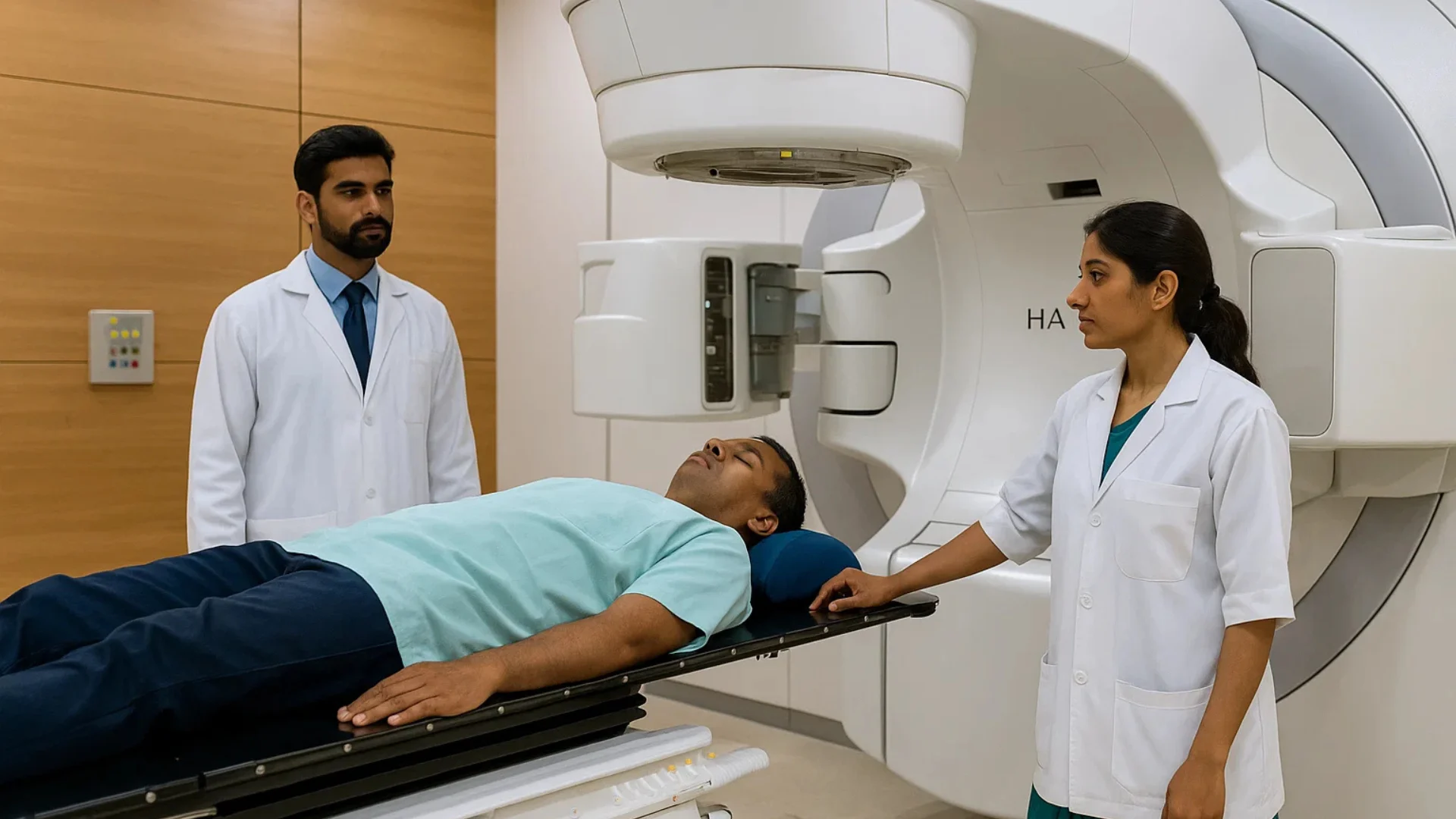
Linear accelerator treatment in India has been found helpful in cancer eradication and many other treatments where radiotherapy is required. Linear Accelerator (LINAC) treatment is an advanced form of radiation therapy used to target and destroy cancer cells with high precision. In India, LINAC technology is widely available in top cancer hospitals and is used to treat a variety of cancers, including brain, breast, lung, and prostate.
The machine delivers high-energy X-rays or electrons directly to the tumour while minimising damage to surrounding healthy tissue. The procedure is non-invasive, painless, and usually done on an outpatient basis. India's affordability, skilled oncologists, and state-of-the-art LINAC machines make it a preferred destination for international cancer patients seeking quality care.
What is LINAC?
A Linear Accelerator (LINAC) is a sophisticated medical device used in radiation therapy to treat cancer. It generates high-energy X-rays or electrons that are precisely targeted to destroy cancer cells while sparing surrounding healthy tissue. LINAC machines are versatile and can treat tumours in nearly any part of the body, including the brain, lungs, breast, and prostate.
Book Appointment
GET A FREE QUOTE
They are commonly used for external beam radiation therapy and can be programmed to deliver customised doses based on tumour size and location. The treatment is non-invasive and typically given in multiple sessions. LINAC is considered one of the most accurate and effective tools in modern oncology.
What are the different types of LINACS?- Types of LINAC
Linear Accelerators (LINACs) are advanced radiation therapy machines used to treat cancer with high precision. Depending on the technology and purpose, there are several types of LINAC systems available globally, including those used for Linear Accelerator treatment in India. Each type is designed to meet specific treatment goals, such as targeting complex tumours or minimising damage to healthy tissue.

Types of LINAC
Conventional LINAC
Conventional LINAC
This is the most widely used system in radiation therapy. It delivers high-energy X-rays to cancerous tumours. Conventional LINACs can rotate around the patient, offering flexible beam angles and allowing for more precise treatment. These are commonly found in hospitals across India.
Image-Guided Radiation Therapy (IGRT) LINAC
Image-Guided Radiation Therapy (IGRT) LINAC
IGRT LINACs are equipped with imaging technology such as CT, MRI, or X-ray systems to visualise the tumour in real time. This helps ensure accurate targeting of radiation, even if the tumour shifts slightly during treatment. IGRT is ideal for tumours located in moving organs like the lungs or prostate.
Book Appointment
GET A FREE QUOTE
Intensity-Modulated Radiation Therapy (IMRT) LINAC
Intensity-Modulated Radiation Therapy (IMRT) LINAC
This type of LINAC modulates the intensity of the radiation beam, allowing for customised radiation doses to different parts of the tumour. IMRT is especially effective for irregularly shaped tumours or those close to vital organs. Many advanced cancer centres in India offer IMRT using LINAC.
Stereotactic Body Radiotherapy (SBRT) and SRS LINAC
Stereotactic Body Radiotherapy (SBRT) and SRS LINAC
SBRT and Stereotactic Radiosurgery (SRS) LINACs deliver very high doses of radiation in a small number of sessions. These are used for small, well-defined tumours in the brain or body and require extreme precision. These systems are available in top oncology hospitals offering Linear Accelerator treatment in India.
Treatment That Can be Performed With a Linear Accelerator
A Linear Accelerator (LINAC) is a vital tool in modern radiation oncology, offering a wide range of cancer treatment options. Through its ability to deliver high-energy beams directly to cancer cells with remarkable precision, LINAC makes it possible to treat various cancers while preserving nearby healthy tissues. The growing availability of linear accelerator treatment in India ensures that patients have access to world-class care at an affordable cost.
External Beam Radiation Therapy (EBRT)
External Beam Radiation Therapy (EBRT)
This is the most common use of LINAC machines. EBRT targets tumours externally with focused radiation, making it suitable for cancers in the brain, breast, prostate, head and neck, and lungs. It is painless, non-invasive, and usually performed on an outpatient basis.
Intensity-Modulated Radiation Therapy (IMRT)
Intensity-Modulated Radiation Therapy (IMRT)
IMRT allows varying radiation intensity within a single treatment field. It is especially effective for complex or irregularly shaped tumours. Cancers in sensitive areas like the spine or near organs such as the bladder and rectum are ideal for IMRT. Many Indian hospitals provide this type of linear accelerator treatment using advanced LINAC systems.
Stereotactic Radiosurgery (SRS) and Stereotactic Body Radiotherapy (SBRT)
Stereotactic Radiosurgery (SRS) and Stereotactic Body Radiotherapy (SBRT)
SRS and SBRT are high-precision treatments used to deliver a concentrated dose of radiation in fewer sessions. SRS is mainly used for brain tumours, while SBRT is ideal for small tumours in the lungs, liver, or spine. These therapies require specialised LINAC machines and expert planning, both of which are available in India's leading cancer centres.
Image-Guided Radiation Therapy (IGRT)
Image-Guided Radiation Therapy (IGRT)
IGRT combines imaging with LINAC treatment to track tumour movement in real-time. It is particularly useful for tumours in organs that shift position, such as the lungs or prostate.
Book Appointment
GET A FREE QUOTE
Overall, linear accelerator treatment in India provides comprehensive, effective solutions for a broad spectrum of cancers.
What is the basic principle of LINAC?
A Linear Accelerator (LINAC) is a highly specialised device used in radiation therapy to treat cancer. Its basic principle lies in the generation and delivery of high-energy radiation beams that precisely target cancer cells while sparing surrounding healthy tissue.
Linear Accelerator Treatment Cost
The cost of linear accelerator treatment in India is significantly more affordable compared to many Western countries, making it a popular destination for international patients. The price varies depending on the type of treatment (IMRT, IGRT, SBRT, etc.), cancer location, number of sessions, and hospital facilities.
On average, the cost ranges from ₹1,50,000 to ₹5,00,000, including consultation, planning, radiation sessions, and follow-up care. High-end centres with advanced LINAC systems may charge more, especially for precision therapies like SBRT or SRS. Despite this, India offers high-quality care, experienced oncologists, and advanced technology at competitive pricing.
|
Type of LINAC Treatment |
Estimated Cost (INR) |
|
External Beam Radiation (EBRT) |
₹1,50,000 – ₹2,50,000 |
|
IMRT (Intensity-Modulated) |
₹2,00,000 – ₹3,50,000 |
|
IGRT (Image-Guided) |
₹2,50,000 – ₹4,00,000 |
|
SRS (Stereotactic Radiosurgery) |
₹3,00,000 – ₹4,50,000 |
|
SBRT (Body Radiotherapy) |
₹3,50,000 – ₹5,00,000 |
Top Hospitals With Linear Accelerator Technologies
India is home to several top-tier cancer hospitals equipped with state-of-the-art linear accelerator technologies, offering advanced radiation treatments like IMRT, IGRT, SBRT, and SRS. These hospitals are staffed by expert oncologists and supported by modern imaging and planning systems to ensure precise and effective cancer care.
Book Appointment
GET A FREE QUOTE
Many of these institutions are NABH or JCI-accredited, providing world-class standards at a fraction of global costs. Patients from across India and abroad choose these centers for high-quality linear accelerator treatment in India. Below is a list of the top 15 hospitals known for cutting-edge LINAC-based cancer therapies.
|
Hospital Name |
City |
|
Tata Memorial Hospital |
Mumbai |
|
AIIMS |
New Delhi |
|
Fortis Memorial Research Institute |
Gurugram |
|
Apollo Hospitals |
Chennai |
|
Max Super Speciality Hospital |
New Delhi |
|
Medanta – The Medicity |
Gurugram |
|
Kokilaben Dhirubhai Ambani Hospital |
Mumbai |
|
Rajiv Gandhi Cancer Institute |
Delhi |
|
HCG Cancer Centre |
Bangalore |
|
Manipal Hospital |
Bangalore |
|
Amrita Institute of Medical Sciences |
Kochi |
|
BLK-Max Super Speciality Hospital |
New Delhi |
|
Aster Medcity |
Kochi |
|
CMC Vellore |
Vellore |
|
Cytecare Cancer Hospital |
Bangalore |
We Care Health Services for Linear Accelerator Treatment
We Care Health Services is a trusted medical tourism provider offering access to world-class linear accelerator treatment in India. Collaborating with top cancer hospitals and experienced radiation oncologists, they help patients receive advanced therapies like IMRT, IGRT, SBRT, and SRS using state-of-the-art LINAC machines.
- Access to Top Hospitals: Partners with leading cancer centres across India, equipped with advanced LINAC technology.
- Expert Oncologists: Connects patients with highly experienced radiation specialists.
- Comprehensive Treatment Options: Facilitates IMRT, IGRT, SBRT, and SRS therapies.
- Affordable Packages: Offers competitive pricing with transparent cost breakdowns.
- Medical Visa Assistance: Helps international patients with visa and travel documentation.
- Pre-Treatment Consultation: Free online evaluation and expert treatment planning.
- Personalised Care Plans: Tailor treatment based on patient condition and needs.
- Accommodation Support: Arranges a stay close to treatment centres.
- Post-Treatment Follow-Up: Continued care and coordination after discharge.
- 24/7 Patient Support: Dedicated care team to guide patients throughout the journey
Book Appointment
GET A FREE QUOTE
The company offers end-to-end support—including medical consultation, treatment coordination, travel assistance, visa processing, accommodation, and post-treatment follow-up. Patients benefit from affordable packages without compromising on quality or safety. We Care ensures personalised care and smooth communication between international patients and India's leading cancer centres, making radiation therapy accessible, efficient, and cost-effective for global patients.
Frequently Asked Questions:
Circular accelerators, such as cyclotrons and synchrotrons, accelerate particles along a circular path using magnetic fields to keep the particles on track. These are commonly used in high-energy physics experiments and cancer treatments like proton therapy.
Both types serve critical roles in science, medicine, and industry, enabling precise particle control for research and therapeutic purposes.