
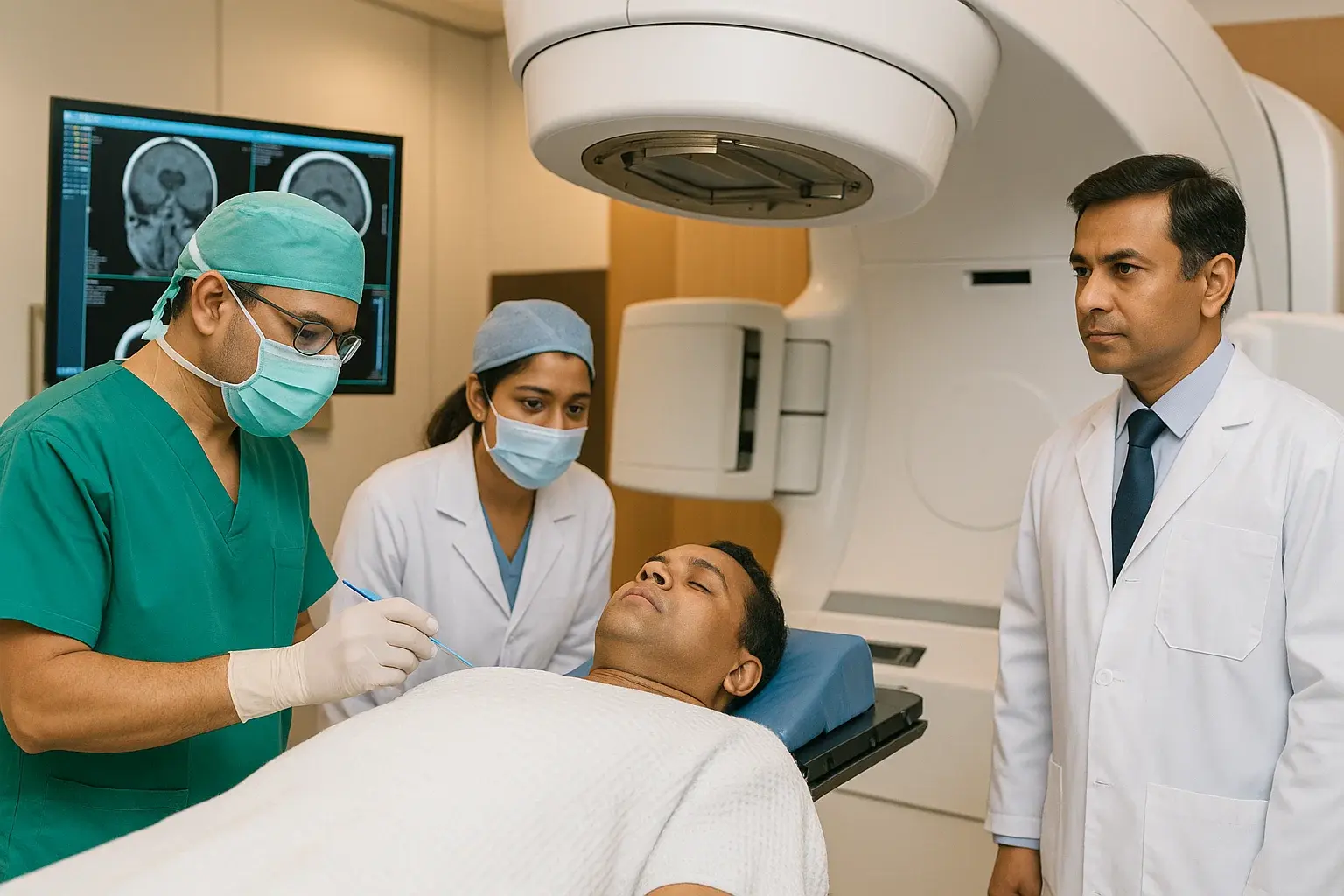
Chordoma treatment in India is gaining global recognition for its advanced medical technology, expert neurosurgeons, and affordable care. Chordoma is a rare type of bone cancer that typically occurs in the skull base, spine, or sacrum. Due to its complex location, treatment requires a multidisciplinary approach involving surgery, radiation therapy, and sometimes targeted therapy.
India offers world-class hospitals equipped with cutting-edge tools like proton therapy and intraoperative navigation systems, which improve precision and outcomes. With high standards of care, experienced oncologists, and cost-effective treatment options, India has become a preferred destination for patients seeking comprehensive chordoma management.
What is Chordoma?
Chordoma is a rare, slow-growing type of bone cancer that develops from remnants of the notochord, a structure present during early fetal development. It most commonly occurs along the spine and at the base of the skull. Although chordomas grow slowly, they are considered malignant because they can invade nearby tissues and bones, and sometimes metastasise.
Book Appointment
GET A FREE QUOTE
Chordoma is difficult to treat due to its location near vital structures, but with early diagnosis and expert care—such as chordoma treatment in India—patients have access to advanced surgical and radiation techniques that significantly improve outcomes.
Key Characteristics are:
- Locations: Skull base (clivus), cervical spine, sacrum
- Symptoms: Headaches, neck/back pain, vision problems, nerve compression, difficulty swallowing (depending on location)
- Diagnosis: MRI, CT scans, and biopsy
- Treatment: Primarily surgery to remove the tumour, followed by radiation therapy. Chemotherapy is rarely effective.
Chordoma Diagnosis and Treatment
These skull base tumours are best diagnosed by MRI and CT scans, which will clearly show the extent of the tumour and bony destruction. Focused MRIs of the pituitary region, sinuses, temporal bones or internal auditory canals may be indicated to obtain better anatomical detail of a chordoma. Other tests may also be needed before surgery, such as angiography (typically now performed as a CT angiogram or an MR angiogram), visual field tests, an audiogram or hormonal tests.
Book Appointment
GET A FREE QUOTE
Several different scans are done to locate the tumour. Two of the most common are the computed tomography (CT or CAT) scan and magnetic resonance imaging (MRI). A CT scan uses X-ray images taken from many angles and computer reconstruction to show parts of the body in cross-section. This helps to locate and estimate the size of the tumour and provides information on whether it can be surgically removed. MRI uses magnets and radio waves to create more detailed cross-sectional scans than computed tomography. Many variations on these two scans use dyes or radioactive materials to provide information about blood flow around the tumour and help determine whether the tumour can be surgically removed.
What is the best treatment for chordoma?- Chordoma Treatment Options
Currently, surgery is the first-line treatment for chordomas. Complete resection (removing the entire tumour) during the first surgery provides the best chances for local control and long-term survival. To achieve a complete resection, aggressive surgery is often required and can lead to significant complications or side effects.
Surgery
The goal of surgery should be to remove as much of the tumour as possible without causing unacceptable harm. Because outcome and prognosis are largely dependent on the success of the initial surgery, before having any operation, it is very important to get multiple opinions from surgical teams who have experience treating chordomas on a regular basis. Some medical centres have multidisciplinary teams of experts who review cases and can help create a coordinated treatment plan for patients with chordoma.
Radiotherapy
In many cases, radiation therapy following surgery is recommended and can improve chances of local control and survival. Because chordomas do not grow rapidly, high doses of radiation are required to kill the tumour cells. Chordomas that are close to critical structures (arteries, brain, brainstem, cranial nerves, dura, spinal nerves), often limit the dose of radiation that can be safely delivered to the tumour.
Book Appointment
GET A FREE QUOTE
In most cases, proton beam radiation can maximise the dose of radiation to the tumour, while sparing adjacent critical structures. Intensity-modulated radiation therapy (IMRT), stereotactic radiosurgery and carbon-ion radiotherapy are also sometimes used to treat chordoma.
Chemotherapy
Chordomas are generally resistant to standard cytotoxic chemotherapy agents, and there are no drugs approved to treat chordoma. Dedifferentiated chordomas are sometimes treated with chemotherapy to kill rapidly multiplying cells. Recently, Gleevec® (imatinib) has been shown to have antitumor effects in some patients with advanced chordomas. Additionally, off-label use of other targeted therapies such as ERBITUX (cetuximab), Iressa (gefitinib), and Tarceva® (erlotinib) have been reported.
What is the best hospital to treat chordoma?
When it comes to chordoma treatment in India, the best hospitals offer a multidisciplinary approach combining neurosurgery, oncology, radiation therapy, and advanced diagnostics. Top centres like AIIMS Delhi, Tata Memorial Hospital, and Medanta – The Medicity are renowned for treating complex skull base and spinal tumours with high precision.
These hospitals are equipped with cutting-edge technologies such as proton therapy, stereotactic radiosurgery, and intraoperative navigation. With internationally trained surgeons, affordable care, and strong clinical outcomes, India is a leading destination for comprehensive and expert chordoma treatment.
|
Hospital Name |
City |
|
AIIMS (All India Institute of Medical Sciences) |
New Delhi |
|
Tata Memorial Hospital |
Mumbai |
|
Medanta – The Medicity |
Gurugram |
|
Apollo Hospitals |
Chennai |
|
Fortis Memorial Research Institute |
Gurugram |
|
Christian Medical College (CMC) |
Vellore |
|
Max Super Speciality Hospital |
New Delhi |
|
Narayana Health |
Bangalore |
|
Amrita Institute of Medical Sciences |
Kochi |
|
KIMS Hospital |
Hyderabad |
|
BLK-Max Super Speciality Hospital |
New Delhi |
|
Manipal Hospitals |
Bangalore |
|
Rajiv Gandhi Cancer Institute |
New Delhi |
|
HCG Cancer Centre |
Bangalore |
|
Kokilaben Dhirubhai Ambani Hospital |
Mumbai |
Metastatic Chordoma Treatment
Metastatic chordoma is a rare and advanced form of chordoma in which the cancer spreads beyond its original location, typically to the lungs, liver, bones, or soft tissues. Because chordomas are slow-growing but locally aggressive, treatment becomes more complex once metastasis occurs. Despite the challenges, metastatic chordoma treatment in India has made significant advancements through a multidisciplinary approach.
Book Appointment
GET A FREE QUOTE
The primary treatment for metastatic chordoma involves surgical removal of accessible tumours, which can help relieve symptoms and improve quality of life. However, complete surgical excision is often difficult in advanced stages. Radiation therapy, particularly proton beam therapy or stereotactic radiosurgery, is commonly used to control tumour growth in hard-to-reach areas or after surgery.
Systemic therapies, including targeted therapies like imatinib or sorafenib, are also used in select cases to slow progression. While traditional chemotherapy is usually ineffective, clinical trials and precision medicine approaches are increasingly available in top Indian hospitals.
Palliative care plays a crucial role in managing pain, neurological symptoms, and emotional well-being. With expert oncologists, advanced technology, and personalized treatment plans, India offers effective options for managing metastatic chordoma, improving both survival and the patient’s overall quality of life.
Chordoma Symptoms
Symptoms of chordoma vary depending on the tumour’s location—typically at the skull base, spine, or sacrum. Early signs are often subtle, making diagnosis challenging. As the tumour grows, it may compress nearby nerves or structures, leading to pain and neurological issues. Patients seeking chordoma treatment in India often report persistent headaches, back or neck pain, numbness, and visual or swallowing difficulties. Recognising these symptoms early is crucial, as prompt medical intervention significantly improves treatment outcomes and preserves neurological function.

Chordoma Symptoms
Skull Base Chordoma symptoms include these symptoms:
- Headaches
- Blurred or double vision
- Difficulty swallowing
- Facial numbness or tingling
- Impaired balance or coordination
Spinal Chordoma
- Neck or back pain
- Numbness or tingling in the arms or legs
- Muscle weakness
- Loss of bladder or bowel control (in severe cases)
- Spinal instability or stiffness
Sacral Chordoma
- Pain in the lower back or tailbone
- Difficulty sitting
- Sciatic pain (radiating down the legs)
- Bladder or bowel dysfunction
- Sexual dysfunction
Chordoma Causes
The exact cause of chordoma is not fully understood, but it is believed to originate from remnants of the notochord, an embryonic structure that typically disappears after birth. In rare cases, these remnants develop into tumours later in life. While chordoma is not generally considered hereditary, some familial cases have been reported. Ongoing research suggests that genetic mutations, especially in the TBXT (T gene), may play a role in its development. Early detection is key to effective chordoma treatment in India.
Book Appointment
GET A FREE QUOTE
- Chordomas arise from leftover notochord tissue present at birth.
- Mutations in the TBXT (T gene) are strongly linked to tumour development.
- Chordoma is more common in adults aged 40–70 years.
- Men are slightly more likely to develop chordoma than women.
- Rare familial cases suggest a possible genetic predisposition.
- People with a family history of chordoma may be at slightly higher risk.
- Non-cancerous notochordal cell tumours may evolve into chordomas.
- No lifestyle, dietary, or environmental factors have been directly linked.
- Most cases are sporadic, with no clear external trigger.
- Continued research is focused on understanding the molecular causes of chordoma.
Cost of Chordoma Treatment
The cost of chordoma treatment in India varies based on the location of the tumour, stage, treatment method, and hospital chosen. On average, surgical removal can range from ₹3,00,000 to ₹7,00,000, while advanced therapies like proton beam therapy or stereotactic radiosurgery may cost between ₹10,00,000 to ₹25,00,000.
Additional costs include diagnostics, hospital stay, rehabilitation, and follow-up care. Despite the expenses, India offers highly affordable and world-class chordoma treatment compared to Western countries. Patients receive care from experienced oncologists and neurosurgeons using technology, making India a top destination for complex cancer treatments.
|
Treatment Type |
Estimated Cost (INR) |
|
Initial Consultation & Diagnosis |
₹5,000 – ₹15,000 |
|
MRI/CT/PET Scans |
₹15,000 – ₹50,000 |
|
Biopsy Procedure |
₹20,000 – ₹40,000 |
|
Surgical Tumour Removal |
₹3,00,000 – ₹7,00,000 |
|
Skull Base/Spinal Neurosurgery |
₹5,00,000 – ₹10,00,000 |
|
Radiation Therapy (Standard) |
₹1,50,000 – ₹3,00,000 |
|
Proton Beam Therapy |
₹10,00,000 – ₹25,00,000 |
|
Stereotactic Radiosurgery (Gamma Knife/CyberKnife) |
₹2,50,000 – ₹6,00,000 |
|
Targeted Therapy (Monthly, if applicable) |
₹50,000 – ₹1,50,000 |
|
Post-operative Rehabilitation & Follow-up |
₹20,000 – ₹75,000 |
We Care Health Services for Chordoma Treatment in India
We Care Health Services is a diverse programme for all kinds of health services. We Care Health Services is a trusted medical facilitator offering comprehensive support for chordoma treatment in India. They connect patients with top neurosurgeons and cancer specialists at internationally accredited hospitals equipped with cutting-edge technologies like proton therapy, stereotactic radiosurgery, and advanced neurosurgical tools.
Book Appointment
GET A FREE QUOTE
We Care ensures personalised care, cost-effective treatment plans, and smooth coordination from diagnosis to recovery. Their dedicated team manages travel, visa assistance, hospital admissions, and post-treatment follow-ups, making them a preferred partner for both domestic and international patients seeking reliable and expert chordoma care in India.
- Network of top-tier hospitals like AIIMS, Medanta, Tata Memorial, and Apollo
- Access to leading neurosurgeons and oncologists experienced in treating rare tumours
- Coordination of advanced treatments like proton therapy and radiosurgery
- Quick appointment booking and zero waiting time for international patients
- End-to-end travel, visa, and accommodation assistance
- Transparent pricing with detailed estimates and no hidden costs
- Personalised care plans tailored to your diagnosis and treatment goals
- On-ground care managers for support throughout your stay
- Post-operative care, follow-up, and rehabilitation arrangements
- 24/7 helpline for assistance and patient support
- Assistance with insurance claims and second medical opinions
- Trusted by thousands of patients from over 40 countries for rare and complex care.