

Laminectomy surgery in India is categorised as a minimally invasive and safe surgery for back pain. It is performed to remove pressure in any patient's vertebral column. A person having sciatica and nerve compression, or a kind of back pain, can take this treatment. The vertebral disc and nearby nerves find a proper path for the passage of transmission after the Laminectomy surgery.
For Free Online Consultation
GET A FREE QUOTE
Laminectomy is a type of spinal surgery designed to relieve pressure on the spinal cord or nerves caused by conditions such as herniated discs, spinal stenosis, or bone spurs. Unlike a full laminectomy, which removes the entire lamina, a Laminectomy involves only the partial removal of the lamina—the thin, bony plate on the back of each vertebra.
What is Laminectomy? - Purpose Of Laminectomy
A laminectomy is a surgical procedure where a larger portion or the entire lamina—the back part of a vertebra that covers the spinal canal is removed. By removing the lamina, the surgeon creates more space within the spinal canal, easing compression and reducing symptoms like chronic back or leg pain, numbness, tingling, or muscle weakness.
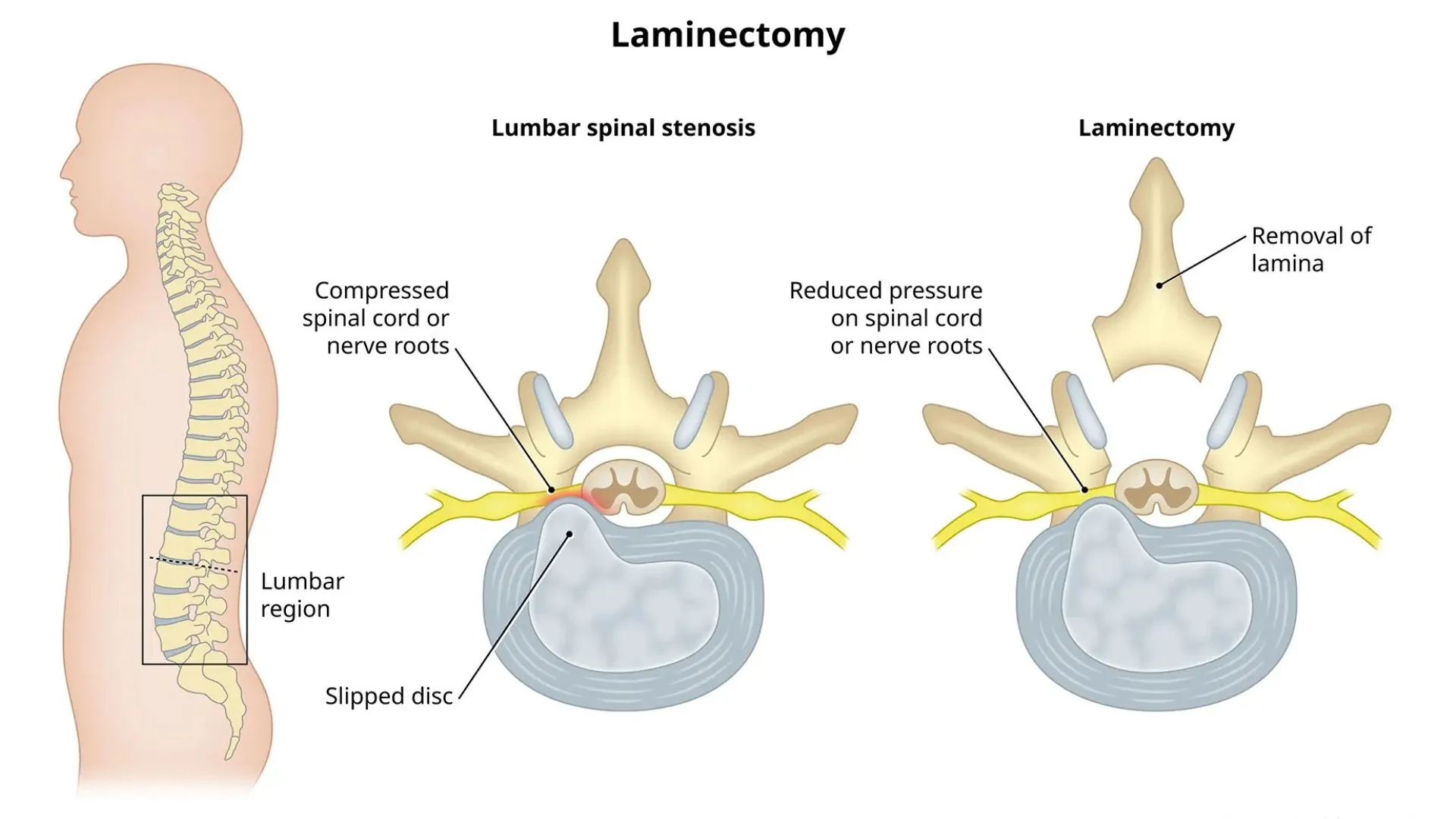
Laminectomy
Unlike a laminotomy, where only a small portion of the lamina is taken out, a laminectomy involves more extensive bone removal, which sometimes requires spinal fusion afterward to maintain stability.
In the context of laminectomy or laminotomy surgery in India, many hospitals now offer minimally invasive techniques, which help reduce recovery time, hospital stay, and complications—making it a popular choice for both domestic and international patients.
A Laminectomy is performed to relieve this pressure by creating a small window in the lamina. Hence the term "otomy," which means "to cut into" rather than remove entirely. Unlike a laminectomy, where the entire lamina is removed
Types of Laminectomy
There are several types of laminectomy, each tailored to the specific region of the spine being treated and the underlying condition causing nerve compression. Understanding the types helps patients make informed decisions, especially when considering laminectomy surgery in India, where advanced spinal care is available at affordable costs.
Laminectomy Surgery Cost in India- Detailed Cost Description
There are different costs for the procedures and the related facilities. There is a range of ideas for specific costs; you have to check the websites of the hospital in particular. Various centres like We Care Health Services are providing costs according to the diagnosis of the patients. Inclusions of the procedures are also given.
|
Type of Facility |
City/Location |
Procedure Type |
Estimated Cost Range (INR) |
Inclusions |
|
Private Super-Specialty Hospital |
Delhi, Mumbai, Bangalore |
Conventional Laminectomy |
₹1,50,000 – ₹2,50,000 |
Surgeon fees, 2–3 days hospital stay, basic diagnostics, post-op care |
|
Minimally Invasive Laminectomy |
₹2,00,000 – ₹3,50,000 |
Advanced tools, shorter stay, physiotherapy session, anesthesia |
||
|
Mid-Tier Private Hospital |
Tier 2 cities (Pune, Lucknow, Indore) |
Conventional Laminectomy |
₹1,00,000 – ₹1,80,000 |
Basic surgery package, medicines, room charges |
|
Minimally Invasive Laminectomy |
₹1,50,000 – ₹2,50,000 |
Includes equipment and physiotherapy |
||
|
Government Hospital |
AIIMS (Delhi), PGIMER (Chandigarh), Govt Medical Colleges |
Conventional Laminectomy |
₹20,000 – ₹50,000 |
Subsidized rates, limited availability, longer waiting periods |
|
Minimally Invasive (limited) |
₹50,000 – ₹1,00,000 |
Available at select govt hospitals only |
||
|
Charitable/Trust Hospitals |
Mission Hospitals, Christian Medical College (Vellore) |
Conventional Laminectomy |
₹30,000 – ₹70,000 |
Discounts based on income, affordable yet high-quality care |
|
Medical Tourism Packages |
Delhi, Chennai, Hyderabad |
Endoscopic Laminectomy (Premium) |
₹3,00,000 – ₹4,50,000 |
Includes accommodation, travel assistance, and pre- and post-op consultations |
Laminectomy Hospitals in India- Which hospital is best for spine surgery in India?
Medical tourism in India has made spinal procedures accessible for patients from abroad as well. Laminectomy surgery in India is treated by hospitals offering complete packages that include accommodation, diagnostics, surgery, and post-operative care. For Indian citizens, health insurance usually covers a large portion of the expenses if the procedure is recommended by a specialist and done in a network hospital. Those without insurance might still find affordable and reliable care in charitable hospitals or teaching institutions, where surgeries are often subsidised.
|
City |
Hospital Affiliation |
|
Bangalore |
Narayana Health |
|
Gurgaon |
Medanta – The Medicity |
|
Mumbai |
Asian Heart Institute |
|
Gurgaon |
Medanta – The Medicity |
|
New Delhi |
Fortis Escorts Heart Institute |
|
Hyderabad |
KIMS-Ushalakshmi Center for Breast Diseases |
|
New Delhi |
VIMHANS |
|
Mumbai |
Breach Candy Hospital |
|
Mumbai |
Jaslok Hospital and Research Centre |
|
Mumbai |
Digestive Health Institute |
|
New Delhi |
Fortis Escorts Heart Institute |
|
New Delhi |
Fortis Hospital, Shalimar Bagh |
|
Gurgaon |
Fortis Memorial Research Institute |
|
Gurgaon |
Fortis Hospital |
|
New Delhi |
Indraprastha Apollo Hospital |
|
Chennai |
Apollo Hospital |
|
Gurgaon |
Medanta – The Medicity |
|
New Delhi |
Indraprastha Apollo Hospital |
|
Mumbai |
Hinduja Hospital |
|
Gurgaon |
Fortis Memorial Research Institute |
|
New Delhi |
Max Healthcare |
|
Gurgaon |
Medanta – The Medicity |
|
Bangalore |
Manipal Hospital |
|
New Delhi |
Indraprastha Apollo Hospital |
|
New Delhi |
All India Institute of Medical Sciences (AIIMS) |
Remarks of We Care Health Services For Laminectomy
We Care Health Services is a coordinated program for different surgeries like open heart surgery and knee replacement surgery. They give treatment for various diseases, including fertility care. The clinic has a personalized approach for patients. Access to cardiologists, anesthesiologists, physiotherapists, and pain management specialists ensures comprehensive care before, during, and after surgery. You will find reasonable prices with affordable packages. The unique approaches are:
For Free Online Consultation
GET A FREE QUOTE
- They are the best service provider and use a personalised approach to treating patients.
- Hygiene, care and management are basic qualities of the clinic.
- Here, you can expect the best technical types of equipment for advanced procedures such as laparoscopy and other diagnostic methods such as ECG, MRI and CT scan.
- Cryopreservation and vitalization are processed at a lower temperature. Advanced techniques such as robotic-assisted techniques are used in surgeries.
- Price for Laminectomy Surgery in India is a reasonable option and is provided with a separate listing for all IVF series treatments.
- India is a house of many experienced surgeons and experienced doctors, who will help you through We Care Health Services.
- Ethical practices of the various surgical treatments are provided by the clinic with the coordination of law and order.
- The clinic continuously maintains a high success rate for various surgeries and the best rating on Google, which means it has a good reputation.
Laminectomy Vs. Laminotomy
Laminotomy and laminectomy are both surgical procedures used to relieve pressure on the spinal cord or spinal nerves, often caused by conditions such as spinal stenosis, herniated discs, or bone overgrowth.

Laminectomy Vs. Laminotomy
- Laminotomy is a minimally invasive procedure that involves the partial removal of the lamina, a section of bone that covers the spinal canal.
- A laminectomy, by contrast, involves the complete removal of the lamina, usually on one or both sides of the affected vertebrae.
- This technique is often preferred when the nerve compression is limited to a small, targeted area.
- The laminectomy procedure is more invasive and is generally recommended when there is extensive compression, such as multi-level spinal stenosis or the presence of a tumor.
- By removing only part of the lamina—often from one side—surgeons can create space for the compressed nerve roots without compromising the structural integrity of the spine.
- In the second one, due to the larger area of bone and tissue removal, laminectomy can potentially destabilize the spine, which may lead to the need for spinal fusion during the same operation.
- Because it is less invasive, Laminotomy typically results in a faster recovery, reduced post-operative pain, and fewer complications.
- The recovery period is longer and may require intensive physiotherapy in laminectomy and post-operative monitoring.
- Patients seeking Laminotomy surgery in India often choose this approach when dealing.
- While both surgeries are commonly performed, Laminotomy is preferred by some hospitals more in comparison to laminectomy surgery in India or its quicker recovery and preservation of spinal function, especially in younger or more active patients.
|
Laminotomy |
Laminectomy |
|
|
Definition |
Partial removal of the lamina (small section) |
Complete removal of the lamina (entire bone section) |
|
Goal |
To relieve pressure while preserving spinal stability |
To fully decompress the spinal canal |
|
Bone Removed |
Only a small part of the lamina (often one side) |
Entire lamina on one or both sides |
|
Invasiveness |
Less invasive |
More invasive |
|
Recovery Time |
Shorter (about 4–6 weeks) |
Longer (can be 6–12 weeks or more) |
|
Spinal Stability |
More likely to preserve natural spinal structure |
May require fusion or stabilization after removal |
|
Common Uses |
Herniated disc, localized nerve compression |
Severe spinal stenosis, tumors, or multi-level compression |
|
Risk of Complications |
Generally lower |
Slightly higher due to more bone/tissue removal |
|
Post-Surgery Rehab |
Typically lighter; faster return to activity |
May require longer physiotherapy and rehabilitation |